
Pacific City, Oregon
Fine Art Collection
Welcome to a dedicated gallery of fine art landscape photography capturing the wild beauty of Pacific City, Oregon. Located along Tillamook County’s scenic Three Capes Scenic Route, Pacific City is renowned for its iconic coastal landmarks, shifting tide pools, and dramatic Pacific Ocean swells.
This collection features fine art prints showcasing Cape Kiwanda, the towering sea stack of Chief Kiwanda Rock (Haystack Rock), the historic Pacific City Dory Fleet, and quiet moments along the Nestucca River estuary. Each photograph is captured using precise long-exposure and polarizing techniques to emphasize the raw textures of sandstone cliffs, sea foam, and coastal atmospheric light.
Whether you are looking for a framed centerpiece for your home or a archival fine art print of the Oregon coast, explore the gallery below. All images are available as museum-quality gallery prints and handmade greeting cards.
📥 Download FREE desktop wallpaper
🖼️ View artwork details & shipping
📸 Request a free wall preview
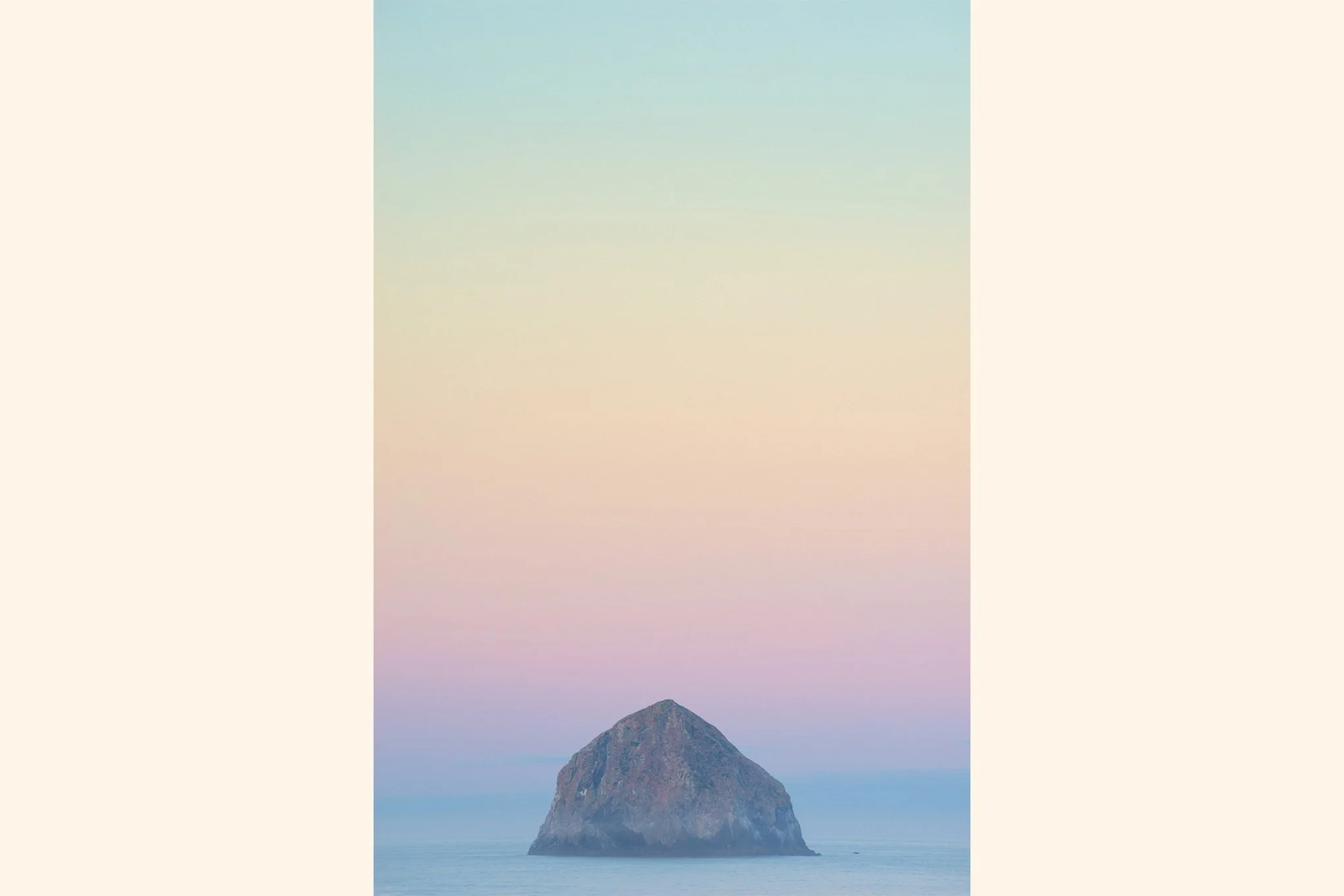
“Dream Tower”
Description:
This photograph captures Haystack Rock (Chief Kiawanda Rock) at Cape Kiwanda during pre-dawn light on the Oregon Coast from Tierra Del Mar. The pastel gradient is produced by the Earth’s shadow and the Belt of Venus, creating soft hues of purple, blue, and orange above the Pacific Ocean. A small dory boat provides scale.
Story:
The soft predawn colors along the Oregon Coast often resemble a dreamsicle, and on this morning those hues seemed to stretch endlessly above the horizon. While working on my abstract photography, I noticed how the gentle light paired beautifully with Haystack Rock. The moment was a happy coincidence, one I had not planned to capture.
To give the image a more artistic feeling, I broke a conventional compositional rule by placing the rock near the bottom of the frame. The result is a tower of color rising above it. A small fishing boat, likely a dory, rests faintly to the right of the rock, offering a sense of scale that reveals just how massive Haystack Rock really is.
It was early summer, and the angle of the sun filled the sky with a wide band of color ranging from purple to blue to orange and yellow. The combination of those hues and the gentle morning light created a scene that feels almost edible.
This photograph was created only two hours after “Chief’s Galaxy,” my image of the Milky Way soaring over Haystack Rock that I photographed from the sand dune at Cape Kiwanda. It was a magical day that also happened to be America’s 243rd birthday. After creating this photograph, I was more than ready for a long nap.
-BAP
Location:
Sandlake Road
Tierra Del Mar, Oregon
45° 14' 23.8'' N, 123° 58' 9.9'' W
Google Map Link
Time: 05:43 PDT (sunrise 05:34)
Date: July 4th, 2019
Camera & Settings:
Single shot
Nikon D800E, NIKKOR 70-200 mm f/4G, Tripod
ISO 100, 200 mm, f/10, 0.5 sec
📥 Download FREE desktop wallpaper
🖼️ View artwork details & shipping
📸 Request a free wall preview
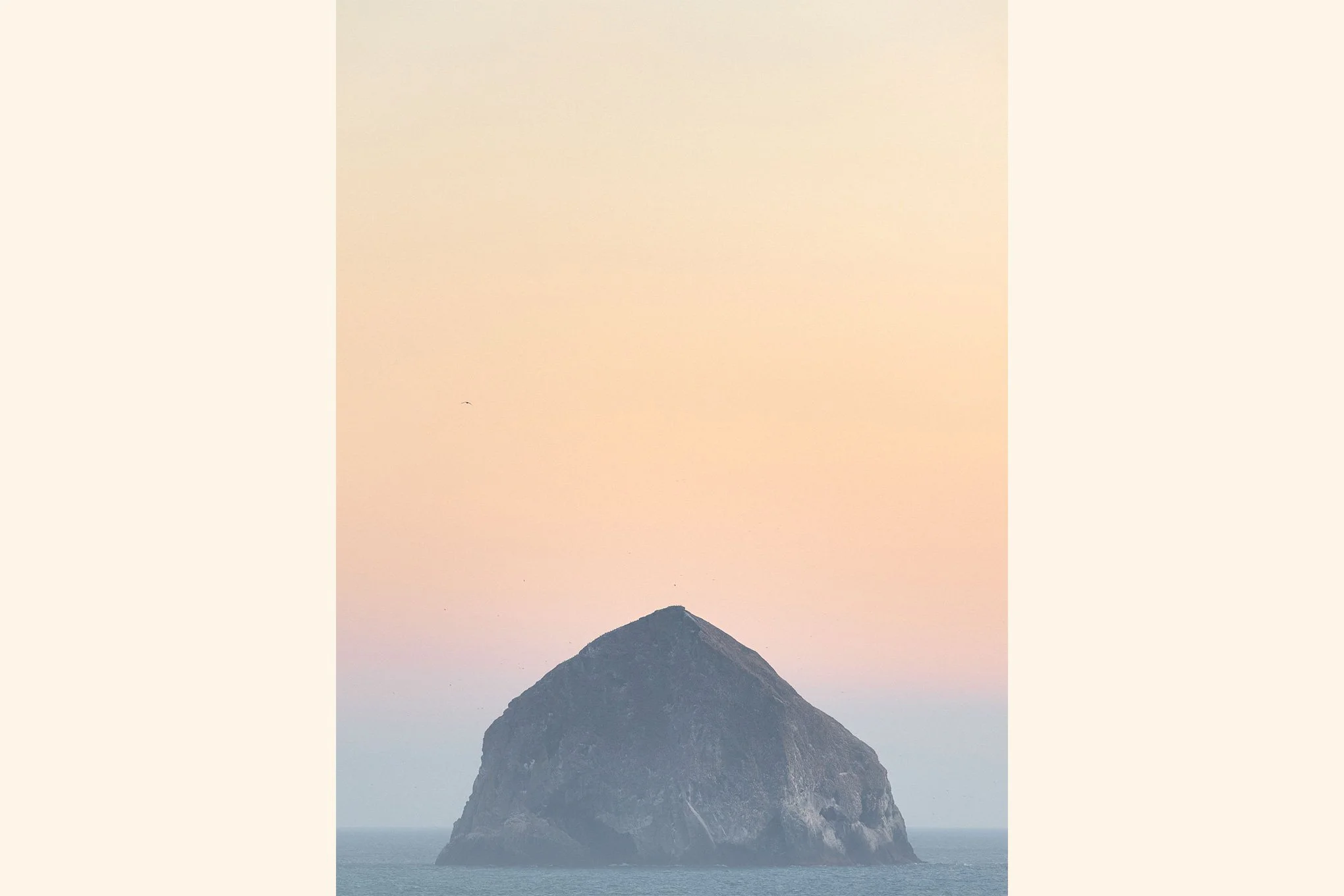
“Sanctuary”
Description:
Haystack Rock (Chief Kiawanda Rock) in Pacific City, Oregon, is part of the Oregon Islands National Wildlife Refuge and is closed to public access year-round. Boats and climbing are prohibited to protect nesting seabirds and marine mammals. This photograph shows the sea stack at dusk, highlighting its role as a critical wildlife sanctuary.
Story:
Included within the Oregon Islands National Wildlife Refuge, Haystack Rock in Pacific City provides essential breeding and resting habitat for seabirds and marine mammals.
As evening settles in, the seabirds become impossible to miss. The rock erupts with thousands of them, each following rhythms dictated by nature rather than the presence of people. Watching them, I often find myself wondering what it would be like to stand on the summit. Would the birds defend their territory? Is there even a place to set foot? How much farther could I see out to sea from that height compared to sea level?
-BAP
(P.S. Download the free wallpaper to see all the birds flying around the rock.)
Location:
Sandlake Road
Tierra Del Mar, Oregon
45° 14' 23.8'' N, 123° 58' 9.9'' W
Google Map Link
Time: 20:01 PDT (sunset 20:04)
Date: August 26th, 2020
Camera & Settings:
Single shot
Nikon D800E, NIKKOR 300 mm f/4E, Tripod
ISO 320, 300 mm, f/8, 1/30 sec
📥 Download FREE desktop wallpaper
🖼️ View artwork details & shipping
📸 Request a free wall preview
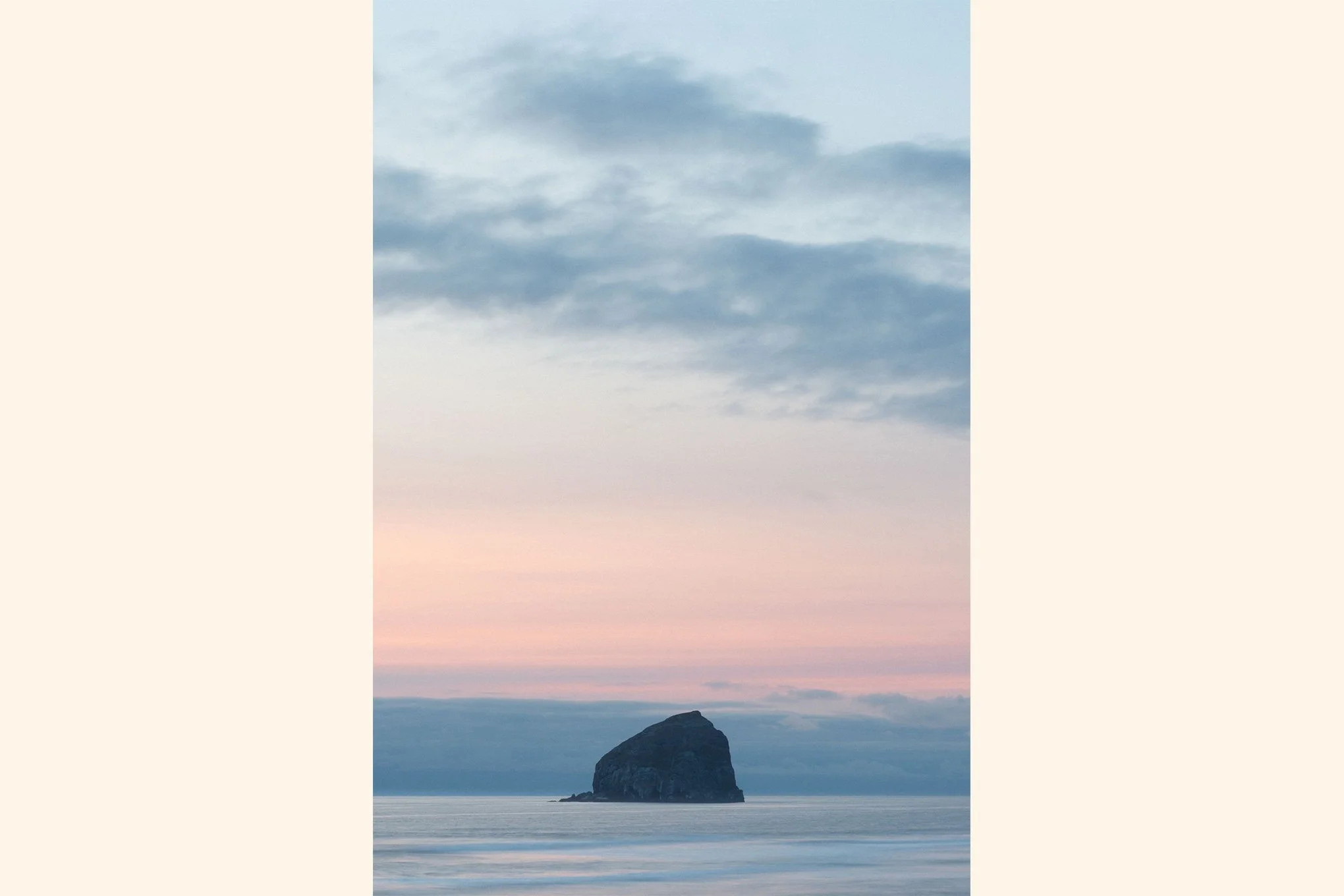
“Pastel Thoughts”
Description:
Haystack Rock (Chief Kiawanda Rock), a basalt sea stack off Pacific City, Oregon, is part of the Oregon Islands National Wildlife Refuge and closed to public access. This image captures the formation after sunset from Bob Straub State Park under pastel coastal light shaped by marine clouds and calm surf.
Story:
Calm waters, blue clouds, and pastel red skies are punctuated by Haystack Rock in the fading light after sunset.
The rock anchors my thoughts. The clouds echo my emotions. The sky reveals what the day left unsaid. Sunset is usually a time when the world winds down and the mind begins to settle.
But that evening was anything but quiet. A couple hundred people were gathered nearby for the Fourth of July fireworks at Bob Straub State Park. There was drinking, dancing, laughing, and the kind of summer chaos that fills the shoreline.
Yet when I look at this photograph, I do not think about the noise. I think about the moment itself and the stillness it carried inside me. The image holds the symbolism more than the scene around it.
Pastel Thoughts.
-BAP
Location:
Bob Straub State Park
Pacific City, Oregon
45° 11' 30.8" N, 123° 58' 09.4" W
Google Map Link
Time: 21:18 PDT (sunset 21:06)
Date: July 4th, 2019
Camera & Settings:
Single shot
Nikon D800E, NIKKOR 24-70 mm f/2.8G, Tripod
ISO 100, 70 mm, f/22, 4 sec

📥 Download FREE desktop wallpaper
🖼️ View artwork details & shipping
📸 Request a free wall preview
“Stepping Stones”
Description:
Basalt rock formations at McPhillips Beach in Pacific City are visible during low tide, with Haystack Rock offshore. Seasonal sand migration, wave action, and storm erosion routinely expose or bury these stones. The area is part of the dynamic coastal environment surrounding Cape Kiwanda on the Oregon Coast.
Story:
Exposed stones at McPhillips Beach guide the eye toward Haystack Rock in Pacific City. These same stones can disappear entirely beneath shifting sand in less than a year.
I returned to this exact spot five months later, hoping to recreate the photograph under different conditions. The stones were gone. I walked in circles, retracing my steps, searching for anything familiar. Nothing surfaced. They were completely hidden.
Had I imagined them?
“Stepping Stones” was made in winter, and I suspect another winter will reveal them again. It is a reminder of how quickly things change. Here today, gone tomorrow. That’s life, isn’t it?
Photographed during the same stormy afternoon as “Storm Pools.”
-BAP
Location:
McPhillips Beach
Pacific City, Oregon
45° 14' 4.3'' N, 123° 58' 17.2'' W
Google Map Link
Time: 18:09 PST (sunset 17:50)
Date: February 19th, 2019
Camera & Settings:
Single shot
Nikon D800E, NIKKOR 24-70 mm f/2.8G, Tripod
ISO 100, 29 mm, f/10, 30 sec

📥 Download FREE desktop wallpaper
🖼️ View artwork details & shipping
📸 Request a free wall preview
“Storm Pools (1)”
Description:
McPhillips Beach in Pacific City reveals extensive tidal pools during winter low tides, when wave action and runoff sculpt temporary depressions across the sand. This photograph documents the storm-shaped shoreline emerging between rain bands along Oregon’s dynamic northern coast.
Story:
McPhillips Beach turns into a cratered landscape in winter, dotted with shallow pools of seawater across the tidal flats.
Braving the bad weather to take advantage of these pools, I found myself completely alone. Dark storm clouds were dumping rain over the ocean, and I knew they would eventually reach the shore.
A strong wind whipped in from the water, carrying the smell of salt. With every step, the waterlogged sand shifted and sank beneath my boots. The storm had paused for only a moment, giving me just enough time to work.
Photographed during the same stormy afternoon as “Storm Pools (2).”
-BAP
Location:
McPhillips Beach
Pacific City, Oregon
45° 13' 58.3'' N, 123° 58' 21.4'' W
Google Map Link
Time: 16:54 PST (sunset 17:50)
Date: February 19th, 2019
Camera & Settings:
Single shot
Nikon D800E, NIKKOR 14-24 mm f/2.8G, Tripod
ISO 100, 14 mm, f/11, 1/15 sec

📥 Download FREE desktop wallpaper
🖼️ View artwork details & shipping
📸 Request a free wall preview
“Storm Pools (2)”
Description:
Shallow winter tidal pools cover the sand flats at McPhillips Beach in Pacific City, Oregon, with Haystack Rock visible offshore. These seasonal formations result from storm-driven wave action and rapid sediment movement along the Cape Kiwanda shoreline.
Story:
Pools of water create a tapestry of texture along the Oregon coast, and McPhillips Beach is especially known for these pockmarked tidal flats during the winter months.
The beach is accessible by car, which often means tire tracks. But on a stormy weekday in the middle of winter, it is easy to find stretches of untouched sand. Seagulls wandered through the pools, and the storm had calmed for a moment.
Rain still felt imminent. I could see it sweeping across the ocean, drifting slowly toward the shore.
Photographed during the same stormy afternoon as “Storm Pools (1).”
-BAP
Location:
McPhillips Beach
Pacific City, Oregon
45° 13' 54.7'' N, 123° 58' 21.3'' W
Google Map Link
Time: 17:18 PST (sunset 17:50)
Date: February 19th, 2019
Camera & Settings:
Single shot
Nikon D800E, NIKKOR 24-70 mm f/2.8G, Tripod
ISO 100, 27 mm, f/8, 1/13 sec

📥 Download FREE desktop wallpaper
🖼️ View artwork details & shipping
📸 Request a free wall preview
“Tidal Vortex”
Description:
Water swirls through the tide pools at Cape Kiwanda in Pacific City as the ebbing tide pulls across sandstone shores and exposed rocks. This photograph captures the dynamic wave patterns and coastal geology that define one of Oregon’s most iconic marine landscapes within the Three Capes Scenic Route.
Story:
Water swirls around a solitary rock in the tide pools of Cape Kiwanda, pulled back by the ebbing tide. The ankle-deep surf tugged at me with surprising force, washing the sand out from under my neoprene boots. Even my tripod struggled as the ground shifted beneath it.
As with “Baker Beach Splash,” each retreating wave forced me to move, reset, and steady myself again. Yet there was something joyful in the push and pull. The water felt as if it were carrying away whatever stress I had brought with me, leaving only the simple rhythm of the tide and the pleasure of being out there.
-BAP
Location:
Cape Kiwanda
Pacific City, Oregon
45° 13' 2.9'' N, 123° 58' 35.5'' W
Google Map Link
Time: 06:46 PDT (morning)
Date: July 5th, 2019
Camera & Settings:
Single shot
Nikon D800E, NIKKOR 14-24 mm f/2.8G, ND Filter, Tripod
ISO 100, 14 mm, f/22, 1/3 sec
📥 Download FREE desktop wallpaper
🖼️ View artwork details & shipping
📸 Request a free wall preview
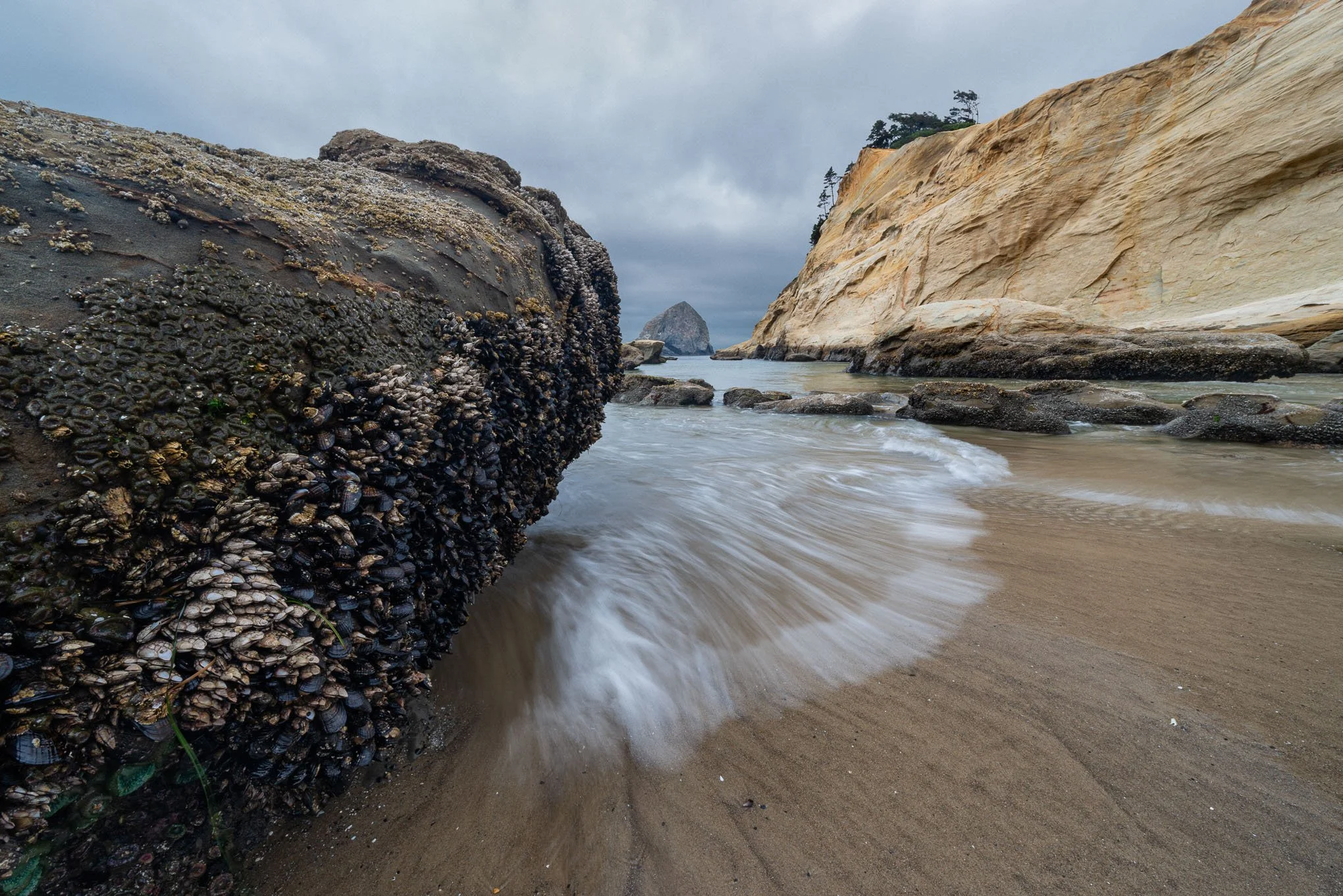
“Tidal Shift”
Description:
A wave fills the tide pools at Cape Kiwanda in Pacific City, Oregon, revealing barnacle-covered rocks and a shifting winter shoreline. This photograph looks toward Haystack Rock during an incoming tide, highlighting the coast’s constantly changing formations and the dynamic interplay between water, sand, and stone.
Story:
The tide turns as a wave washes into the tide pools of Cape Kiwanda. I worked my way backward from the far edge of the pools, watching for a composition that would frame Haystack Rock between the mollusk-covered stone on the left and the scattered line of rocks to the right.
Standing in the shifting water, I waited for a wave to rise just high enough to fill the space between them. These tide pools have always held a special place for me. I have explored them all my life, and they never look the same twice. Each season rearranges them, revealing and hiding details as it pleases.
Here, the ocean has the final word. When the tide begins to change direction, it offers a quiet warning. This way or that way, once the water turns, it is time to go.
-BAP
Location:
Cape Kiwanda
Pacific City, Oregon
45° 13' 3.1'' N, 123° 58' 33.8'' W
Google Map Link
Time: 09:20 PDT (morning)
Date: July 1st, 2019
Camera & Settings:
Single Exposure
Nikon D800E, NIKKOR 14-24 mm f/2.8G, Tripod
ISO 100, 14 mm, f/22, 1/4 sec
📥 Download FREE desktop wallpaper
🖼️ View artwork details & shipping
📸 Request a free wall preview
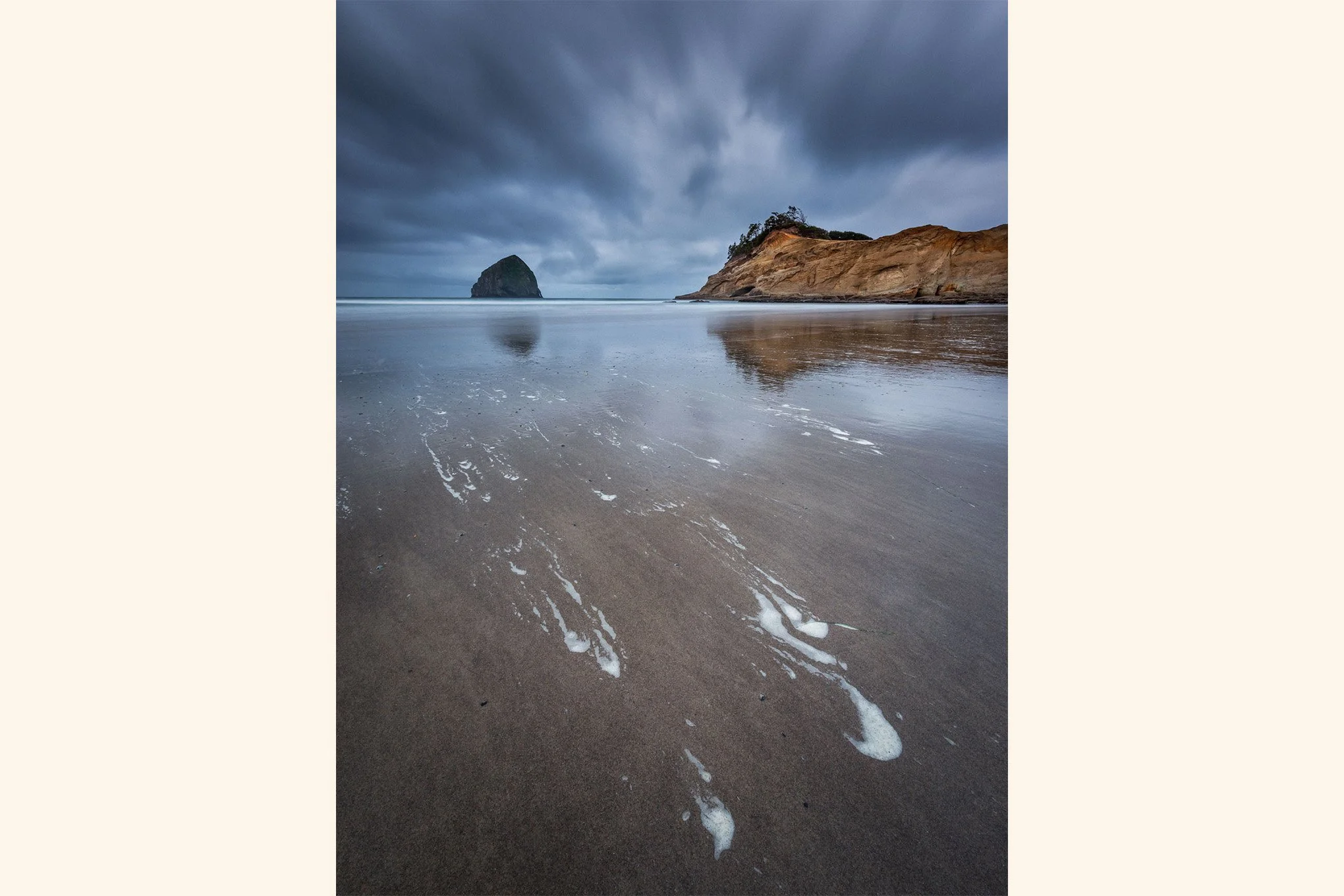
“Foam Lines”
Description:
Foam trails stretch across the beach at Cape Kiwanda in Pacific City, Oregon, as winter storm clouds gather over the coast. This view captures Haystack Rock, low tide reflections, and the sculpted sandstone headland formed over millions of years by wind, waves, and shifting coastal forces.
Story:
Ocean foam streaks the sand as storm clouds gather over the Oregon coast in Pacific City. Winter mornings like this are quiet. The beach is empty of dory fishermen, and the stillness feels complete. It is one of my favorite times to visit.
You can lose yourself in thought on mornings like this. Stress steps aside for a while. The shoreline changes with the tide, and at low water the beach can turn mirror-like, reflecting the sky in perfect silence.
But on this day the sky was restless. Dark clouds churned with energy, and rain felt moments away. A line of foam from a retreating wave pulled my attention toward the horizon, where Haystack Rock and Cape Kiwanda seem forever locked in a tug-of-war over who commands the view.
The morning had everything I love about this place. Powerful. Dynamic. Wet. Oregon.
-BAP
Location:
Cape Kiwanda
Pacific City, Oregon
45° 13' 2.7'' N, 123° 58' 28'' W
Google Map Link
Time: 09:20 PDT (morning)
Date: February 19th, 2019
Camera & Settings:
Single Exposure
Nikon D800E, NIKKOR 14-24 mm f/2.8G, Tripod
ISO 50, 14 mm, f/22, 30 sec
📥 Download FREE desktop wallpaper
🖼️ View artwork details & shipping
📸 Request a free wall preview
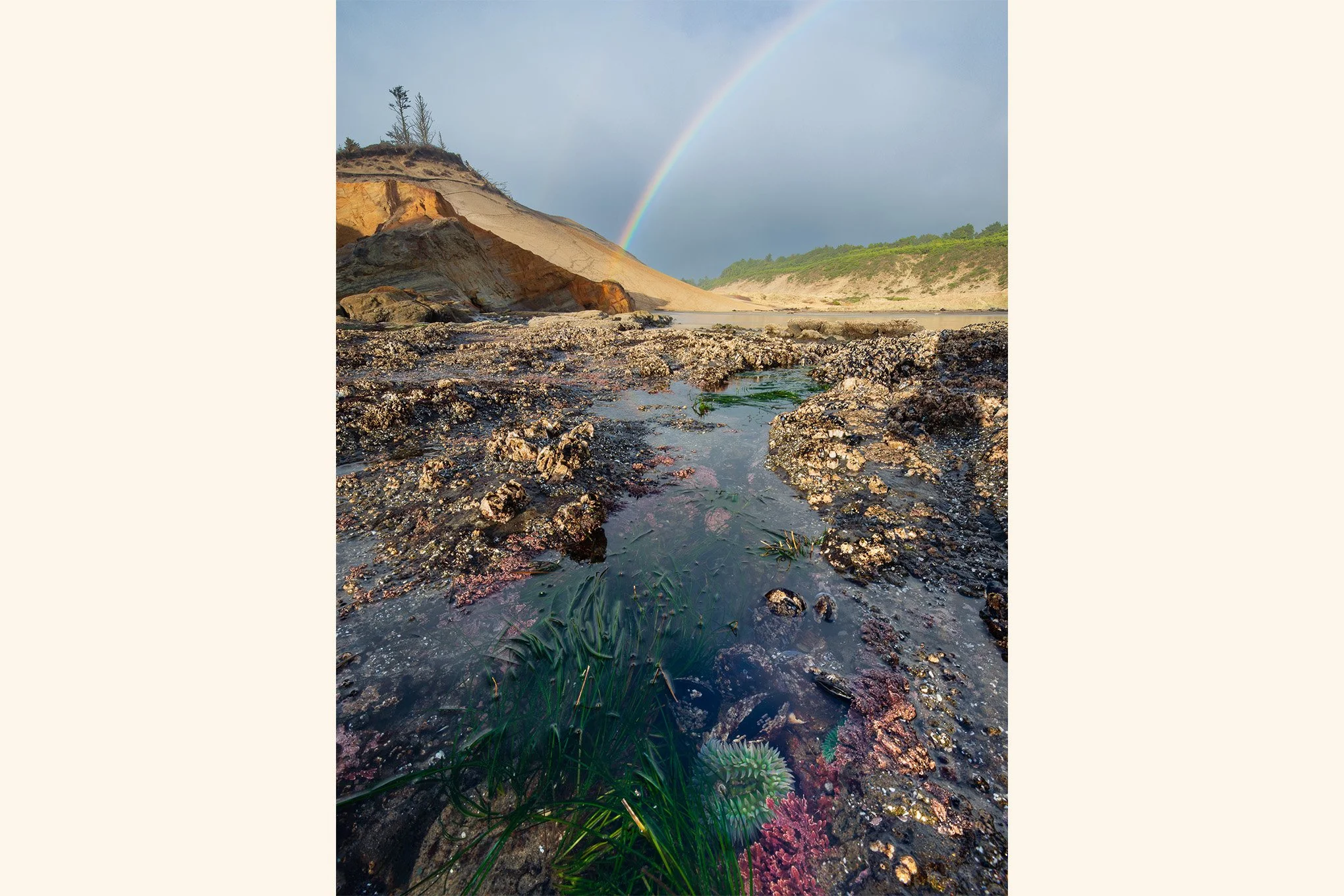
“Rainbow Pool”
Description:
This Oregon Coast photograph features a colorful tide pool at Cape Kiwanda in Pacific City, with seaweed, anemones, and barnacle-covered rock formations in the foreground. Sandstone cliffs and sweeping dunes rise behind, while a rainbow arcs through the misty sky, capturing classic Pacific Northwest coastal scenery.
Story:
When the forecast calls for scattered showers, there is always a chance of a rainbow. Because it was low tide in the afternoon, this one formed over the land. In the morning they sometimes arc over the ocean, but winter light in Oregon sits so low on the horizon that capturing a rainbow from the tide pools at dawn is nearly impossible.
Exploring these pools has always been a joy. I have wandered through them since I was three years old, though I didn’t bring a camera into them until I was twenty-eight. The spot where I stood for this photograph is safe during low tide and cradles a pocket of water that shelters all kinds of small creatures.
A rain shower swept through just as I entered the pools. My camera stayed dry in my backpack while I climbed across the barnacle-covered rocks. When the rain passed and the sun began to break through, the faintest hint of a rainbow appeared and slowly strengthened. I moved quickly, pulling out the camera and setting up the tripod before the colors faded.
A fleeting moment, held still.
-BAP
Location:
Cape Kiwanda
Pacific City, Oregon
45° 13' 1.8'' N, 123° 58' 33'' W
Google Map Link
Time: 16:36 PST (sunset 17:45)
Date: February 16th, 2019
Camera & Settings:
Single shot
Nikon D800E, NIKKOR 14-24 mm f/2.8G, Tripod
ISO 100, 14 mm, f/22, 1/8 sec
Limited Edition Fine Art Print ✨
Only 5 editions per size
Greeting Card is open edition
📥 Download FREE desktop wallpaper
🖼️ View artwork details & shipping
📸 Request a free wall preview
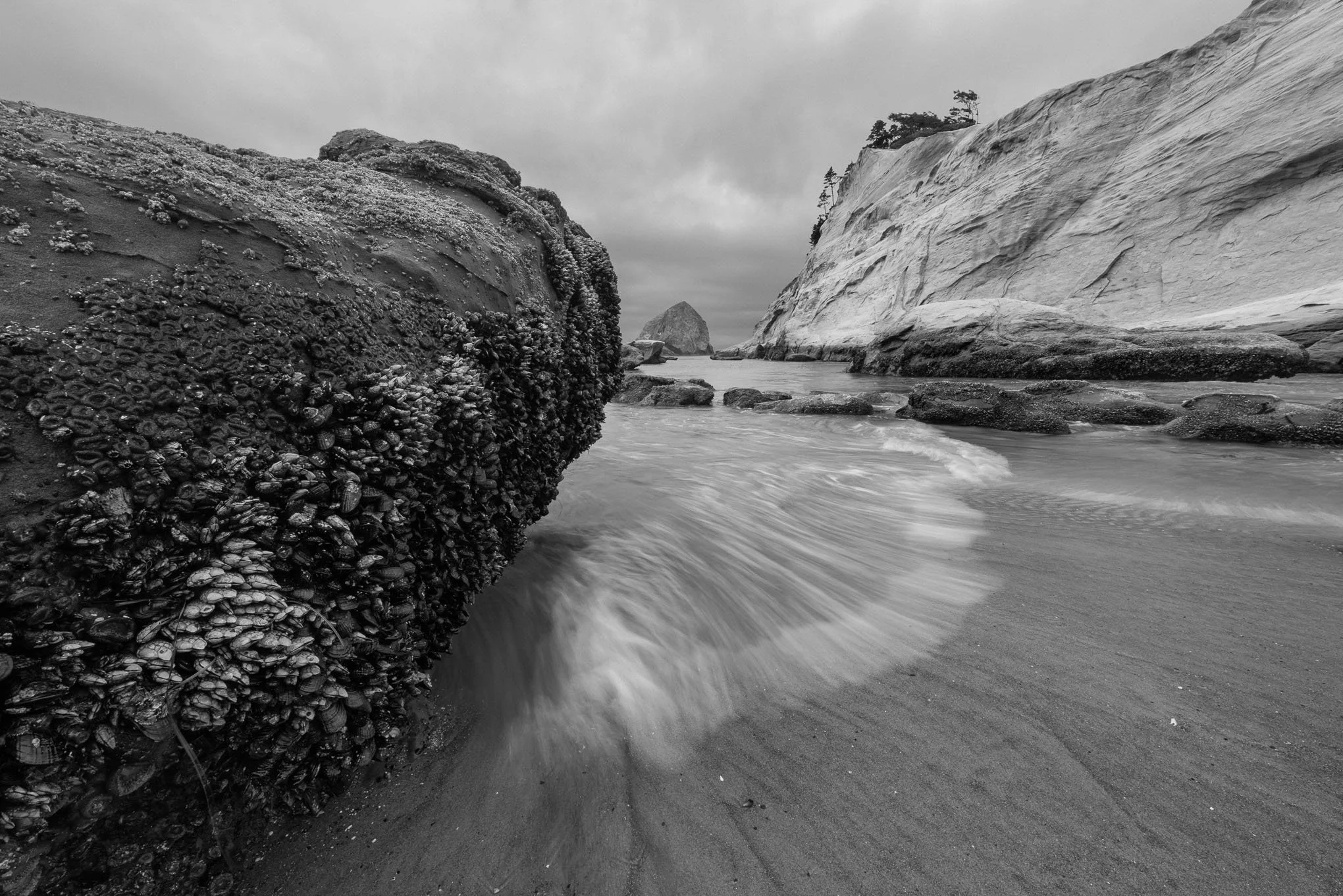
“Tidal Shift (BW)”
Description:
This black-and-white view of Cape Kiwanda captures a wave sweeping through tide pools with a view toward Haystack Rock in Pacific City, Oregon. The absence of color emphasizes tonal gradients, rugged rock formations, and shifting tidal patterns that shape the Oregon Coast’s constantly changing environment.
Story:
The tide turns as a wave washes into the tide pools of Cape Kiwanda. I worked my way backward from the far edge of the pools, watching for a composition that would frame Haystack Rock between the mollusk-covered stone on the left and the scattered line of rocks to the right.
Standing in the shifting water, I waited for a wave to rise just high enough to fill the space between them. These tide pools have always held a special place for me. I have explored them all my life, and they never look the same twice. Each season rearranges them, revealing and hiding details as it pleases.
Here, the ocean has the final word. When the tide begins to change direction, it offers a quiet warning. This way or that way, once the water turns, it is time to go.
-BAP
Location:
Cape Kiwanda
Pacific City, Oregon
45° 13' 3.1'' N, 123° 58' 33.8'' W
Google Map Link
Time: 09:20 PDT (morning)
Date: July 1st, 2019
Camera & Settings:
Single Exposure
Nikon D800E, NIKKOR 14-24 mm f/2.8G, Tripod
ISO 100, 14 mm, f/22, 1/4 sec
📥 Download FREE desktop wallpaper
🖼️ View artwork details & shipping
📸 Request a free wall preview
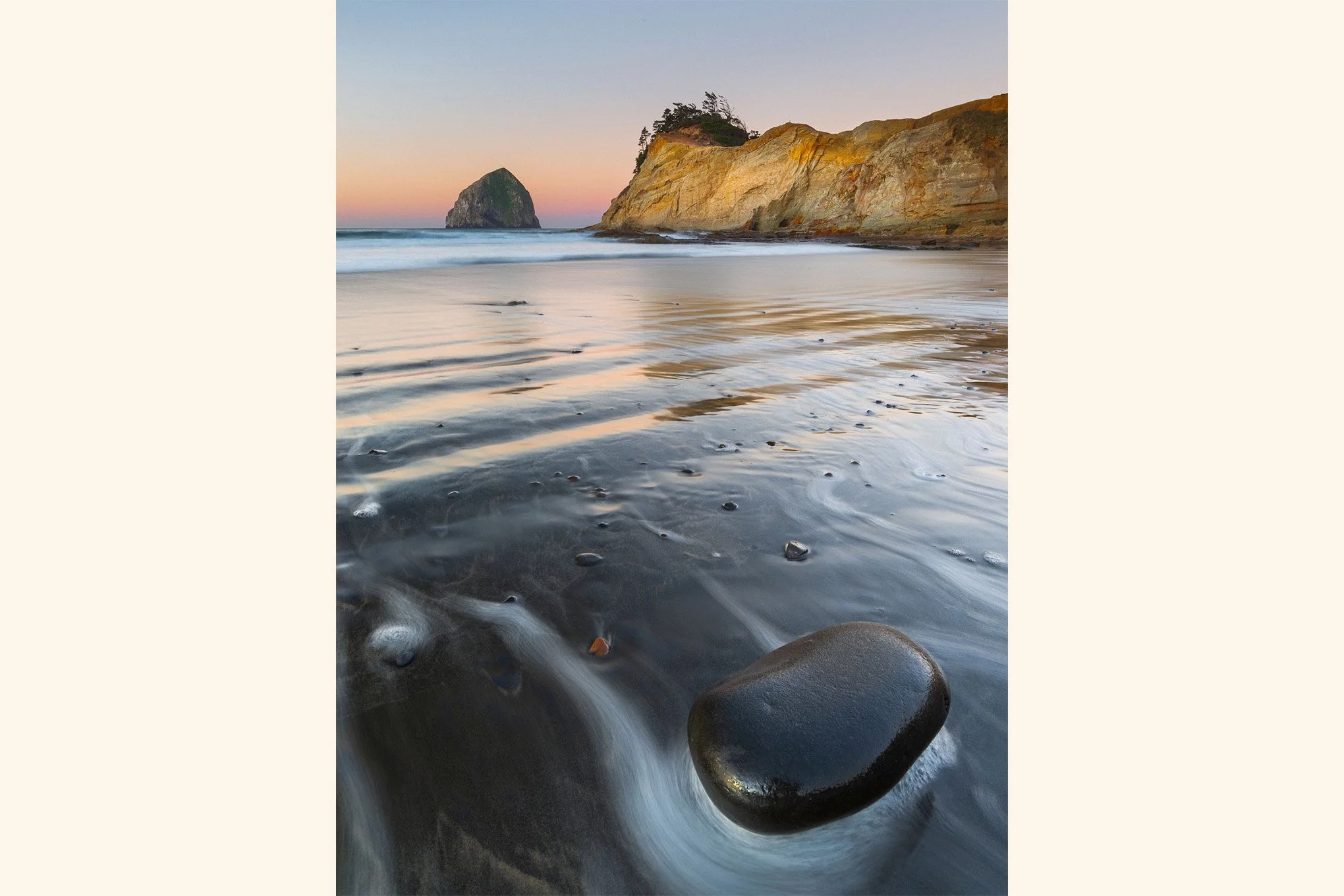
“Castaway”
Description:
A polished basalt stone rests on the tide-washed beach at Cape Kiwanda in Pacific City, Oregon. This coastline combines ancient sandstone, basalt remnants, and active erosion from Pacific swells. Part of the Three Capes Scenic Route, it includes Haystack Rock, a landmark volcanic formation along Oregon’s dynamic marine geology.
Story:
An unusually large stone remained on the sand as the tide retreated at Cape Kiwanda. The beach was still quiet. Sunrise was approaching, the ocean was calm, and the dory fishermen had yet to appear.
Wearing hip-waders, I walked the shoreline searching for a foreground element that felt right. The dark brown sand shimmered with tiny smooth stones and bits of shell. They were interesting, but too small. The ripples in the sand were beautiful, yet they lacked presence.
Then, near the edge of the sandstone cliff, I found it. A single large stone, resting alone on the beach. Its size felt out of place, almost as if it had traveled from a distant shoreline where stones like this are common. Here, it stood as a quiet anomaly, waiting to be noticed.
-BAP
Location:
Cape Kiwanda
Pacific City, Oregon
45° 13' 2.9'' N, 123° 58' 27.4'' W
Google Map Link
Time: 07:34 PST (sunrise 07:37)
Date: January 31st, 2019
Camera & Settings:
Single shot
Nikon D800E, NIKKOR 20 mm f/1.8G, Tripod
ISO 100, 20 mm, f/16, 4 sec
📥 Download FREE desktop wallpaper
🖼️ View artwork details & shipping
📸 Request a free wall preview
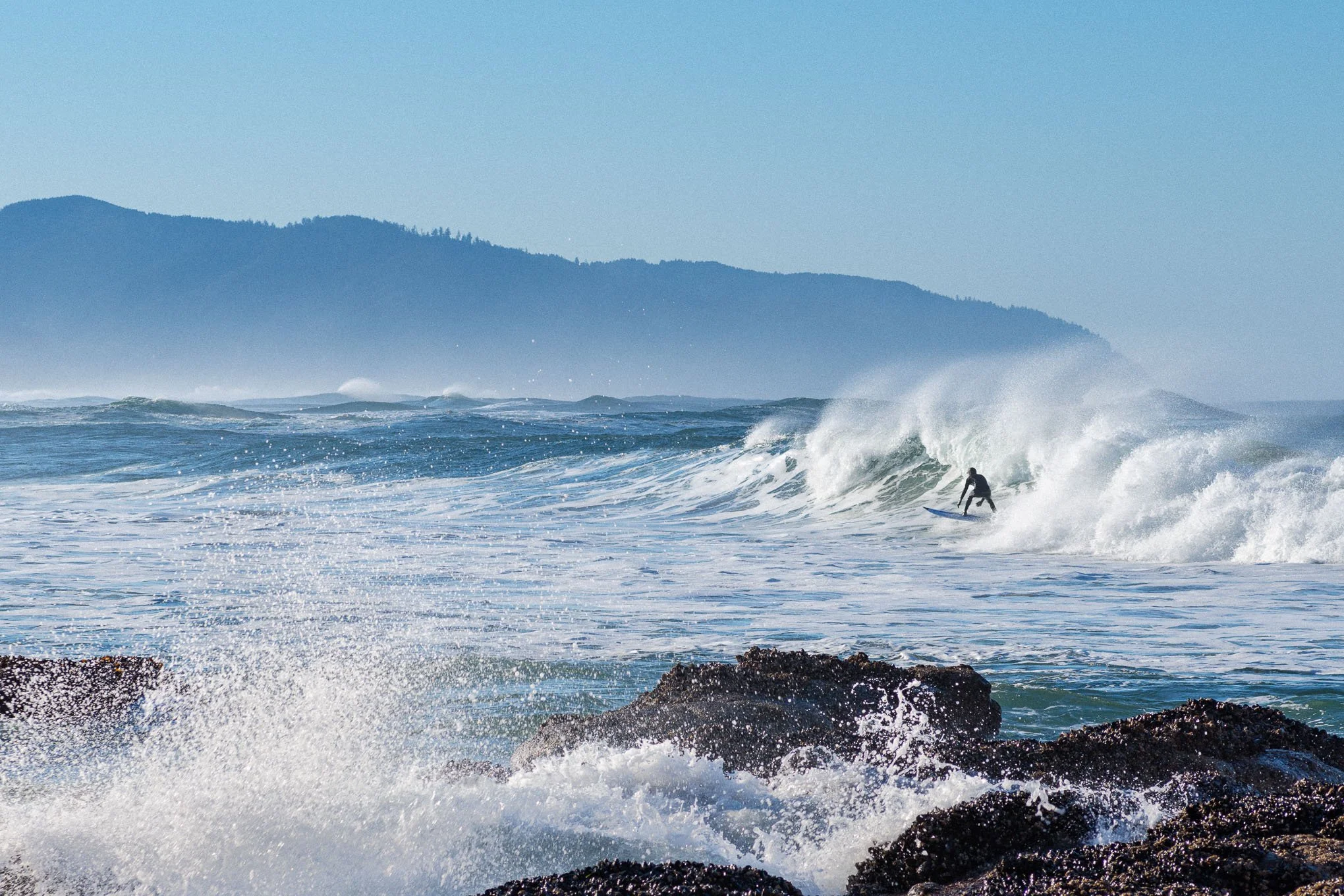
“Surfer’s Charge”
Description:
A winter surfer rides a breaking wave at Cape Kiwanda in Pacific City, Oregon. This photograph captures the powerful surf, cold Pacific water, and rugged tide-pool coastline that make the area a favorite for experienced surfers. Morning light and offshore winds shaped perfect conditions for this Pacific Northwest surf scene.
Story:
A surfer catches a winter wave in Pacific City as the morning sun shines against a clear blue sky. The light was so bright it almost suggested summer. The tide was beginning its slow march back toward shore — I had been exploring the tide pools.
Just out of frame, black oystercatchers patrolled the tide pools. Their bright red beaks are strong enough to pry open stubborn mollusks, and their piercing “kleep” cut through the sound of the frothy water. Each crash of a wave sent a salty mist into the air like a brief, briny rain.
I waited among the rocks of the tide pool for the moment when everything aligned: a surfer riding a bucking wave and, at that same instant, another wave slamming against the rocks in front of me. The timing mattered, and patience was the key.
The surfers wore full-body wetsuits to brace against the bitter cold of the Pacific, committed to the chase even on a winter morning.
-BAP
Location:
Cape Kiwanda
Pacific City, Oregon
45° 13' 1.9'' N, 123° 58' 33.2'' W
Google Map Link
Time: 09:30 PST
Date: February 10th, 2019
Camera & Settings:
Single shot
Nikon D800E, Tokina 100 mm f/2.8, Tripod
ISO 100, 100 mm, f/9, 1/320 sec
📥 Download FREE desktop wallpaper
🖼️ View artwork details & shipping
📸 Request a free wall preview
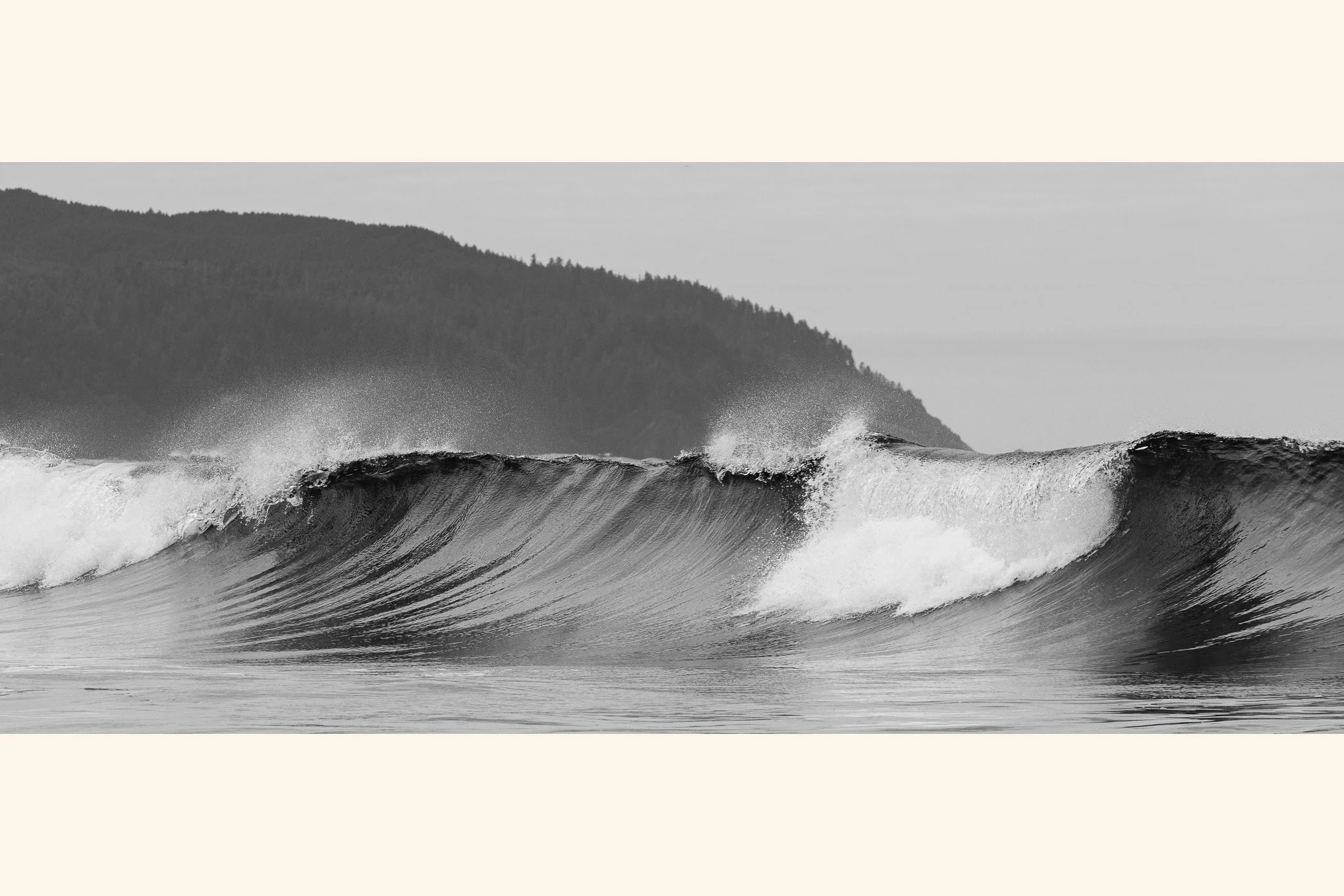
“Echo”
Description:
A black-and-white ocean wave breaks along the Oregon Coast at Pacific City, photographed from the tide pools near Cape Kiwanda. The image emphasizes the wave’s curling form, surface detail, and rising spray, with Cascade Head and the coastal headlands adding depth to this dramatic Pacific Ocean scene.
Story:
Echo
The cape stands ancient,
the wave young and restless.
Still, they share a curve,
a symmetry of becoming.
Each sculpted by the other,
each bound by gravity’s hand —
a single thought repeated
in water and stone.
-BAP
Location:
Cape Kiwanda
Pacific City, Oregon
45° 13' 2.4'' N, 123° 58' 32.6'' W
Google Map Link
Time: 10:36 PDT (morning)
Date: July 3rd, 2019
Camera & Settings:
Single shot
Nikon D800E, NIKKOR 70-200 mm f/4G, CPL filter, Tripod
ISO 100, 200 mm, f/8, 1/500 sec

📥 Download FREE desktop wallpaper
🖼️ View artwork details & shipping
📸 Request a free wall preview
“Dory Dog”
Description:
At Cape Kiwanda’s tide pools, a dory fisherman prepares his boat in the soft blue hour before sunrise. Haystack Rock rises offshore while the sandstone headland reflects across the beach. Pacific City is home to Oregon’s only surf-launched dory fleet, a distinctive part of the coast’s maritime history.
Story:
A dory fisherman at Pacific City readies his gear as his loyal companion barks non-stop from the pickup truck at what I could guess was me! The soft pastel colors in this photograph come from the time before sunrise, a brief window known as blue hour.
Blue hour is one of my favorite times to photograph. The world feels quieter, and fewer people are around. On this morning, however, I learned that fishermen appreciate it too. Perhaps it is not the light they seek, but the tide, since low tide aligned perfectly with both blue hour and sunset that day.
I was not expecting a dory boat to launch so close to the tide pools. I had been fully prepared to make this image without a person in the frame. His arrival was an unexpected photobomb. And since the light was changing faster than he was moving, I simply had to work with the moment.
There was no other choice
And that was perfectly fine.
-BAP
[Photographed the same morning as “Tide Pool Morning”.]
Location:
Cape Kiwanda
Pacific City, Oregon
45° 13' 3'' N, 123° 58' 27.5'' W
Google Map Link
Time: 05:16 (sunrise 05:31)
Date: June 29th, 2019
Camera & Settings:
Single shot
Nikon D800E, NIKKOR 24-70 mm f/2.8G, CPL filter, Tripod
ISO 100, 56 mm, f/11, 8 sec

📥 Download FREE desktop wallpaper
🖼️ View artwork details & shipping
📸 Request a free wall preview
“Tide Pool Morning”
Description:
At Cape Kiwanda in Pacific City, Oregon, sunrise reveals the tide pools as waves recede and the first light catches the sandstone cape and Haystack Rock. This summer morning scene shows exposed marine life, calm surf, and reflective water, capturing the rare beauty of an exceptionally low tide on the Oregon Coast.
Story:
As dory boats worked the channel between the rock and the cape, the tide pools of Cape Kiwanda slowly revealed themselves on a summer morning in 2019. The sky was scattered with small clouds that caught the first light of day, and the waves were calm enough to leave a shimmer of water reflecting the cape.
Freshly exposed mollusks dripped with seawater, and tiny crabs rushed to find shelter before the light grew stronger. I could feel the tide dropping quickly. Today it would fall exceptionally low, uncovering parts of the shoreline that remain hidden most of the year.
For the moment, the tide pools were quiet. Soon, outside visitors would arrive. But just then, the place belonged entirely to the morning.
-BAP
[Photographed the same morning as “Dory Dog”.]
Location:
Cape Kiwanda
Pacific City, Oregon
45° 13' 2.2'' N, 123° 58' 32.8'' W
Google Map Link
Time: 05:50 PDT (sunrise 06:05)
Date: June 29th, 2019
Camera & Settings:
Single shot
Nikon D800E, NIKKOR 24-70 mm f/2.8G, CPL filter, Tripod
ISO 100, 24 mm, f/11, 1/3 sec
📥 Download FREE desktop wallpaper
🖼️ View artwork details & shipping
📸 Request a free wall preview
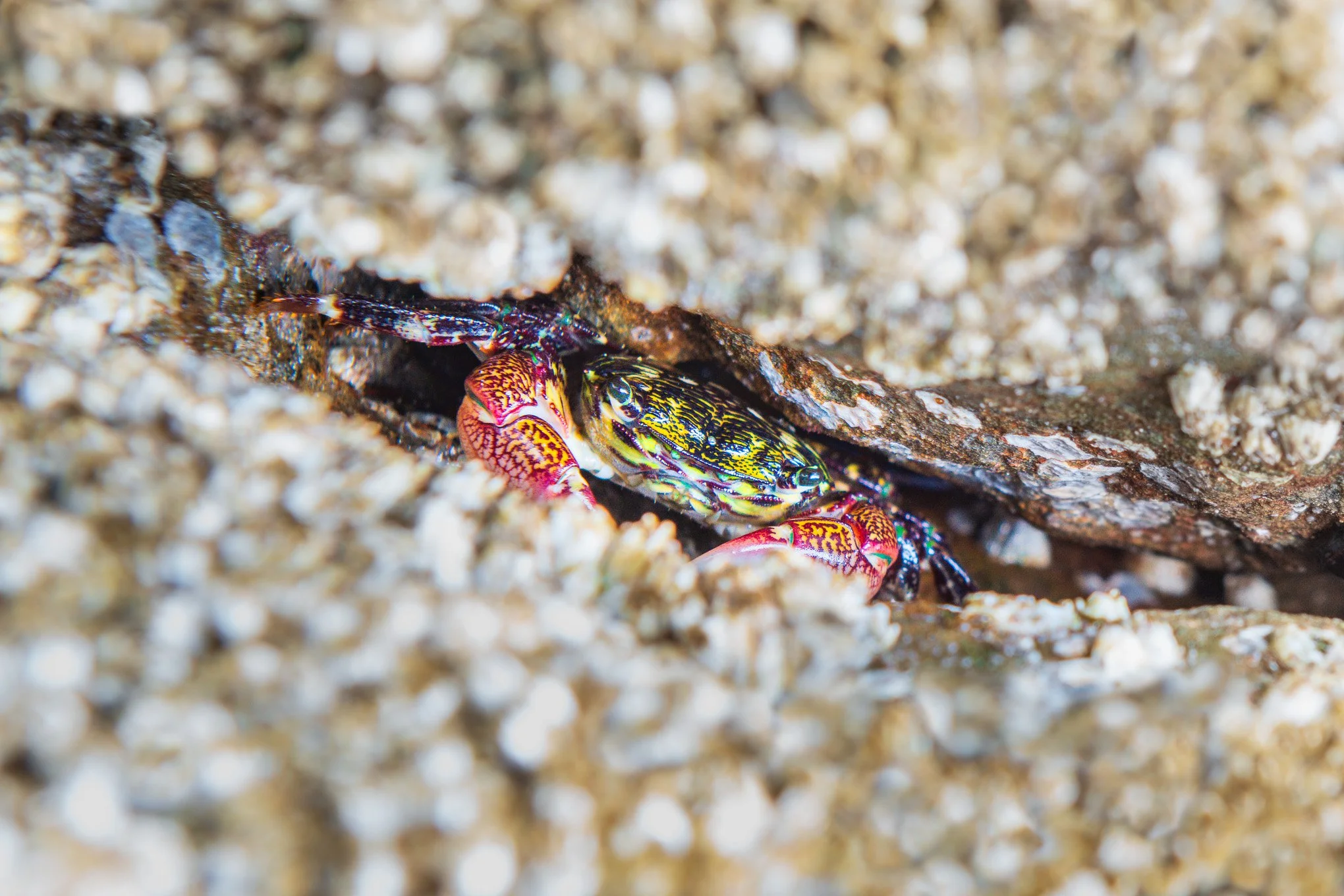
“Peekaboo”
Description:
Photographed at Cape Kiwanda on the Oregon Coast, this close-up image captures a colorful shore crab nestled among barnacle-covered rocks in the intertidal zone. The detailed textures and vibrant shell patterns highlight the resilience and beauty of marine life thriving along the rugged Pacific Northwest shoreline.
Story:
I have never been the type to pick up an animal that isn’t soft and furry. Something about the quick legs of insects and crustaceans has always unsettled me. I admire people who handle them without hesitation, but with a camera in hand I can get close in my own way, using the reach of my lens instead of my fingers.
Tide pools make that possible. Part of the joy is the discovery. Life hides in every crevice, darting and scurrying the moment you draw near. Our instincts tune in to movement, and these shore crabs know it. They sprint across the rocks until they find a pocket that feels safe.
For this photograph, I kept my tripod ready and my camera attached, waiting for a crab to pause long enough to be seen. In that small moment of stillness, I captured it.
-BAP
Location:
Cape Kiwanda
Pacific City, Oregon
45° 13' 2.3'' N, 123° 58' 34.3'' W
Google Map Link
Time: 07:17 PDT (morning)
Date: July 3rd, 2019
Camera & Settings:
Single shot
Nikon D800E, NIKKOR 24-70 mm f/2.8G, CPL filter, Tripod
ISO 200, 70 mm, f/8, 1/5 sec
📥 Download FREE desktop wallpaper
🖼️ View artwork details & shipping
📸 Request a free wall preview
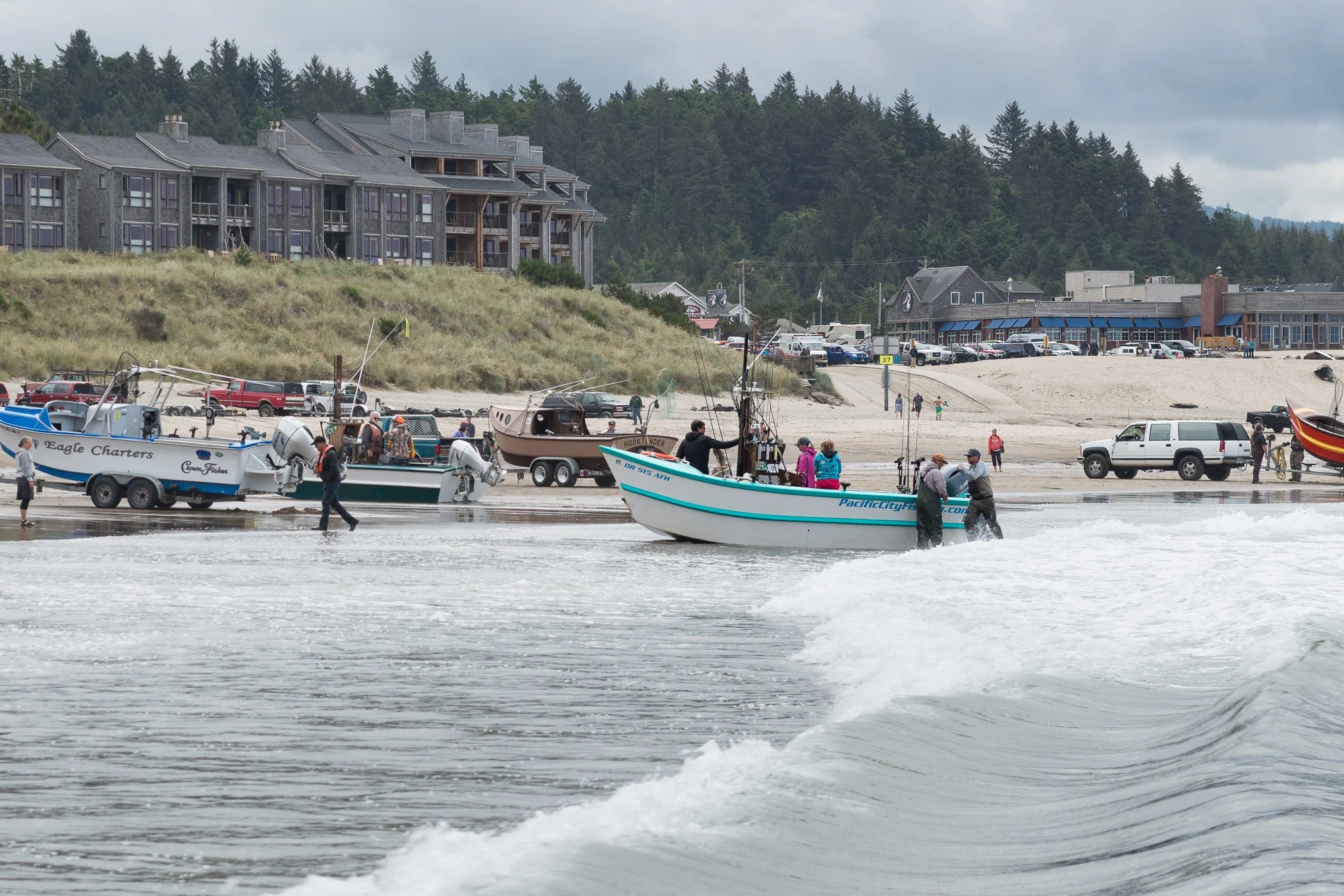
“The Dorys”
Description:
Photographed in Pacific City, Oregon, this image captures the return of dory boats to shore near Cape Kiwanda, where fishermen and charter crews guide their vessels through the surf. The scene highlights Pacific City’s distinctive surf-launching tradition, a defining aspect of Oregon Coast maritime culture.
Story:
A morning spent exploring and photographing the tide pools of Pacific City gave me the perfect vantage point to watch the dory boats return after their sunrise launch. One by one they came in, sounding their horns to warn beachgoers as they approached at full speed. Standing on the rocks that form the tide pools, I was able to capture a view that feels almost like the perspective of a surfer waiting for a wave.
Every third weekend of July, the annual Dory Days Festival takes place, celebrating the long and unique fishing heritage of Pacific City.
-BAP
Location:
Cape Kiwanda
Pacific City, Oregon
45° 13' 2.4'' N, 123° 58' 32.6'' W
Google Map Link
Time: 10:36 PDT (morning)
Date: July 3rd, 2019
Camera & Settings:
Single shot
Nikon D800E, NIKKOR 24-70 mm f/2.8G, CPL filter, Tripod
ISO 100, 70 mm, f/8, 1/100 sec

📥 Download FREE desktop wallpaper
🖼️ View artwork details & shipping
📸 Request a free wall preview
“Dragon’s Tail”
Description:
At sunrise, a retreating wave slides down the dark sandstone of Cape Kiwanda, revealing patterns that resemble a dragon’s tail. Haystack Rock sits on the horizon as the Pacific surges beneath colorful clouds. The scene reflects the raw beauty and unpredictable conditions of Oregon’s most dramatic headland.
Story:
A wave recedes off the backside of Cape Kiwanda during a colorful sunrise. This photograph was taken in a dangerous part of the cape. Although access is not prohibited by law, the state strongly discourages venturing this far out. It is risky terrain, and conditions can turn quickly.
Timing was everything. I needed a swell strong enough to wash up onto the cape at the exact moment the sunrise lit the clouds with color. Long stretches of waiting separated those rare waves that reached far enough across the rock.
As I stood there watching the ocean rise and fall, the shape of the cape began to resemble a dragon’s tail slipping in and out of the sea. Haystack Rock, visible in the distance, felt like the tip of that tail. Wild and unpredictable, it was a creature that took no prisoners.
-BAP
Location:
Cape Kiwanda
Pacific City, Oregon
45° 13' 2.7'' N, 123° 58' 47.5'' W
Google Map Link
Time: 07:21 PST (sunrise 07:12)
Date: February 18th, 2019
Camera & Settings:
Single shot
Nikon D800E, NIKKOR 24-70 mm f/2.8G, CPL filter, Tripod
ISO 100, 24 mm, f/6.3, 1.6 sec
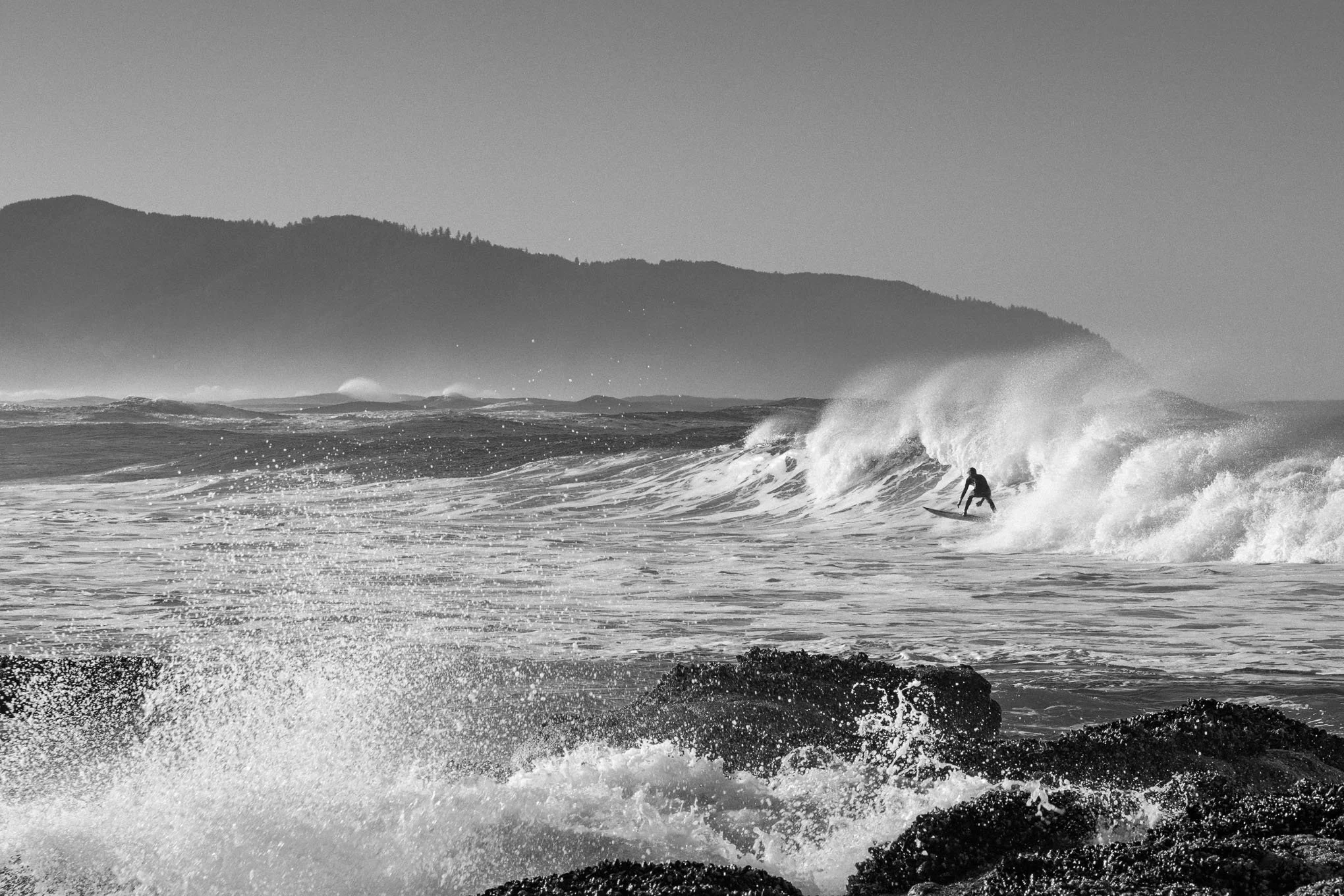
Limited Edition Fine Art Print ✨
Only 5 editions per size
Greeting Card is open edition
📥 Download FREE desktop wallpaper
🖼️ View artwork details & shipping
📸 Request a free wall preview
“Surfer’s Charge (BW)”
Description:
A winter surfer rides a breaking wave at Cape Kiwanda in Pacific City, Oregon. This black-and-white photograph captures the powerful surf, cold Pacific water, and rugged tide-pool coastline that make the area a favorite for experienced surfers. Morning light and offshore winds shaped perfect conditions for this Pacific Northwest surf scene.
Story:
A surfer catches a winter wave in Pacific City as the morning sun shines against a clear blue sky. The light was so bright it almost suggested summer. The tide was beginning its slow march back toward shore — I had been exploring the tide pools.
Just out of frame, black oystercatchers patrolled the tide pools. Their bright red beaks are strong enough to pry open stubborn mollusks, and their piercing “kleep” cut through the sound of the frothy water. Each crash of a wave sent a salty mist into the air like a brief, briny rain.
I waited among the rocks of the tide pool for the moment when everything aligned: a surfer riding a bucking wave and, at that same instant, another wave slamming against the rocks in front of me. The timing mattered, and patience was the key.
The surfers wore full-body wetsuits to brace against the bitter cold of the Pacific, committed to the chase even on a winter morning.
-BAP
Location:
Cape Kiwanda
Pacific City, Oregon
45° 13' 1.9'' N, 123° 58' 33.2'' W
Google Map Link
Time: 09:30 PST
Date: February 10th, 2019
Camera & Settings:
Single shot
Nikon D800E, Tokina 100 mm f/2.8, Tripod
ISO 100, 100 mm, f/9, 1/320 sec

📥 Download FREE desktop wallpaper
🖼️ View artwork details & shipping
📸 Request a free wall preview
“Sandstone Swirl”
Description:
Cape Kiwanda in Pacific City is one of the few sandstone capes on the Oregon Coast. This sunrise photograph showcases its sculpted shapes, layered textures, and soft morning color beside the Pacific Ocean. A vivid look at the geology that makes this headland so distinctive.
Story:
Clouds glow with color as a new day begins at Cape Kiwanda. Unlike many of the basalt capes along the Oregon coast, this one is made entirely of sandstone. Wind, water, and time have carved it into curves and contours that feel almost sculpted by hand. For a photographer, it is a buffet of patterns and surprises.
“Sandstone Swirl” was a photograph I discovered while scouting for the “Dragon’s Tail”. I had come for another composition, but this swirl of color caught my eye the moment I stepped near it.
Sandstone carries an incredible palette. Browns blend into orange and gray, and in this scene those tones rise to meet the soft pinks and purples of the morning clouds. Even the blue sky becomes part of the harmony.
-BAP
Location:
Cape Kiwanda
Pacific City, Oregon
45° 13' 3.3'' N, 123° 58' 47.5'' W
Google Map Link
Time: 07:21 PST (sunrise 07:14)
Date: February 17th, 2019
Camera & Settings:
Single shot
Nikon D800E, NIKKOR 14-24 mm f/2.8G, Tripod
ISO 100, 14 mm, f/16, 0.4 sec
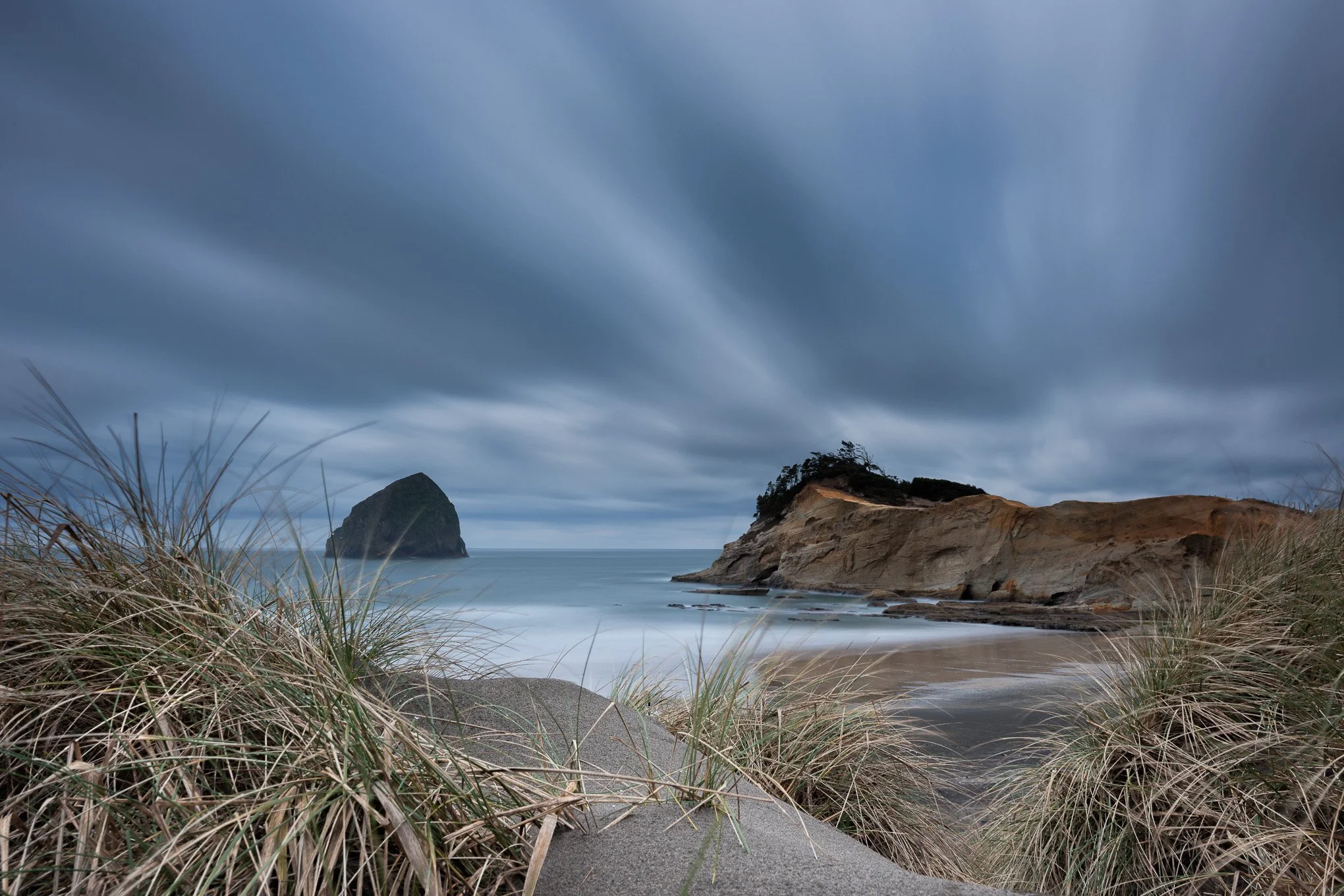
📥 Download FREE desktop wallpaper
🖼️ View artwork details & shipping
📸 Request a free wall preview
“Dune Storm”
Description:
A stormy morning at Cape Kiwanda in Pacific City, Oregon, captured with a long exposure that blurs incoming clouds over the sandstone headland. Haystack Rock sits offshore as dune grasses frame the foreground. The image reflects the dramatic weather patterns common along this stretch of the Oregon Coast.
Story:
As a storm moved onshore, the sky darkened and the wind began to rise while the rain returned in waves. There were hardly any people on the beach when I made this photograph. Rain had been falling on and off throughout the night and well into the morning.
A brief pause in the weather gave me enough time to create this long-exposure image, which captures the dramatic motion of the clouds while softening the ocean below. Long exposures can transform a scene, especially when wind pushes the clouds directly toward the subject. Here, that subject is the sandstone cape of Cape Kiwanda.
Not every day on the Oregon coast looks like this, but when storms gather and the sky turns restless, Pacific City often takes on this exact mood.
-BAP
Location:
Cape Kiwanda
Pacific City, Oregon
45° 13' 4'' N, 123° 58' 23.8'' W
Google Map Link
Time: 08:04 PST (sunrise 07:10)
Date: February 19th, 2019
Camera & Settings:
Single shot
Nikon D800E, NIKKOR 24-70 mm f/2.8G, 10-Stop ND Filter, Tripod
ISO 100, 24 mm, f/8, 226 sec
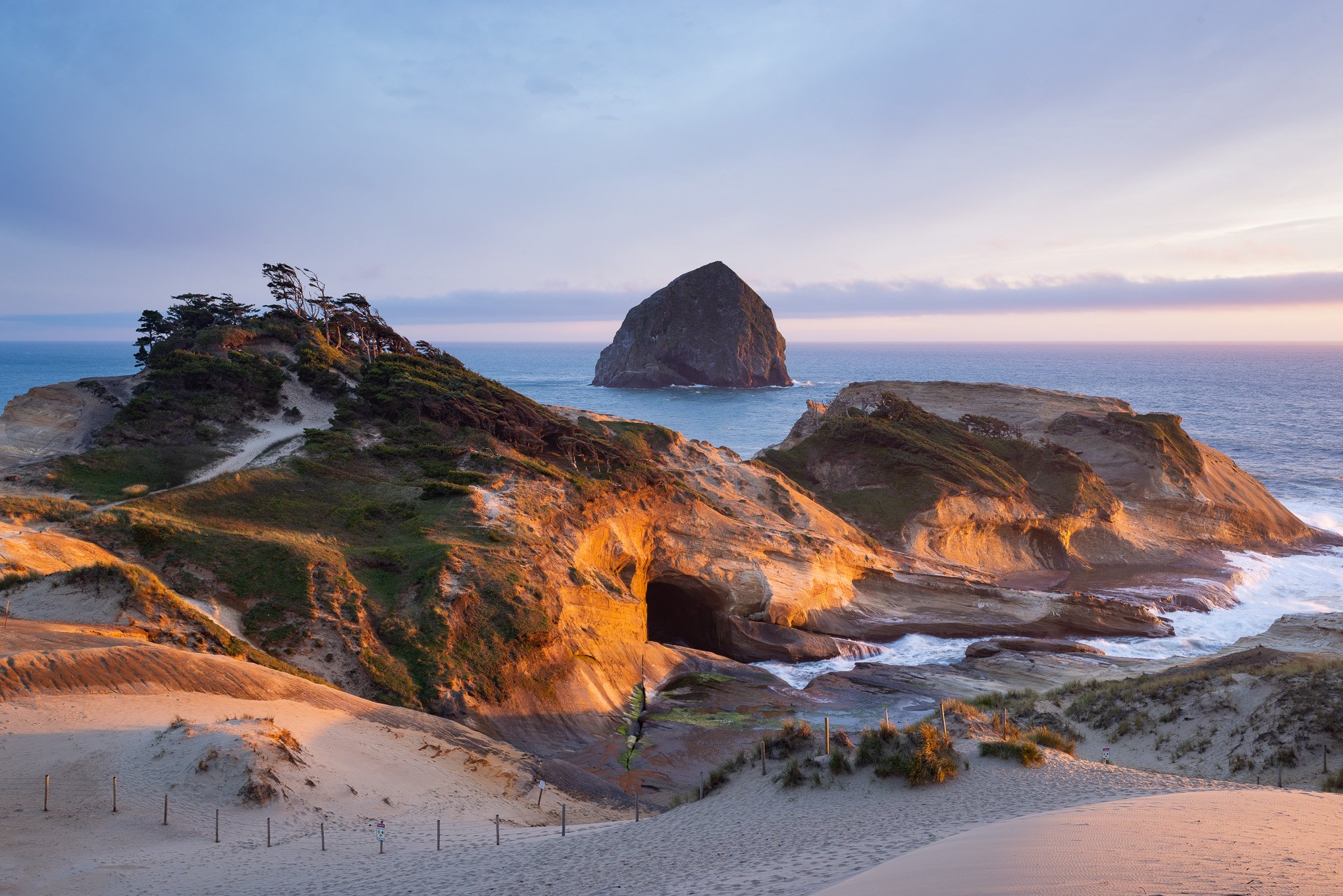
📥 Download FREE desktop wallpaper
🖼️ View artwork details & shipping
📸 Request a free wall preview
“Cape Kiwanda (1)”
Description:
This photograph shows Cape Kiwanda in Pacific City, Oregon, illuminated by sunset. The sandstone cliffs, offshore Haystack Rock, and surrounding dunes form one of the Oregon Coast’s most recognizable viewpoints. Taken during a rare quiet evening in early summer, the scene highlights the cape’s dramatic terrain and shifting coastal conditions.
Story:
It was the day before the beach would reopen to the public in early June of 2020, during the height of COVID-19 restrictions. Even though it was June, the number of footprints in the sand looked more like winter — a rare quiet for the Oregon coast’s summer season.
But I was racing against time. There were more people out that evening than I expected, and I needed a clean frame. After setting up my tripod and camera, I waited for gaps in the crowd. Clouds hovered along the horizon and drifted across the sky, and I knew the sun would remain visible for only a brief window. Its golden rays were already giving the sandstone a warm glow.
With barely a New York minute to spare, an opening appeared. I fired off a series of exposures, each one free of people, each one with a slightly different rhythm in the waves. Then the sun slipped behind a bank of clouds along the horizon, and the moment vanished.
Photography is full of instances like this, when all the elements align for only a few seconds. The combination of dramatic clouds and the unusually low number of footprints for that time of year makes this a rare photograph — a fleeting intersection of season, circumstance, and light.
-BAP
Location:
Cape Kiwanda
Pacific City, Oregon
45° 13' 8.4'' N, 123° 58' 34.6'' W
Google Map Link
Time: 20:46 PDT (sunset 20:59)
Date: June 4th, 2020
Camera & Settings:
Single Exposure
Nikon D800E, Carl Zeiss Planar 50mm f/1.7 T*, CPL filter, tripod
ISO 100, 50 mm, f/11, 1/3 sec
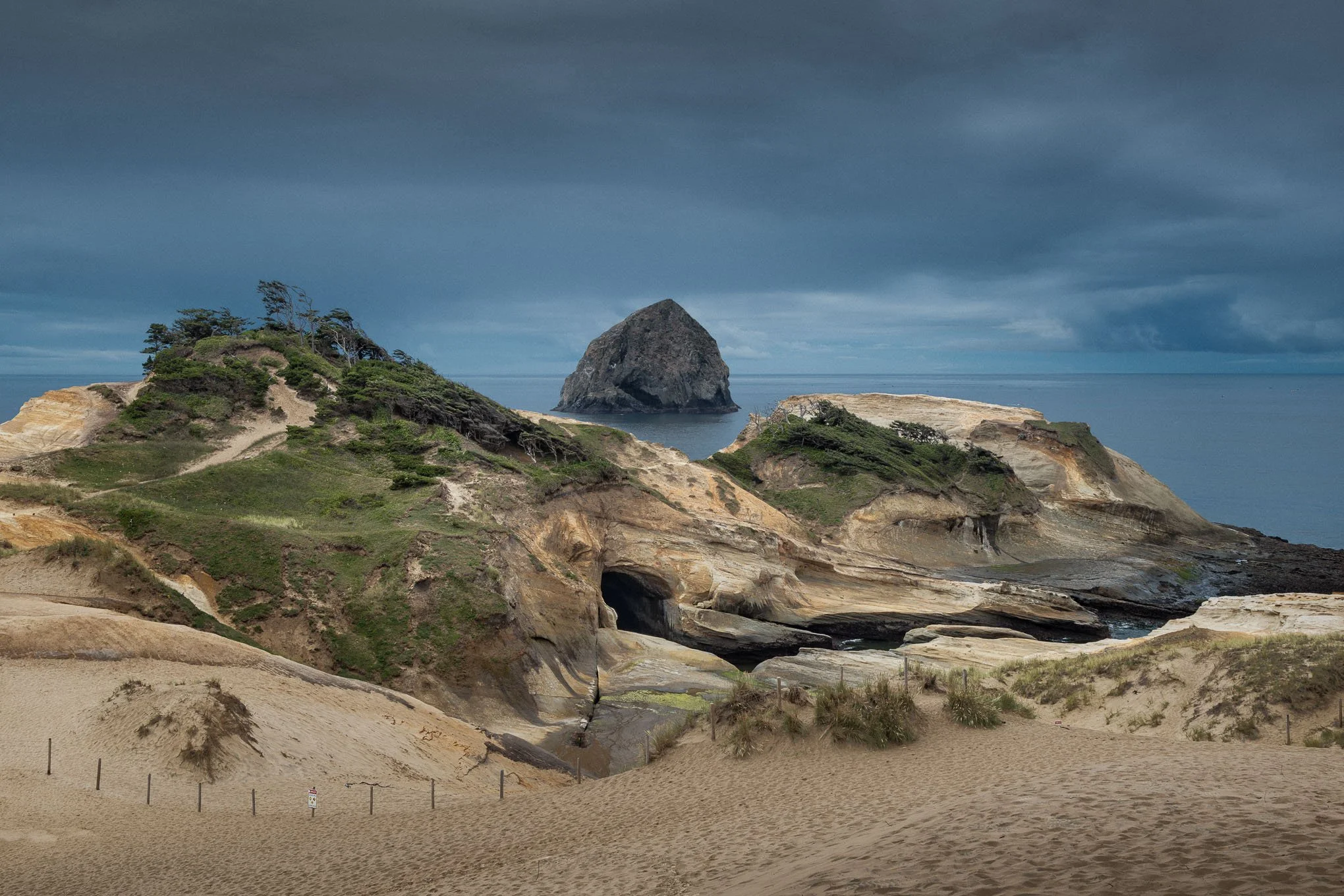
📥 Download FREE desktop wallpaper
🖼️ View artwork details & shipping
📸 Request a free wall preview
“Cape Kiwanda (2)
Description:
A minus tide exposes Cape Kiwanda’s sandstone ledges and mussel beds in Pacific City, Oregon, with Haystack Rock rising offshore. Dory boats launch along the beach under an overcast sky, revealing the natural geology and coastal activity that define this well-known Oregon Coast landmark.
Story:
A minus tide at Cape Kiwanda reveals dory boats, an overcast sky, and a shoreline sitting lower than usual. If you look closely, you can see the “bathtub ring” around Haystack Rock, also known as Chief Kiawanda Rock. The dark areas on the cape are also visible during the minus tide, covered in mussels and mollusks that are usually hidden.
There were many dory fishermen out that morning. From where I stood, I could watch them launching out to sea. Photographed early in the day, there were still few beachgoers. It was a perfect moment to be outside, whether you were carrying fishing gear or a camera.
-BAP
Location:
Cape Kiwanda
Pacific City, Oregon
45° 13' 8.4'' N, 123° 58' 34.6'' W
Google Map Link
Time: 06:54 PDT (sunrise: 05:33)
Date: July 2nd, 2019
Camera & Settings:
Single Exposure
Nikon D800E, NIKKOR 14-24 mm f/2.8G, tripod
ISO 100, 22 mm, f/11, 1/13 sec
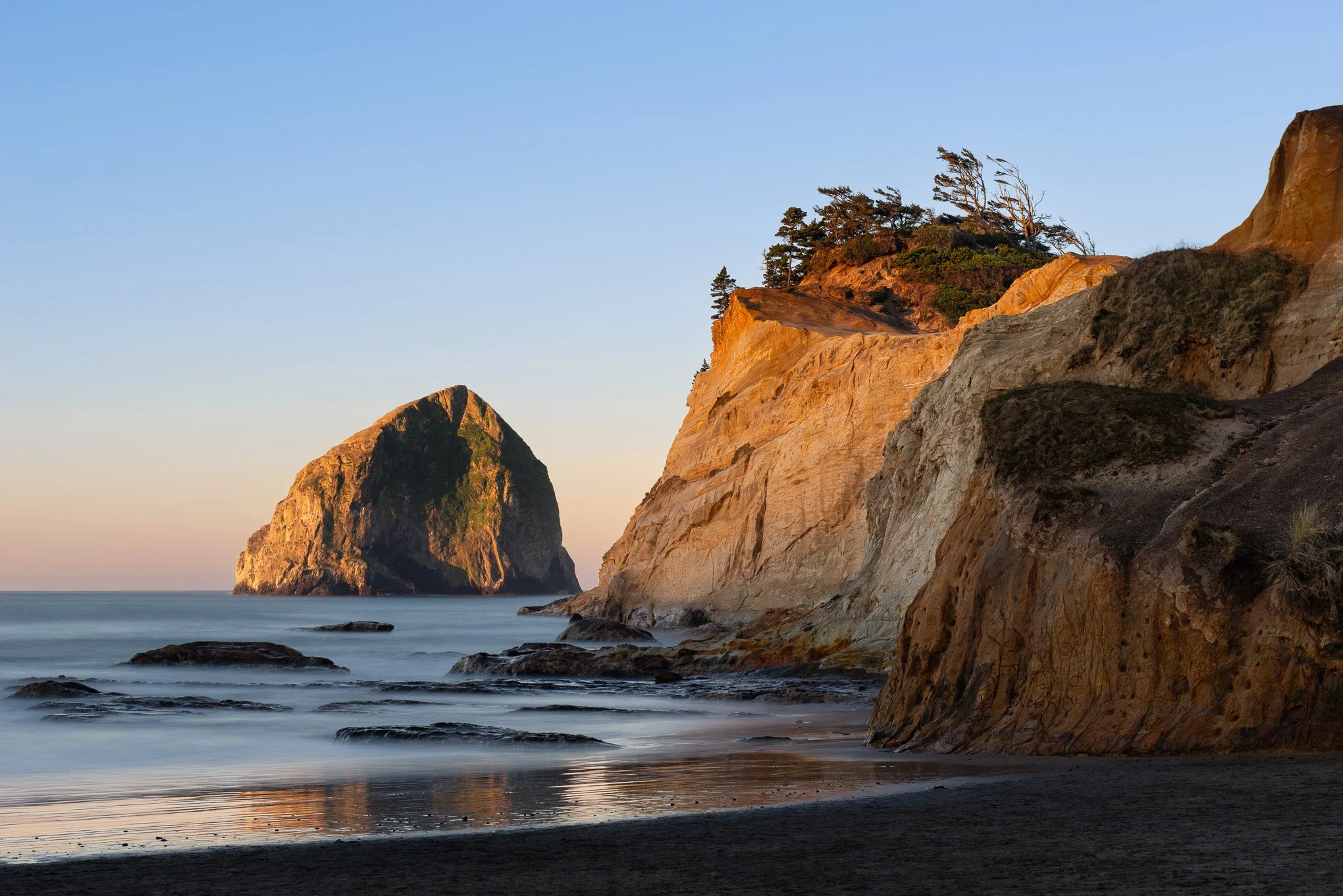
📥 Download FREE desktop wallpaper
🖼️ View artwork details & shipping
📸 Request a free wall preview
“Cascading Light”
Description:
Morning sun lights the cliffs of Cape Kiwanda as Haystack Rock rises offshore in Pacific City, Oregon. This peaceful winter scene highlights the warm sandstone tones and gentle ocean conditions that draw visitors and coastal homeowners back to this iconic Oregon Coast landmark.
Story:
Sunlight begins to illuminate Cape Kiwanda and Haystack Rock in Pacific City, Oregon.
The light was spectacular.
It was winter, and the sun was rising from the southeast. From this angle, the first touch of light struck the very tip of Haystack Rock and then began to wash down its face, revealing more and more of the rock with each passing second.
Soon after Haystack Rock began to glow, the western edge of Cape Kiwanda caught the sun as well. As the sun climbed higher, the light continued to spread across the cape, uncovering its contours one layer at a time.
The way the light moved was unusual. It felt as if it were shifting left to right rather than top to bottom, guided by the shape of the Coast Range mountains. This sideways illumination helped accentuate the layers of Cape Kiwanda. You can see not only the different colors in the sandstone, but also the depth of the formation itself.
Just like the tiers of a waterfall, the light changes as it moves. Its intensity is not uniform across the landscape, and that creates the soft, cascading effect seen in this photograph.
-BAP
Location:
Cape Kiwanda
Pacific City, Oregon
45° 13' 5.6'' N, 123° 58' 28.6'' W
Google Map Link
Time: 07:58 PST (sunrise 07:37)
Date: January 31st, 2019
Camera & Settings:
Single shot
Nikon D800E, NIKKOR 24-70 mm f/2.8G, CPL Filter, 10-Stop ND Filter, Tripod
ISO 100, 62 mm, f/10, 46 sec
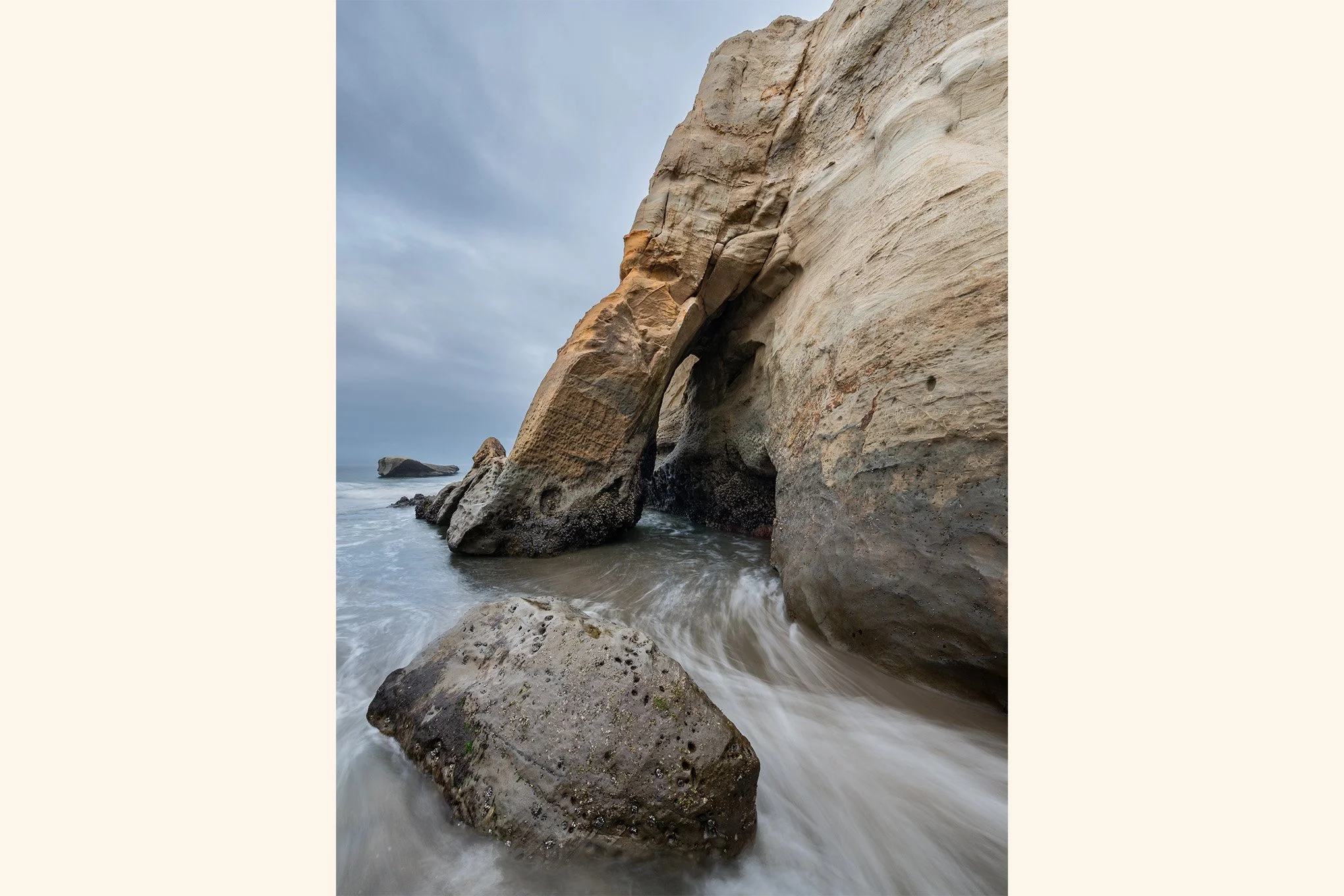
📥 Download FREE desktop wallpaper
🖼️ View artwork details & shipping
📸 Request a free wall preview
“Barnacle Arch”
Description:
A natural sandstone arch at Cape Kiwanda shows how wind, waves, and erosion sculpt the Oregon Coast. Barnacles cover the shaded interior, exposed briefly between tides. Photographed at Pacific City, this scene captures the rugged shoreline and shifting water patterns that define this iconic coastal landmark
Story:
Water threads itself through a sandstone arch worn thin by centuries of weather, its edges softened yet still stubborn against the tide.
Barnacles cling to the dim interior, closed tight in the hush before the sea returns. In another moment they will stir awake, opening their shells to meet the world again.
Inside the arch the light is quieter, a small cathedral for creatures with shells. The ocean becomes the hymn.
This place is not mine; I am only passing through, one more visitor between tides.
But the barnacles, patient and unmoving, hold fast to the walls. This is their doorway, their shelter, their arch.
-BAP
Location:
Cape Kiwanda
Pacific City, Oregon
45° 13' 3.9'' N, 123° 58' 35.3'' W
Google Map Link
Time: 05:52 PDT (sunrise 05:34)
Date: July 5th, 2019
Camera & Settings:
Single shot
Nikon D800E, NIKKOR 14-24 mm f/2.8G, ND Filter, Tripod
ISO 100, 14 mm, f/14, 1 sec
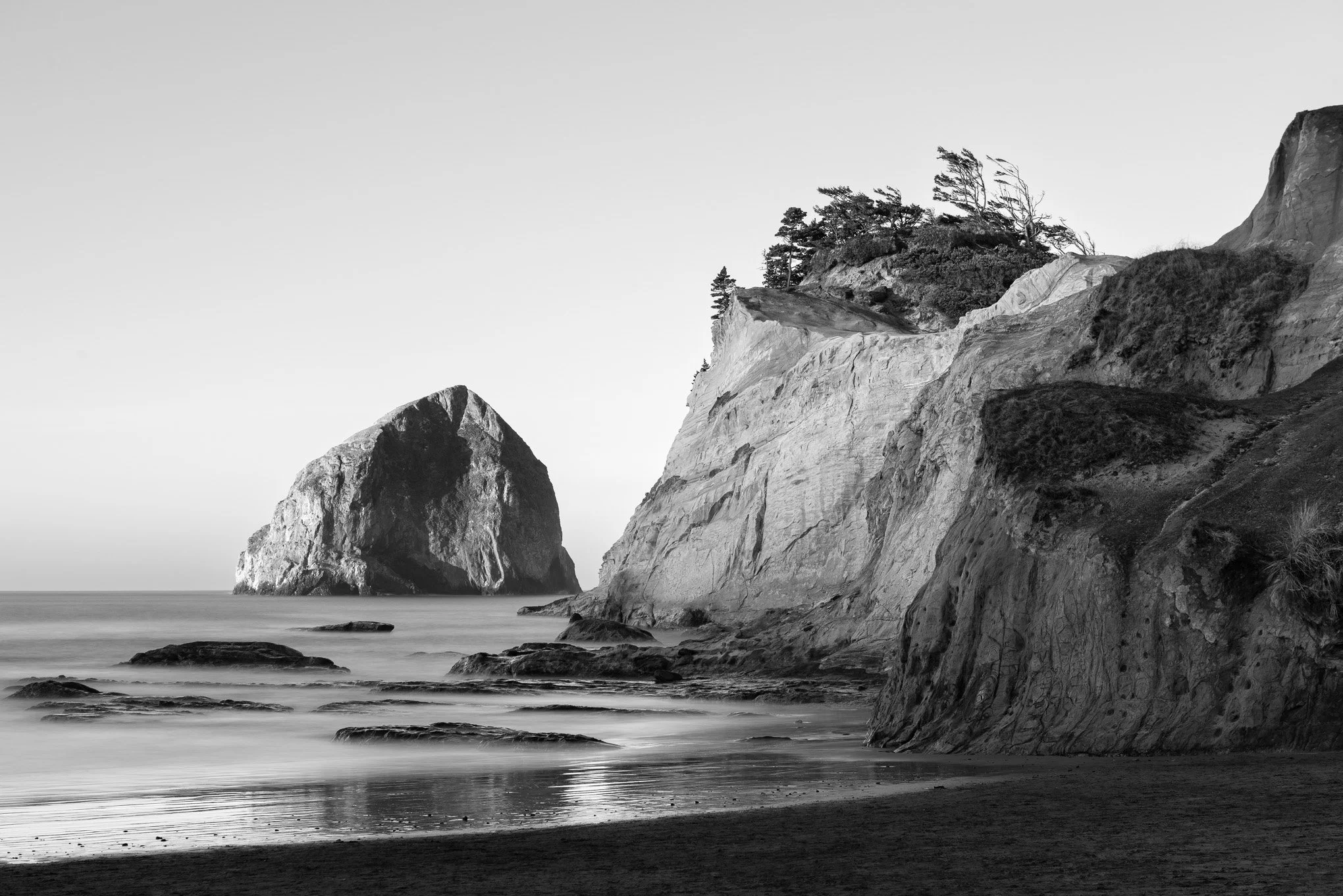
Limited Edition Fine Art Print ✨
Only 1 edition per size
Greeting Card is open edition
📥 Download FREE desktop wallpaper
🖼️ View artwork details & shipping
📸 Request a free wall preview
“Cascading Light (BW)”
Description:
This black-and-white photograph captures Cape Kiwanda and Haystack Rock in Pacific City, Oregon at sunrise. Soft morning light reveals the sandstone cliffs and tide pools, highlighting the shapes and textures that define this iconic Oregon Coast landmark.
Story:
Sunlight begins to illuminate Cape Kiwanda and Haystack Rock in Pacific City, Oregon.
The light was spectacular.
It was winter, and the sun was rising from the southeast. From this angle, the first touch of light struck the very tip of Haystack Rock and then began to wash down its face, revealing more and more of the rock with each passing second.
Soon after Haystack Rock began to glow, the western edge of Cape Kiwanda caught the sun as well. As the sun climbed higher, the light continued to spread across the cape, uncovering its contours one layer at a time.
The way the light moved was unusual. It felt as if it were shifting left to right rather than top to bottom, guided by the shape of the Coast Range mountains. This sideways illumination helped accentuate the layers of Cape Kiwanda. You can see not only the different colors in the sandstone, but also the depth of the formation itself.
Just like the tiers of a waterfall, the light changes as it moves. Its intensity is not uniform across the landscape, and that creates the soft, cascading effect seen in this photograph.
-BAP
Location:
Cape Kiwanda
Pacific City, Oregon
45° 13' 5.6'' N, 123° 58' 28.6'' W
Google Map Link
Time: 07:58 PST (sunrise 07:37)
Date: January 31st, 2019
Camera & Settings:
Single shot
Nikon D800E, NIKKOR 24-70 mm f/2.8G, CPL Filter, 10-Stop ND Filter, Tripod
ISO 100, 62 mm, f/10, 46 sec
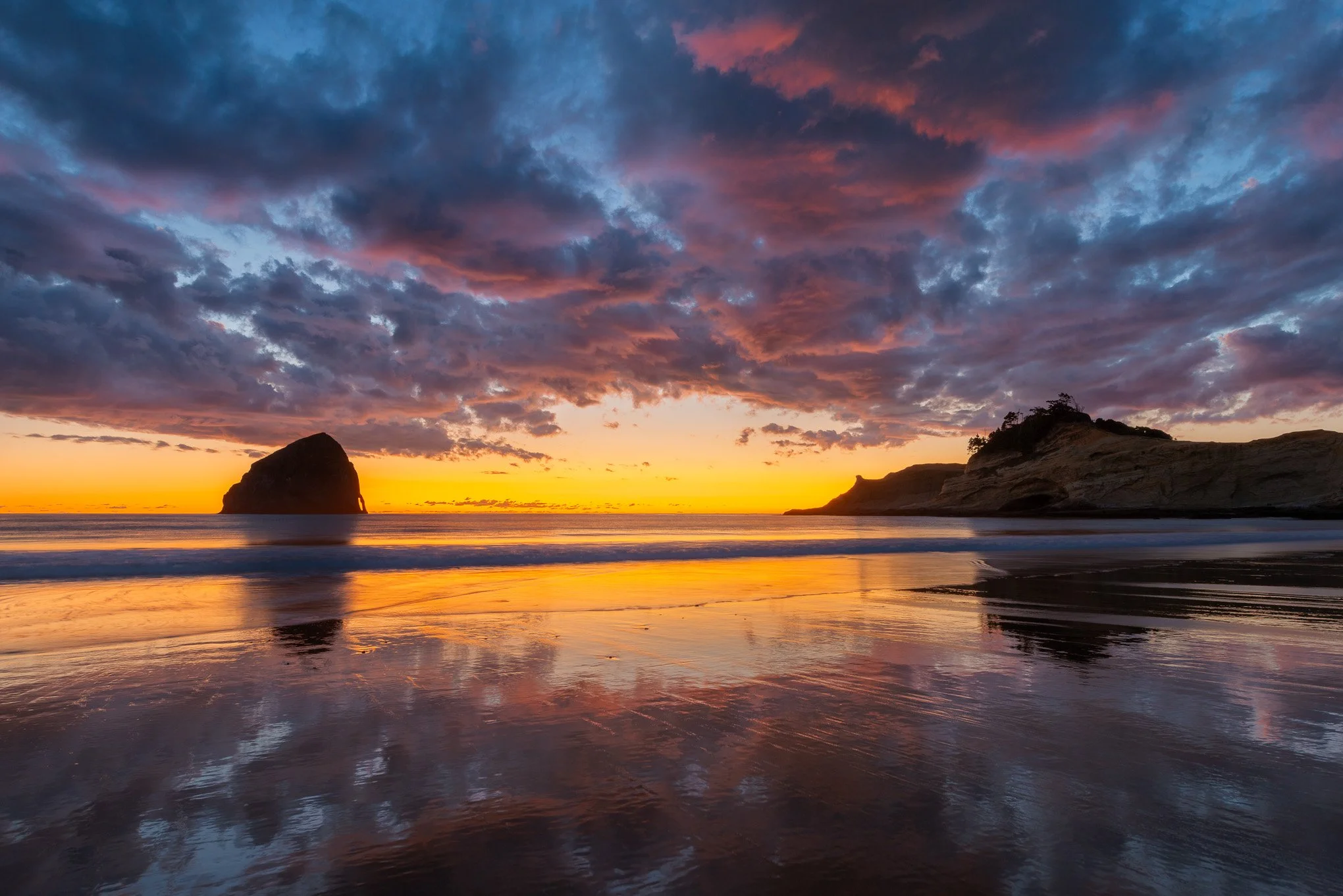
📥 Download FREE desktop wallpaper
🖼️ View artwork details & shipping
📸 Request a free wall preview
“Pacific City Reflections”
Description:
Pacific City lies along a broad sandy beach on the northern Oregon Coast, bordered by the sandstone cliffs of Cape Kiwanda. Haystack Rock, a basalt sea stack, rises just offshore, while gentle tides and open shoreline create wide reflective stretches of sand at low water, offering expansive views of sea and sky.
Story:
Colors collide as the rocks divide in this dynamic sunset from Pacific City, Oregon.
The textured sky mirrored in the water was captivating. The sun had set nearly thirty minutes earlier, yet Mother Nature’s show continued long after the horizon swallowed the light.
I had already photographed “Starburst Reflection” and “Kiwanda Tapestry,” and I felt spent. Several times I packed up my gear and decided I was finished, only to be pulled back by imagination and instinct. The evening refused to let go.
Moments like this feel rare, though perhaps they happen more often than we notice. You find yourself standing inside a natural phenomenon that appears without warning and vanishes just as quickly. This was one of those nights that made up for all the times I drove to a location hoping for magic and left with nothing but gray skies.
Maybe someone else on the beach felt that same spark. Maybe a moment like this encourages someone to pick up a camera for the first time.
The flat, sandy shoreline at Pacific City becomes something special when the sky reflects off the wet sand. On this evening, it was spectacular.
-BAP
Location:
Cape Kiwanda
Pacific City, Oregon
45° 12' 59.2'' N, 123° 58' 23.4'' W
Google Map Link
Time: 19:23 PDT (sunset 18:58)
Date: September 30th, 2019
Camera & Settings:
Single shot
Nikon D800E, NIKKOR 14-24 mm f/2.8G, Tripod
ISO 100, 22 mm, f/9, 1.6 sec

📥 Download FREE desktop wallpaper
🖼️ View artwork details & shipping
📸 Request a free wall preview
“Visitation”
Description:
A rainbow forms over the Pacific Ocean between Haystack Rock and Cape Kiwanda during a winter sunrise. Photographed in Pacific City, Oregon, this beach is known for surfing, whale watching, and dory fishing. It sits along the Three Capes Scenic Route, roughly halfway between Tillamook and Lincoln City.
Story:
A double rainbow appeared one morning at Pacific City when the perfect mix of sun, clouds, and rain collided during high tide. The light was shifting quickly, and each minute changed the intensity of the colors. With every passing moment, the arches grew stronger, then fainter, then stronger again.
Rainbows can be fickle to photograph. Sometimes they form complete arcs that stretch from one end of the horizon to the other, like a peacock displaying its full plumage. Other times they reveal only a partial curve, a quiet suggestion of the larger circle hidden in the sky. Their beauty lies in that unpredictability. You cannot schedule a rainbow; you can only be ready when one appears.
Whenever I see one, I think of what it represents. A rainbow often arrives after a storm or a burst of rain, and with it comes a sense of calm — a soft reminder that the sky has decided to brighten again. There is something almost uplifting in that moment. It feels like a message from above telling you that the day is shifting toward something better.
For me, photographing a rainbow is not just about capturing its shape or its colors. It is about preserving the feeling that arrives with it. Awe. Hope. Renewal. The sense that, even briefly, the world is offering a promise.
-BAP
Location:
Cape Kiwanda
Pacific City, Oregon
45° 12' 56.8'' N, 123° 58' 18.5'' W
Google Map Link
Time: 08:36 PST (sunrise 07:50)
Date: January 16th, 2019
Camera & Settings:
Single shot
Sony RX100 IV, Tripod
ISO 125, 11.93 mm (35 mm), f/7.1, 1/30 sec
📥 Download FREE desktop wallpaper
🖼️ View artwork details & shipping
📸 Request a free wall preview
“Kiwanda Tapestry”
Description:
Sunset colors spread across Pacific City’s shoreline, lighting Haystack Rock, a 335-foot basalt sea stack connected to the Nestucca legend of Chief Kiawanda. The monolith’s volcanic origins and coastal erosion create the rugged form that dominates Cape Kiwanda’s iconic view.
Story:
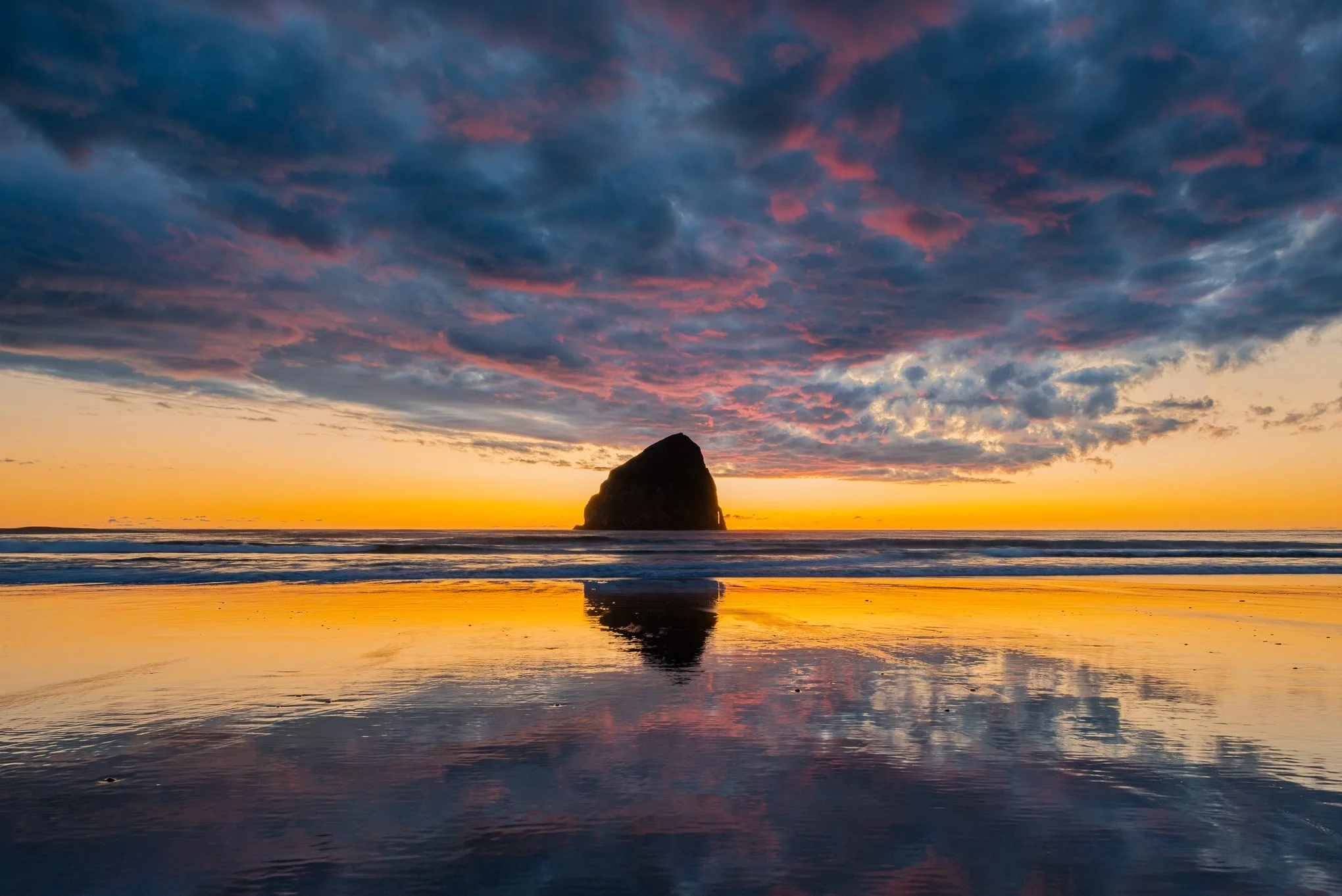
Pink and purple clouds drifted above Haystack Rock, forming a textured sky that looked almost storm-like. The sunset in this photograph feels caught between two worlds. It creates its own glow, yet it also marks the quiet beginning of darkness.
What had been forecast as a mild evening turned into a stunning display. The colors intensified, the sky deepened, and the wet sand offered a nearly perfect reflection that doubled the beauty of the scene.
Photographed during the same spectacular evening as “Starburst Reflection” and “Pacific City Reflections.”
-BAP
Location:
Cape Kiwanda
Pacific City, Oregon
45° 12' 52.8'' N, 123° 58' 19.2'' W
Google Map Link
Time: 19:04 PDT (sunset 18:58)
Date: September 30th, 2019
Camera & Settings:
Single shot
Nikon D800E, NIKKOR 14-24 mm f/2.8G, Tripod
ISO 100, 24 mm, f/18, 0.6 sec
📥 Download FREE desktop wallpaper
🖼️ View artwork details & shipping
📸 Request a free wall preview
“Equinox”
Description:
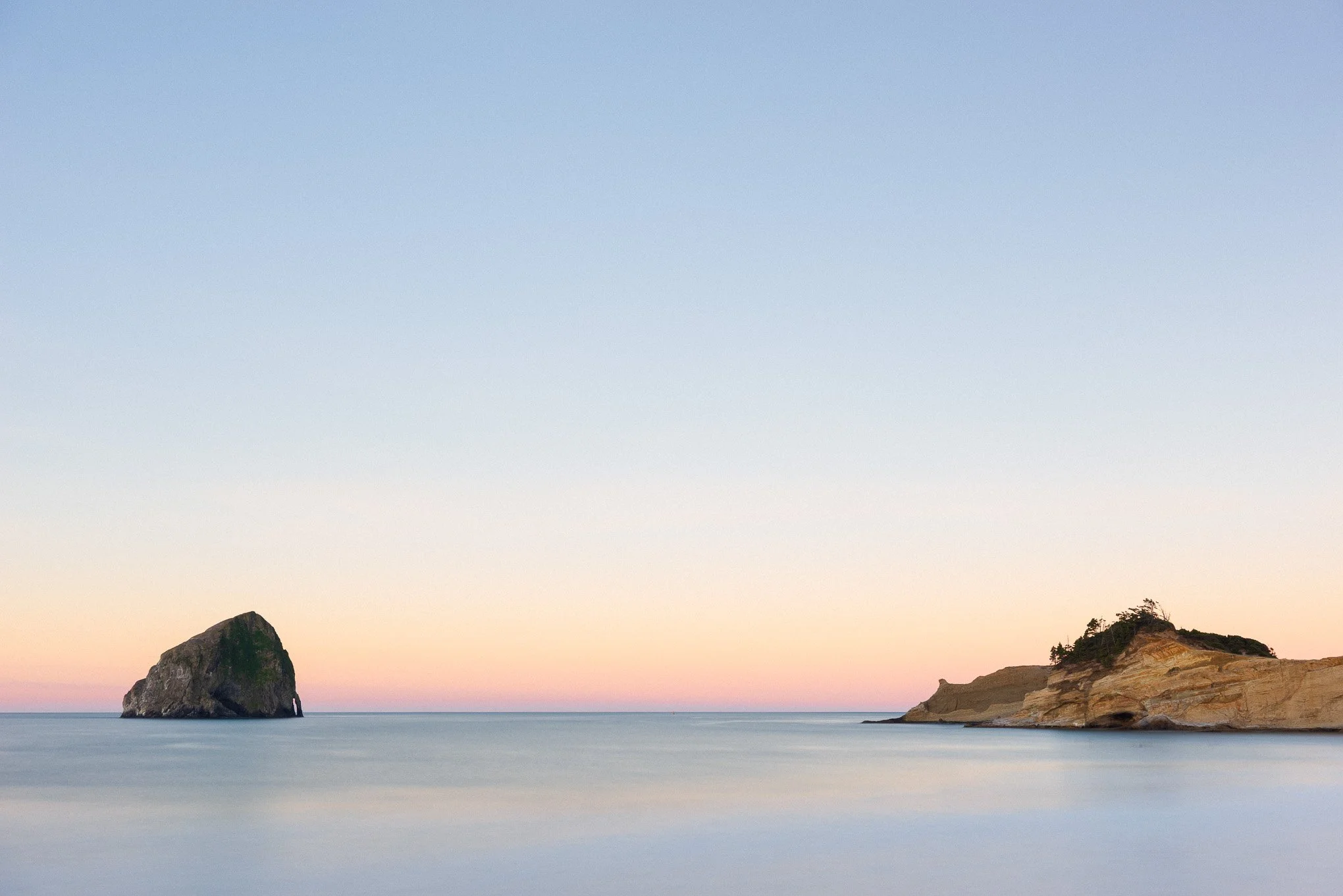
Haystack Rock and Cape Kiwanda stand as opposites in this long exposure photograph captured at sunrise during the winter season at Pacific City, Oregon. This beach is known for surfing, whale watching, and dory fishing. It sits along the Three Capes Scenic Route, roughly halfway between Tillamook and Lincoln City.
Story:
The balance between two elements — rock and cape — came together on a crisp winter morning. The cold was sharp, but it allowed me to capture the soft pastel light of sunrise because the sun was rising behind me.
Understanding the direction of light and how it interacts with a scene is essential for photographers. It is the balance of elemental forces, the weight of objects arranged through the viewfinder. To simplify the composition, I used a 10-stop neutral density filter, which kept the shutter open for seventy-nine seconds. The long exposure flattened the ocean and turned the waves into something that looked like ice.
This photograph reminds me of those still winter moments when breath condenses into fog, the nose reddens and drips, and the world feels hushed and untouched. The cold becomes invigorating, like waking from a dream and stepping into Wonderland.
Equinox
Elemental forces balance;
pastel sky, pastel sea,
black rock, sandstone.
Waves dissolving,
blurred lines, crisp cold,
fantasy caught, reality held still.
-BAP
Location:
Cape Kiwanda
Pacific City, Oregon
45° 13' 0.2'' N, 123° 58' 22'' W
Google Map Link
Time: 07:44 PST (sunrise 07:39)
Date: January 29, 2019
Camera & Settings:
Single Exposure
Nikon D800E, NIKKOR 24-70 mm f/2.8G, tripod
10-Stop ND Filter
ISO 50, 32 mm, f/6.3, 79.0 sec

📥 Download FREE desktop wallpaper
🖼️ View artwork details & shipping
📸 Request a free wall preview
“Starburst Reflection”
Description:
A dramatic sunset at low tide radiates with warmth as Haystack Rock and Cape Kiwanda reflect in the sand. Photographed from Pacific City, Oregon. This beach is known for surfing, whale watching, and dory fishing. It sits along the Three Capes Scenic Route, roughly halfway between Tillamook and Lincoln City.
Story:
A sunset at Pacific City exceeded all expectations and delivered a vivid display of color.
The forecast had called for clear skies, and I confirmed the conditions through the webcam at the Inn at Cape Kiwanda before leaving my home in the valley. But weather along the Oregon coast can shift quickly. Clouds often form along the horizon as sunset approaches, and more often than not they swallow the sun before it reaches the water.
For this photograph, the timing worked in my favor. The clouds added texture and depth to the sky without blocking the light. As the tide receded, it left behind a reflective sheen on the sand, creating a mirror that doubled the colors above.
When the sun aligned with the arch of Haystack Rock, it burst through in a perfect moment of light.
-BAP
Location:
Cape Kiwanda
Pacific City, Oregon
45° 12' 52.8'' N, 123° 58' 19.2'' W
Google Map Link
Time: 18:56 PDT (sunset 18:58)
Date: September 30th, 2019
Camera & Settings:
Single shot
Nikon D800E, NIKKOR 14-24 mm f/2.8G, Tripod
ISO 100, 24 mm, f/18, 1/4 sec

📥 Download FREE desktop wallpaper
🖼️ View artwork details & shipping
📸 Request a free wall preview
“Prized Possession”
Description:
Pacific City features an open, walkable beach shaped by tides, wind, and seasonal swells. The sandstone headlands of Cape Kiwanda and nearby Haystack Rock create sheltered intertidal zones where visitors often observe seabirds, marine invertebrates, and changing reflections across the wet sand.
Story:
A juvenile gull shows off a starfish clutched in its beak at Pacific City.
This cute little guy totally photobombed my composition as I tried capturing the pinkish early morning light glowing in the clouds. I had seen him coming… but I didn’t expect this.
As adorable as he was, I had already watched how he acquired his prized possession. While chasing another gull through the air, our bird knocked the starfish loose from its previous owner. It cartwheeled through the sky… spinning… tumbling… before plopping onto the ground right in front of my camera.
Sometimes nature gives you a moment you never planned for… and this was one of them.
-BAP
Location:
Cape Kiwanda
Pacific City, Oregon
45° 12' 59.3'' N, 123° 58' 24.2'' W
Google Map Link
Time: 07:23 PST (sunrise)
Date: February 11th, 2020
Camera & Settings:
Single shot
Nikon D800E, NIKKOR 24-70 mm f/2.8G, CPL filter, Tripod
ISO 500, 24 mm, f/10, 1/50 sec
📥 Download FREE desktop wallpaper
🖼️ View artwork details & shipping
📸 Request a free wall preview
“Kiwanda Storm”
Description:
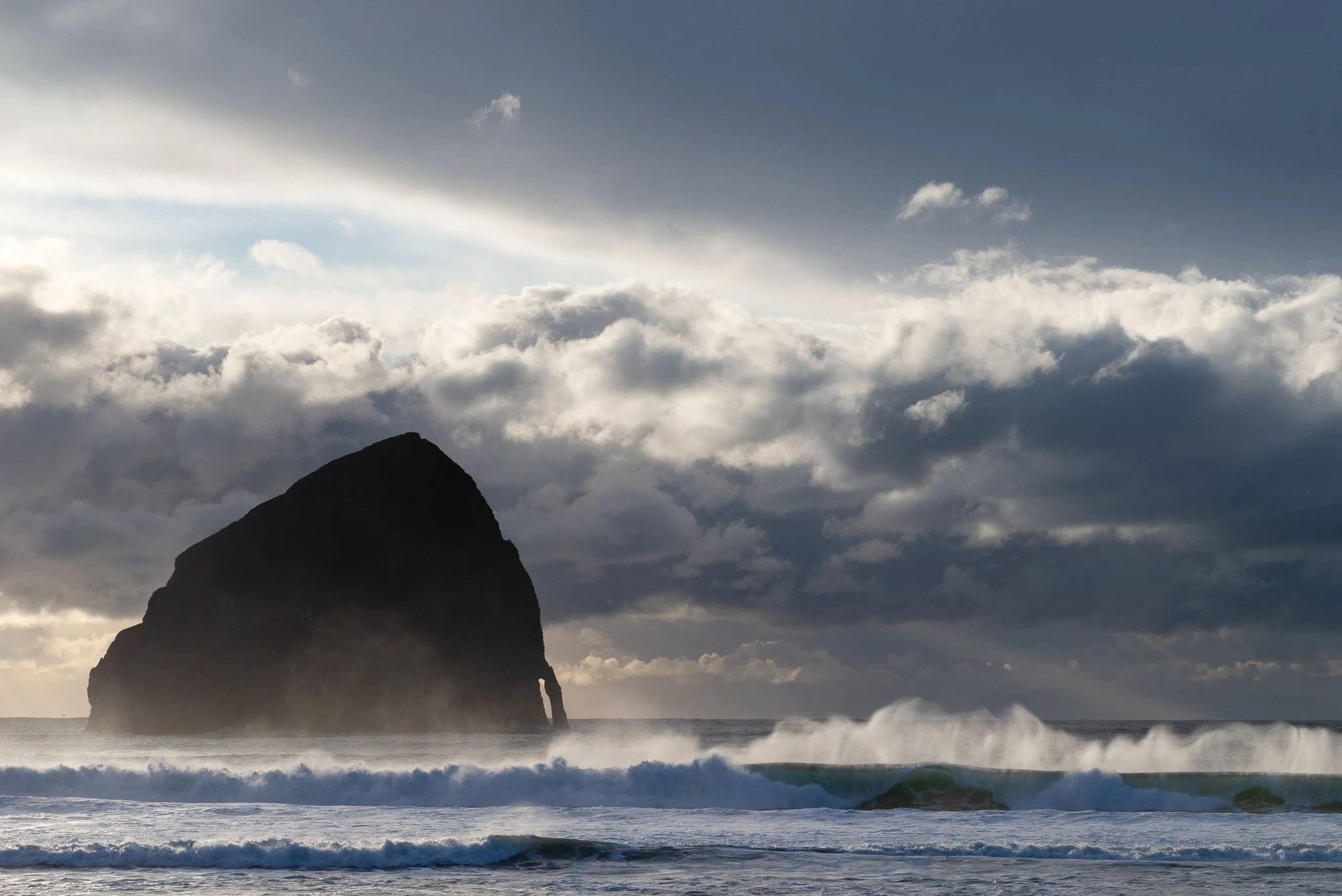
A winter storm briefly clears over Haystack Rock in Pacific City, Oregon, a 327-foot basalt sea stack known to the Nestucca people as Chief Kiawanda. This major Oregon Coast landmark is easily viewed from the beach when storm light reveals the sea arch and breaking waves.
Story:
A sunbreak during a winter storm along the Oregon coast illuminates the crests of windswept waves in front of Haystack Rock.
Cape Kiwanda is a place I return to often, not to repeat myself, but because it never offers the same moment twice. Light, weather, tide, and season create endless combinations, and each visit reveals a slightly different version of the familiar. Winter, especially, is full of surprises.
During these months the sun sits low on the horizon, and from this perspective the arch of Haystack Rock becomes clearly visible. The right conditions can transform the coastline in an instant.
For this photograph, patience mattered. I waited for a sunbreak to move across the storm clouds and for a wave to crest at just the right moment. With my eye pressed to the viewfinder I watched the ocean crash, settle, and rise again as time unfolded through each passing wave.
-BAP
Location:
Cape Kiwanda
Pacific City, Oregon
45° 12' 56.3'' N, 123° 58' 16.8'' W
Google Map Link
Time: 16:37 PST (sunset 17:35)
Date: February 9th, 2019
Camera & Settings:
Single shot
Nikon D800E, Tokina 100 mm f/2.8, Tripod
ISO 100, 100 mm, f/9, 1/320 sec
📥 Download FREE desktop wallpaper
🖼️ View artwork details & shipping
📸 Request a free wall preview
“Chief’s Reflection”
Description:
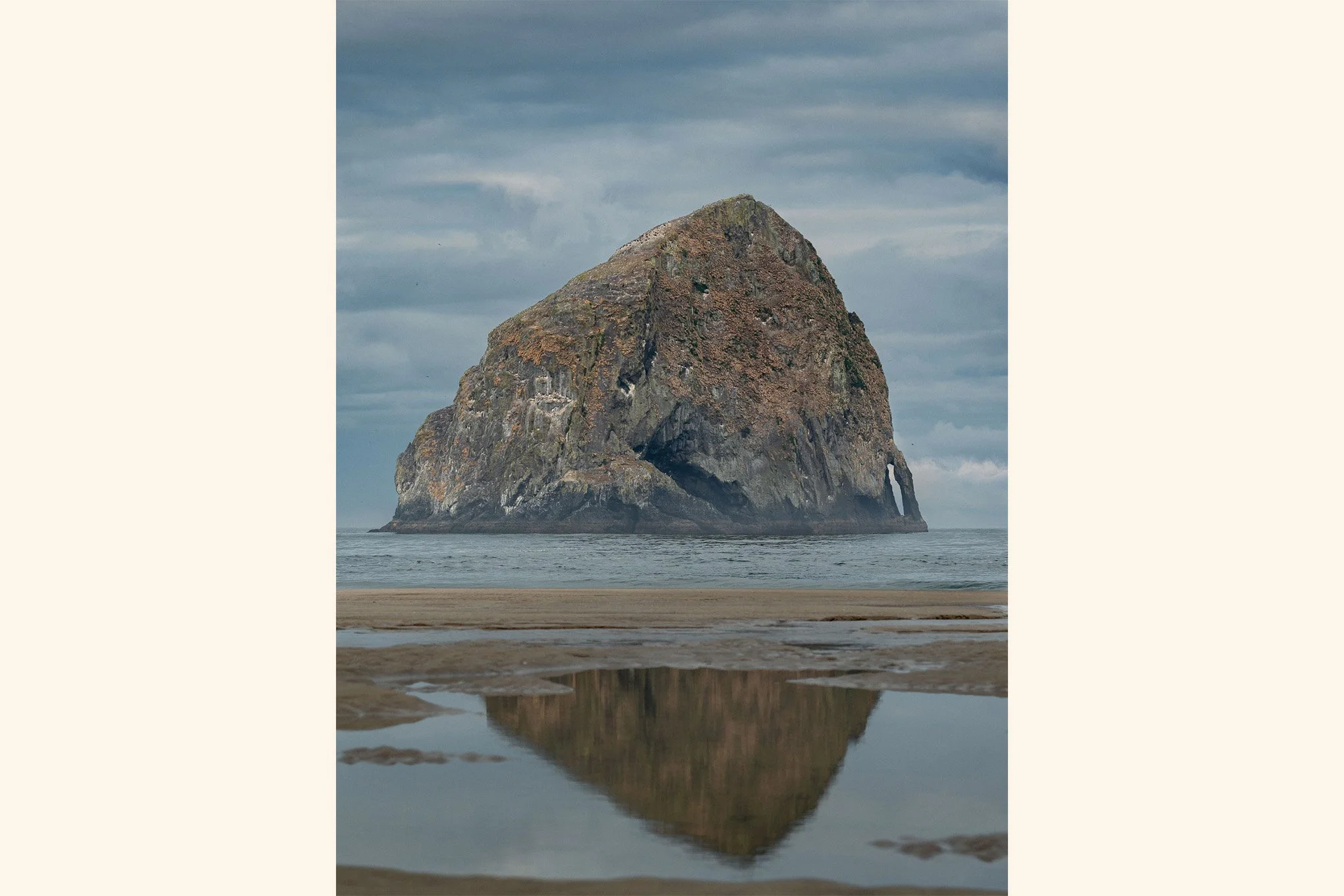
A rare minus tide reveals a quiet reflection of Haystack Rock, known to the Nestucca people as Chief Kiawanda. The 335-foot basalt sea stack shows its exposed tide line and lighter summer tones beneath overcast skies. These conditions briefly create perfect pools for photographing this iconic Oregon Coast landmark.
Story:
Haystack Rock, also known as Chief Kiwanda, is reflected in a shallow pool of water during an overcast day at Pacific City.
Stranded pools like this sometimes form during low tide, but not always. This one appeared during a minus tide when the ocean had receded far beyond its usual reach. If you look closely, you can see a lightly colored ring around the base of the rock indicating the average tide level.
The trapped water created a natural mirror, offering a chance to photograph a quiet portrait of Chief Kiwanda. It is not a perfect reflection of the basalt monolith. Instead, it feels like a shadow, an impression — a softer echo of the rock towering above it.
The coloration is unusual as well. Photographed in summer under thick cloud cover, the rock appears a light brown rather than its typical slate gray and moss green. Moments like this are rare, shaped by tide, weather, and a little luck.
-BAP
Location:
Cape Kiwanda
Pacific City, Oregon
45° 12' 54.2'' N, 123° 58' 21.9'' W
Google Map Link
Time: 06:46 (sunrise 05:34)
Date: July 3rd, 2019
Camera & Settings:
Single shot
Nikon D800E, NIKKOR 70-200 mm f/4G, Tripod
ISO 100, 120 mm, f/9, 1/15 sec
📥 Download FREE desktop wallpaper
🖼️ View artwork details & shipping
📸 Request a free wall preview
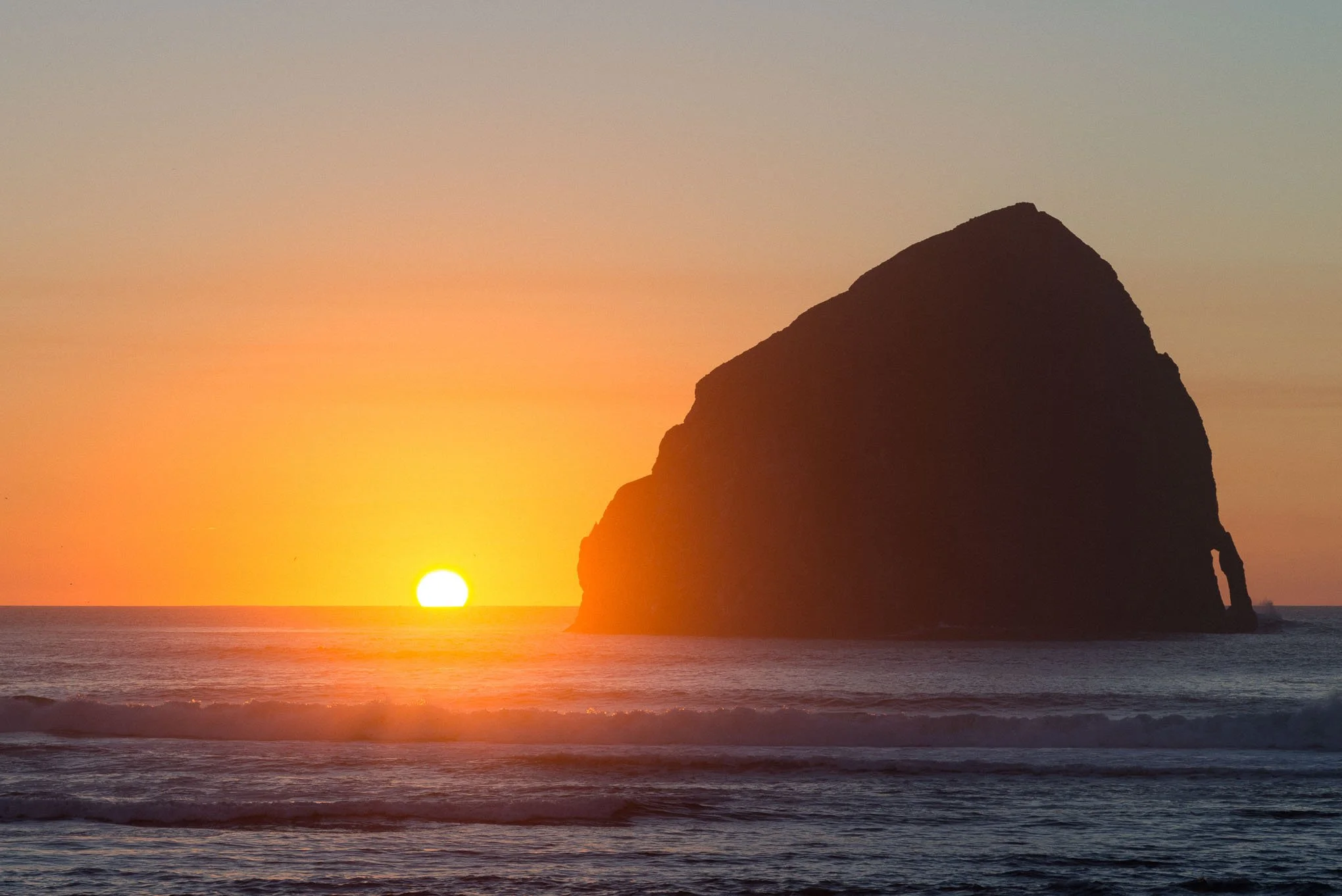
“Kiwanda Sunset”
Description:
A winter sunset sets beside Haystack Rock in Pacific City, Oregon, a 335-foot basalt sea stack traditionally known as Chief Kiawanda to the Nestucca people. This Oregon Coast landmark is easily viewed from the beach and parking area as the sun meets the Pacific Ocean.
Story:
The sun sinks toward the horizon beside Haystack Rock in Pacific City, filling the winter sky with a warm, golden glow. Moments like this are simple yet profound, the kind that stop you in your tracks no matter how many times you have watched the sun meet the sea.
The air was cold, but the light felt anything but. Winter sunsets along the Oregon coast often carry a clarity that summer never quite matches. The colors are cleaner, the atmosphere calmer, and the sky glows with a quiet intensity as the sun begins its descent.
I waited for the moment when the sun would begin to dip below the horizon, its light radiating outward — one final act.
Photographed along the edge of the parking lot, the shoreline was surprisingly alive with people during a crisp afternoon in January:
• walkers carrying their shoes over the cool sand
• beer lovers sharing pints from the Pelican Brew Pub
• children chasing each other with pure, youthful joy
• even a beachcomber sweeping the sand with a metal detector
It was an afternoon when time felt unimportant, marked only by the slow descent of the sun.
-BAP
Location:
Cape Kiwanda
Pacific City, Oregon
45° 12' 56.3'' N, 123° 58' 16.7'' W
Google Map Link
Time: 17:19 PST (sunset 17:21)
Date: January 30th, 2019
Camera & Settings:
Single shot
Nikon D800E, Tokina 100 mm f/2.8, Tripod
ISO 100, 100 mm, f/10, 1/125 sec
📥 Download FREE desktop wallpaper
🖼️ View artwork details & shipping
📸 Request a free wall preview
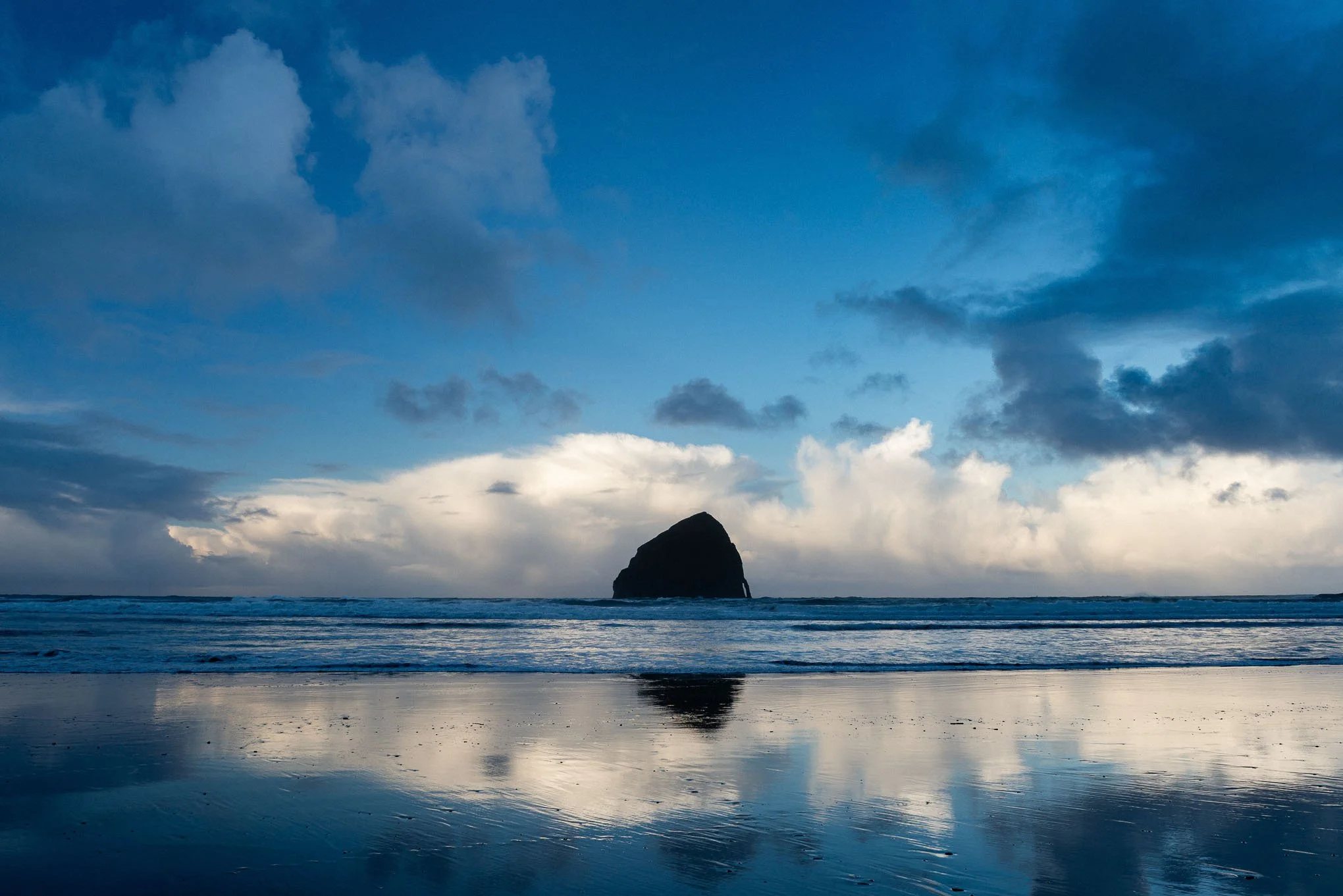
“Haystack Blues”
Description:
Haystack Rock in Pacific City, traditionally known as Chief Kiawanda to the Nestucca people, rises 335 feet above the Pacific. Photographed at low tide, its silhouette reflects across wet sand under an unusually blue sky, capturing a rare moment of coastal weather along the Oregon Coast.
Story:
A rare moment along the Oregon coast: Haystack Rock standing in silhouette, a dark brushstroke against a canvas of white edged in blue.
Morning light had only just begun its work when the sky deepened into an almost impossible shade. The wet sand became a mirror, doubling the blue until it felt as if the world were made of nothing else.
A day at the coast can brighten any mood, even under an ordinary sky. But this was no ordinary sky. On this morning, the clouds themselves carried the same blue as the heavens above them.
I cannot say why. I cannot say how. Perhaps they hid from the sun and borrowed their color from reflected light. Perhaps it was something rarer still.
Whatever the cause, the effect was stunning.
I have never seen clouds like that again.
Have you?
-BAP
Location:
Pacific City, Oregon
45° 12' 51.4'' N, 123° 58' 18.3'' W
Google Map Link
Time: 07:12 PST (sunrise 07:09)
Date: February 20th, 2019
Camera & Settings:
Single shot
Nikon D800E, NIKKOR 24-70 mm f/2.8G, CPL Filter, Tripod
ISO 100, 24 mm, f/8, 1/50 sec

📥 Download FREE desktop wallpaper
🖼️ View artwork details & shipping
📸 Request a free wall preview
“Clearing Break”
Description:
A subdued winter sunset shows Haystack Rock and Cape Kiwanda reflected in the glistening sand. Photographed from Pacific City, Oregon. This beach is known for dory fishing, surfing, and whale watching. It sits along the Three Capes Scenic Route, roughly halfway between Lincoln City and Tillamook.
Story:
After a storm-filled day on the Oregon coast, the clouds finally began to loosen their grip as the sun moved toward the horizon.
The evening had seemed destined for disappointment — too many clouds sitting heavy on the edge of the sea. Earlier, it was impossible to know what the sky would decide. But I arrived with an open mind, ready for whatever unfolded.
I had just come down from the big sand dune nearby when I noticed the reflection on the beach. The sand had become a perfect mirror, untouched by foot or paw. It was mesmerizing, a sheet of light stretching out before me.
Standing there, taking it in, I realized the clouds were slowly beginning to clear. They swirled and drifted apart just enough for the faint outline of the sun to appear, offering a quiet promise after a day full of storms.
-BAP
Location:
Cape Kiwanda
Pacific City, Oregon
45° 13' 1'' N, 123° 58' 25.8'' W
Google Map Link
Time: 17:40 PST (sunset 17:45)
Date: February 16th, 2019
Camera & Settings:
Single shot
Nikon D800E, NIKKOR 14-24 mm f/2.8G, Tripod
ISO 100, 22 mm, f/11, 1/20 sec

📥 Download FREE desktop wallpaper
🖼️ View artwork details & shipping
📸 Request a free wall preview
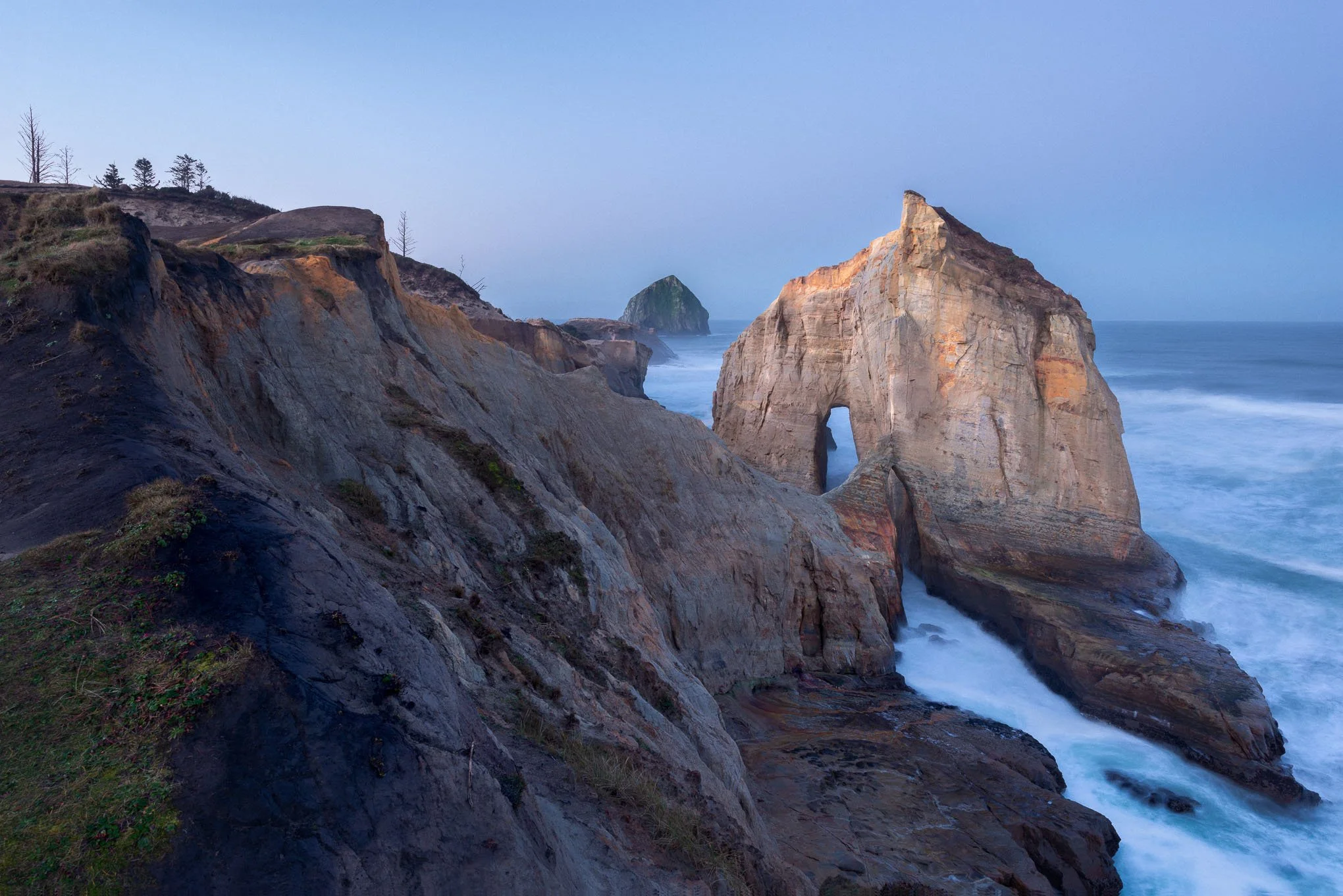
“Anchor Rock (1)”
Description:
Part of the Cape Kiwanda State Natural Area on Oregon’s northern coast, this west-facing view was photographed just before sunrise. The sandstone cliffs of Cape Kiwanda have been sculpted over millennia by wind, waves, and rain. Located near Pacific City along the Three Capes Scenic Route.
Story:
Waves flow and churn through sandstone arches in the early morning light along the Oregon coast.
I remember this morning as if it were yesterday: clear, cold, and leaving me panting for breath. To reach this spot, I had to charge up and over the large sand dune at the southern edge of the cape. By the time I reached the top, my legs were burning.
As I caught my breath, I looked over the edge and saw the scene you see here. The tide was coming in, and waves occasionally swept over the rocks below. The sandstone cape, its jagged edges forming an arch above the frothing ocean, connected to a larger formation whose fractured sides had been chiseled by wind and sea.
In that moment, the headland reminded me of a ship’s anchor — heavy, weathered, and holding fast against the restless water, its arched base curving like flukes gripping the sea.
-BAP
Location:
Cape Kiwanda
Pacific City, Oregon
45° 13' 17.3'' N, 123° 58' 31.9'' W
Google Map Link
Time: 07:34 PST (sunrise 07:38)
Date: January 30th, 2019
Camera & Settings:
Single shot
Nikon D800E, NIKKOR 20 mm f/1.8G, Tripod
ISO 100, 20 mm, f/8, 5 sec
📥 Download FREE desktop wallpaper
🖼️ View artwork details & shipping
📸 Request a free wall preview
“Anchor Rock (2)”
Description:
Part of the Cape Kiwanda State Natural Area on Oregon’s northern coast, this southwest-facing view was photographed just before sunrise in the winter. The sandstone cliffs of Cape Kiwanda, located near Pacific City along the Three Capes Scenic Route, have been sculpted over millennia by wind, waves, and rain. Haystack Rock, made of basalt, is visible in the distance.
Story:
The sandstone cliffs of Cape Kiwanda glow in the cool light of blue hour as sunrise approaches on a winter morning along the Oregon coast. High tide pressed against the base of the cape, and unlike on rare minus-tide days, there was no walking beneath the arch you see in this photograph.
To reach this vantage point, I walked the shoreline at Pacific City and climbed the large sand dune to the left side of the photograph. It was still as dark as night, so I needed a headlamp, but the stars were bright and unfiltered. Along the Oregon coast, the rural landscape keeps the night sky clear of major light pollution. The heavens felt larger, sharper, alive. But the glow of the coming sunrise was already beginning to mute the stars in the east.
Huffing and puffing up the dune, I paused more than once simply to take in the stillness. Eventually I reached the crest, then worked my way down and around toward the cliff edge, where I would set up my tripod. The soft sand gave way to firm, rain-darkened sandstone. I slipped a few times on the angled slope as it curved away from the edge — a needed reminder to be respectful of the terrain.
From here, with the tide rising and the cliffs beginning to gather light, the composition revealed itself. The moment felt quiet, cold, and utterly alive.
-BAP
Location:
Cape Kiwanda
Pacific City, Oregon
45° 13' 18.6'' N, 123° 58' 31.5'' W
Google Map Link
Time: 06:44 PST (sunrise 07:02)
Date: February 24th, 2021
Camera & Settings:
Single shot
Nikon D800E, NIKKOR 14-24 mm f/2.8G, Tripod
ISO 100, 22 mm, f/11, 5.0 sec

📥 Download FREE desktop wallpaper
🖼️ View artwork details & shipping
📸 Request a free wall preview
“Anchor Rock (3)”
Description:
This long-exposure photograph was taken from Cape Kiwanda on the Oregon Coast, looking southwest toward the sea arch and Haystack Rock. Captured one hour after sunset under full moonlight, the 320-second exposure smooths the ocean’s motion, highlighting the sandstone formations and coastal contours in soft, even illumination.
Story:
I was curious to see how time would shape this photograph as I saw the moon in the sky after sunset had past. It was a pleasant evening in winter off the coast. A little chilly, but nothing a jacket, hat and gloves couldn’t handle. I had spent the better part of the afternoon exploring the dunes and cape for photographic opportunities.
This location on Cape Kiwanda is one I have come back to several times and is perfect for watching the sunset alone since. I had to wait about an hour to get this photograph to work and the exposure was over five minutes (5 minutes and 20 seconds.) At such long exposures, even the glow of sunset could still be captured by the sensor while my eyes only saw twilight.
I titled this piece “Anchor Rock (3)” because the headland’s shape reminds me of an upside-down anchor, its arched base curving like flukes gripping the sea.
-BAP
Location:
Cape Kiwanda
Pacific City, Oregon
45° 13' 18.6'' N, 123° 58' 31.5'' W
Google Map Link
Time: 18:51 PST (sunset 17:50)
Date: February 17th, 2019
Camera & Settings:
Single shot
Nikon D800E, NIKKOR 20 mm f/1.8G, Tripod
ISO 100, 20 mm, f/5.6, 320 sec
📥 Download FREE desktop wallpaper
🖼️ View artwork details & shipping
📸 Request a free wall preview
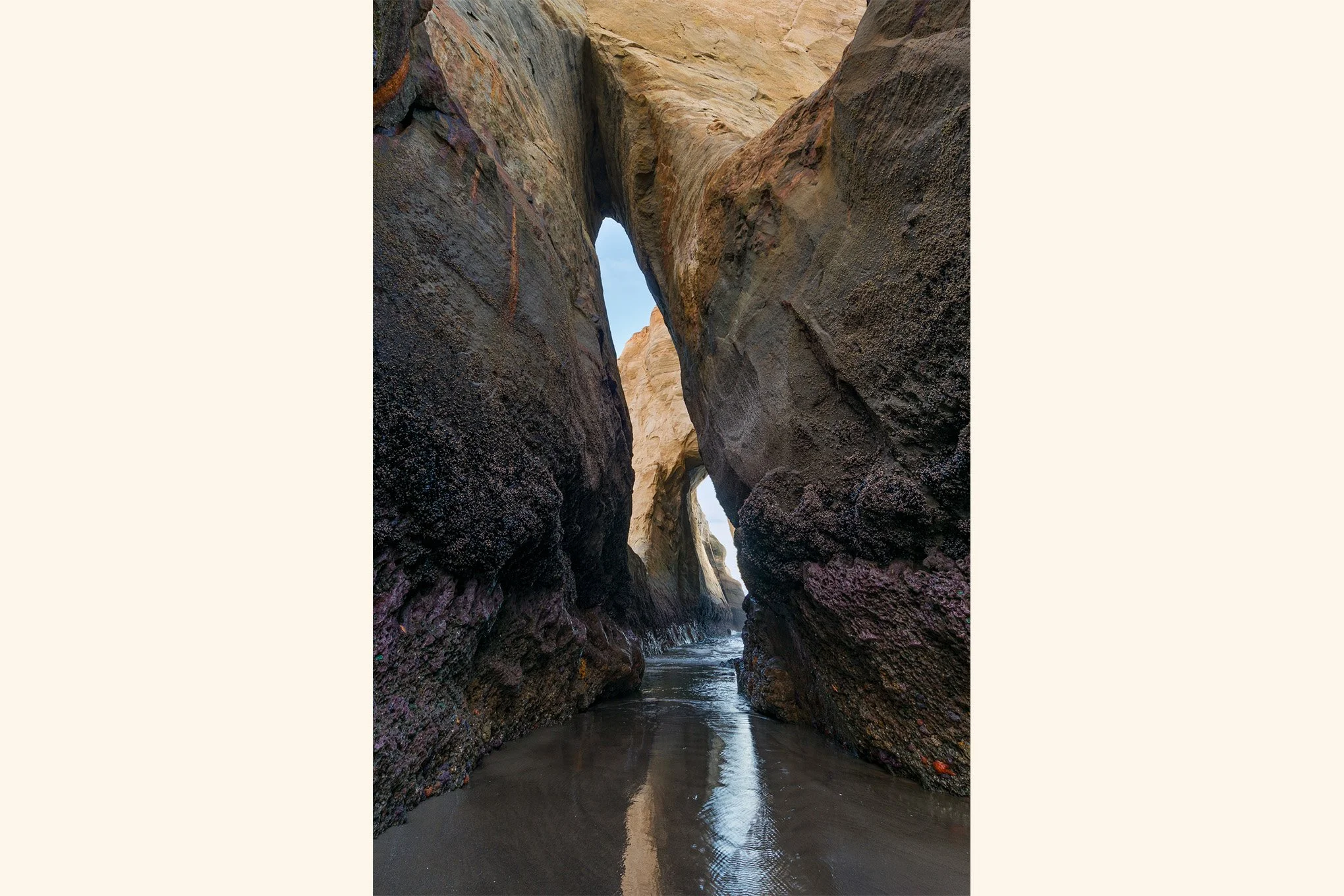
“Cathedral (2)”
Description:
Photographed during a minus tide at Cape Kiwanda in Pacific City, Oregon, this image reveals a hidden sea cave with towering sandstone walls sculpted by waves and wind. The reflective wet sand and narrow passageway showcase the raw, otherworldly beauty of the Oregon Coast’s ever-changing shoreline.
Story:
At minus tide, the ocean steps back just long enough to reveal one of Cape Kiwanda’s quietest sanctuaries. The walls rise like stone organs, their surfaces carved by centuries of wind and salt. Every sound is amplified, the hush of water, the echo of your own breath, the distant heartbeat of waves returning.
I named this photograph “Cathedral” because the feeling inside is unmistakable. Light filters through the narrow opening above like stained glass made of sky and the arches remind me of the flying buttresses of the gothic cathedrals I’ve witnessed while traveling through Europe.
It’s easy to forget this place exists most of the year, buried beneath the tide. But when the ocean recedes during the summer it leaves behind a fleeting invitation: step inside, stand in the presence of time itself, and feel how small and sacred the world can be.
-BAP
Location:
Cape Kiwanda
Pacific City, Oregon
45° 13' 17.3'' N, 123° 58' 34.9'' W
Google Map Link
Time: 06:23 PDT (sunrise 06:01)
Date: August 1st, 2019
Camera & Settings:
Single shot
Nikon D800E, NIKKOR 14-24 mm f/2.8G, Tripod
ISO 100, 14 mm, f/11, 1/6 sec

Limited Edition Fine Art Print ✨
Only 3 editions per size
Greeting Card is open edition
📥 Download FREE desktop wallpaper
🖼️ View artwork details & shipping
📸 Request a free wall preview
“Forbidden Way (BW)”
Description:
Photographed at Cape Kiwanda in Pacific City, Oregon, this rare low-tide view shows a narrow sandstone corridor carved over millennia by waves, wind, and winter storms. The exposed passage reveals the fragile, tide-shaped geology of the Cape Kiwanda State Natural Area, accessible only during the lowest ocean tides.
Story:
The incoming tide brings with it cold Pacific water that makes exploring this area nearly impossible. Only during the lowest tides, usually under a super moon, does the ocean retreat far enough to reveal the full length of this passage. Even then, the moment is brief. Before long, the tide returns and the water rises, sealing the corridor once more.
Standing down there, between walls marked by tide-worn stone and scattered marine life, I felt as if I had reached the entrance to a place that rarely reveals itself. It was a tantalizing glimpse — a reminder of how quickly access can vanish. The ocean closes the way, forbidding all would-be explorers from moving forward.
I’ve photographed this area from the cliffs above as well. You can see that perspective in “Anchor Rock.”
-BAP
Location:
Cape Kiwanda
Pacific City, Oregon
45° 13' 17.7'' N, 123° 58' 34.5'' W
Google Map Link
Time: 07:43 PDT (sunrise 06:00)
Date: July 31st, 2019
Camera & Settings:
Single shot
Nikon D800E, NIKKOR 14-24 mm f/2.8G, Tripod
ISO 100, 14 mm, f/8, 1/30 sec

📥 Download FREE desktop wallpaper
🖼️ View artwork details & shipping
📸 Request a free wall preview
“Forbidden Way”
Description:
Photographed at Cape Kiwanda in Pacific City, Oregon, this rare low-tide view shows a narrow sandstone corridor carved over millennia by waves, wind, and winter storms. The exposed passage reveals the fragile, tide-shaped geology of the Cape Kiwanda State Natural Area, accessible only during the lowest ocean tides.
Story:
The incoming tide brings with it cold Pacific water that makes exploring this area nearly impossible. Only during the lowest tides, usually under a super moon, does the ocean retreat far enough to reveal the full length of this passage. Even then, the moment is brief. Before long, the tide returns and the water rises, sealing the corridor once more.
Standing down there, between walls marked by tide-worn stone and scattered marine life, I felt as if I had reached the entrance to a place that rarely reveals itself. It was a tantalizing glimpse — a reminder of how quickly access can vanish. The ocean closes the way, forbidding all would-be explorers from moving forward.
I’ve photographed this area from the cliffs above as well. You can see that perspective in “Anchor Rock.”
-BAP
Location:
Cape Kiwanda
Pacific City, Oregon
45° 13' 17.7'' N, 123° 58' 34.5'' W
Google Map Link
Time: 07:43 PDT (sunrise 06:00)
Date: July 31st, 2019
Camera & Settings:
Single shot
Nikon D800E, NIKKOR 14-24 mm f/2.8G, Tripod
ISO 100, 14 mm, f/8, 1/30 sec
📥 Download FREE desktop wallpaper
🖼️ View artwork details & shipping
📸 Request a free wall preview
“Fractured Coast”
Description:
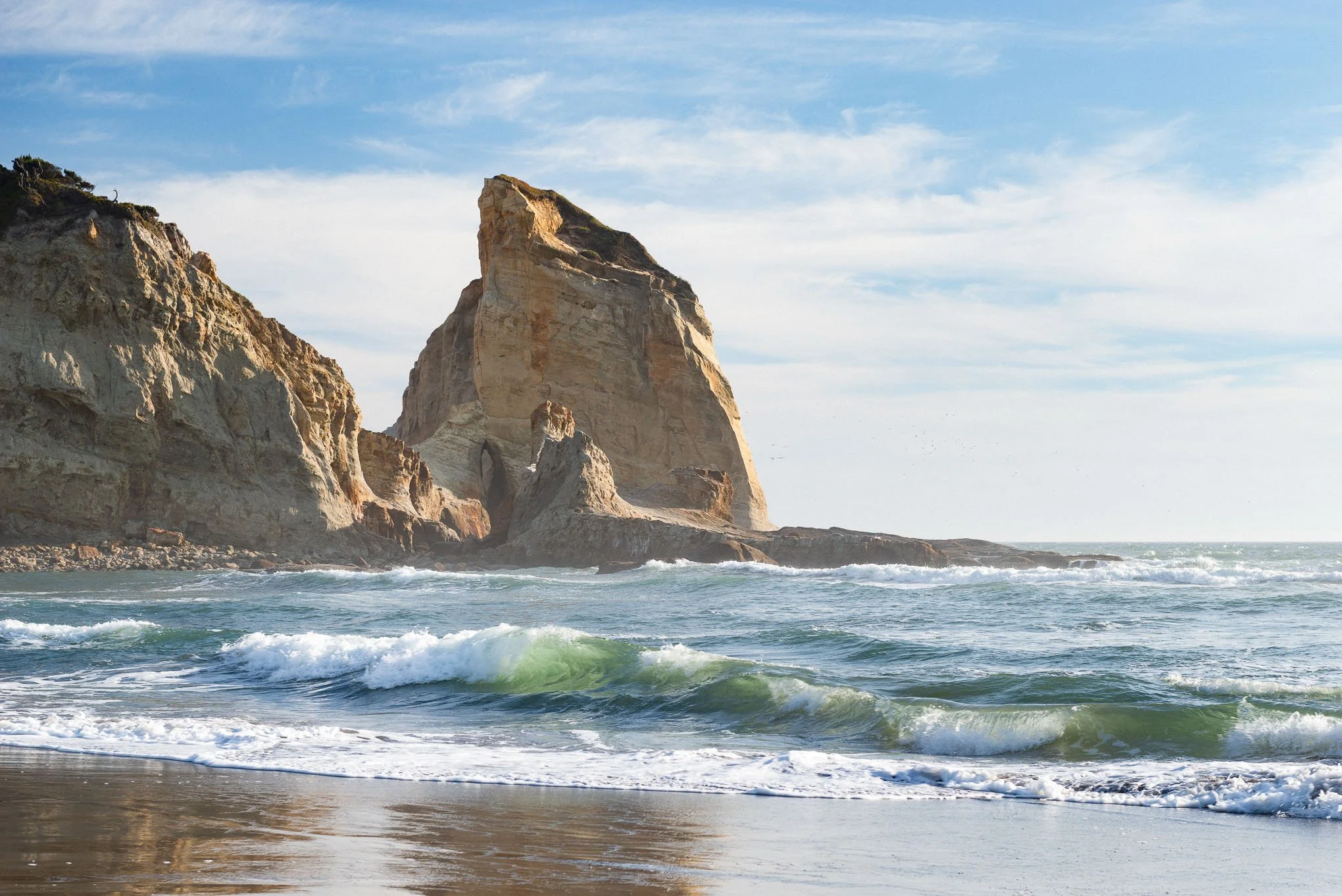
McPhillips Beach, the quieter stretch of shoreline at Cape Kiwanda, features sandstone cliffs shaped by constant erosion along Oregon’s northern coast. This summer image looks toward Anchor Rock and the cape’s weathered formations as waves break across the broad, drive-on beach just north of Pacific City and south of Tierra Del Mar.
Story:
Light from the afternoon sun backlights the ocean, turning the water a vivid green while the weathered sandstone cliffs of Cape Kiwanda rise in the distance.
This lesser-visited side of the cape has a beauty all its own.
Photographed in summer, when the sun sits higher and farther north, the light traced the edges of the sandstone in a way that made every curve feel sculpted by hand. Each wave rolling in seemed to glow from within, flashing an iridescent green the moment the sunlight met its crest.
With the timing just right, I caught a breaking wave whose arc mirrored the curve of the sandstone behind it — two forces echoing each other for only a heartbeat.
This photograph is one of several that feature the sandstone monolith I call Anchor Rock. You can see more of it in “Anchor Rock,” “Forbidden Way”, “Cathedral”, and “Breaking Rocks”.
-BAP
Location:
McPhillips Beach
Cape Kiwanda
Pacific City, Oregon
45° 13' 25.5" N, 123° 58' 25" W
Google Map Link
Time: 19:16 PDT
Date: June 11th, 2019
Camera & Settings:
Single shot
Nikon D800E, NIKKOR 24-70 mm f/2.8G, CPL filter, Tripod
ISO 100, 70 mm, f/8, 1/125 sec
Limited Edition Fine Art Print ✨
Only 3 editions per size
Greeting Card is open edition
📥 Download FREE desktop wallpaper
🖼️ View artwork details & shipping
📸 Request a free wall preview
“Crescendo (1) (BW)”
Description:
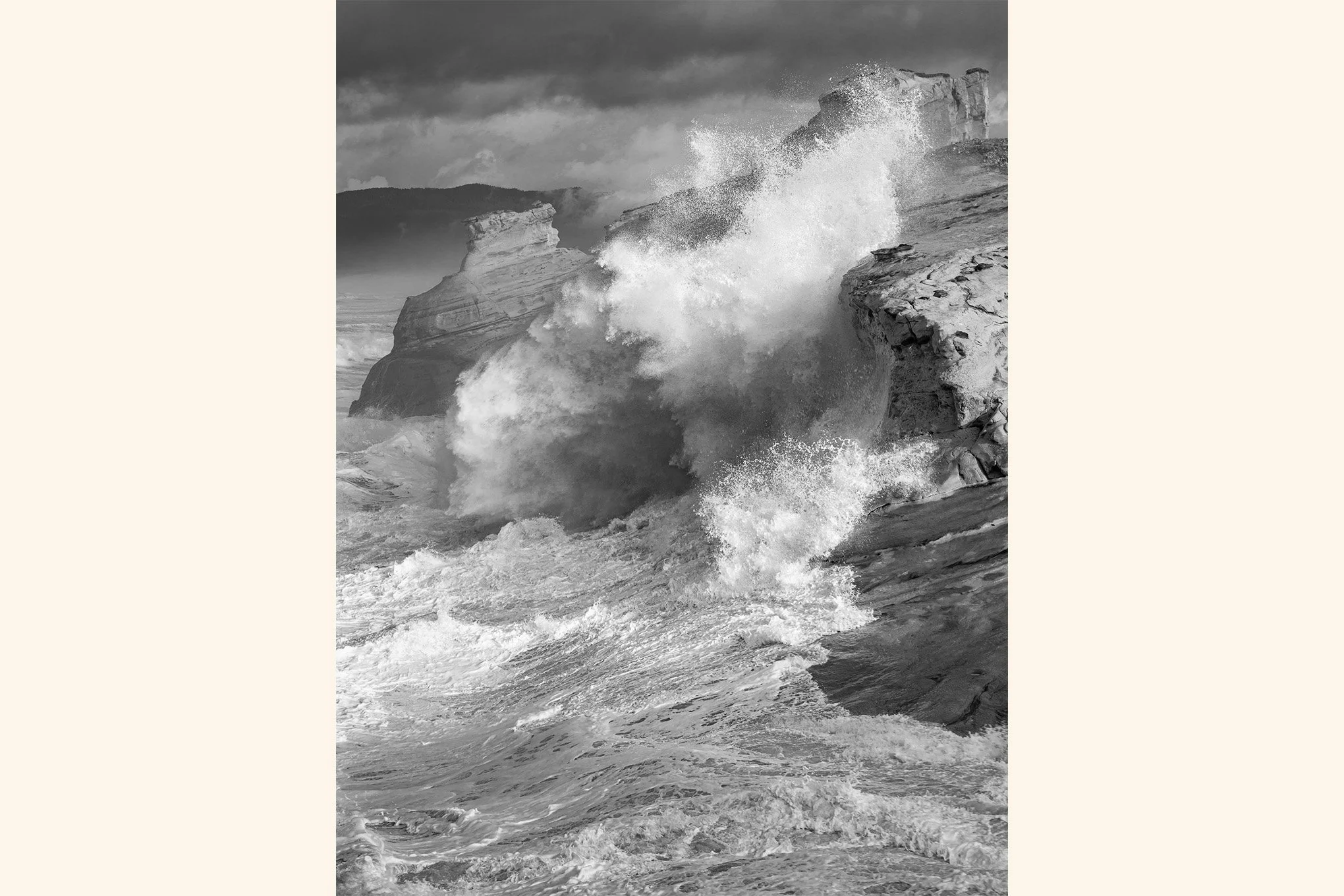
Cape Kiwanda’s sandstone cliffs take a direct hit from winter surf along the Oregon Coast. Formed from roughly 18-million-year-old sandstone sculpted by wind and waves, this Pacific City headland is part of the Three Capes Scenic Route and known for powerful storm seas.
Story:
A large swell smashes against the sandstone cliffs of Cape Kiwanda during a storm on a November morning.
The ocean rolled like thunder as it barreled toward the cliffs, where each swell burst upward in a spray of white water. Temporary waterfalls formed as the water receded. Birds scattered from the impact. Spectators gathered along the overlook to witness the ocean at full power.
I had come here specifically to see the forces of water meet sandstone — the browns and oranges of the cape contrasting beautifully with the gray-green Pacific. Not every swell produced a dramatic burst, so patience was required to capture the right moment.
As the storm passed, the light began to shift. When I first arrived, the sky was overcast and the distant coast range was hidden in fog. As the clouds thinned, reflected light turned the rain-darkened sandstone a bronze glow. Only later, when a brief shaft of sunlight broke through the clouds, did the scene align for this photograph.
Inspired by what I witnessed, I wrote the following:
Roaring swell,
Crashing spray,
Ocean crush,
Punch.
Sandstone breaking,
Battered coast,
Crescendo.
-BAP
Location:
Cape Kiwanda
Pacific City, Oregon
45° 13' 4.4'' N, 123° 58' 42.7'' W
Google Map Link
Time: 09:56 PST (morning)
Date: November 25th, 2020
Camera & Settings:
Single shot
Nikon D800E, NIKKOR 70-200 mm f/4G, Tripod
ISO 100, 102 mm, f/9, 1/125 sec
📥 Download FREE desktop wallpaper
🖼️ View artwork details & shipping
📸 Request a free wall preview
“Crescendo (1)”
Description:
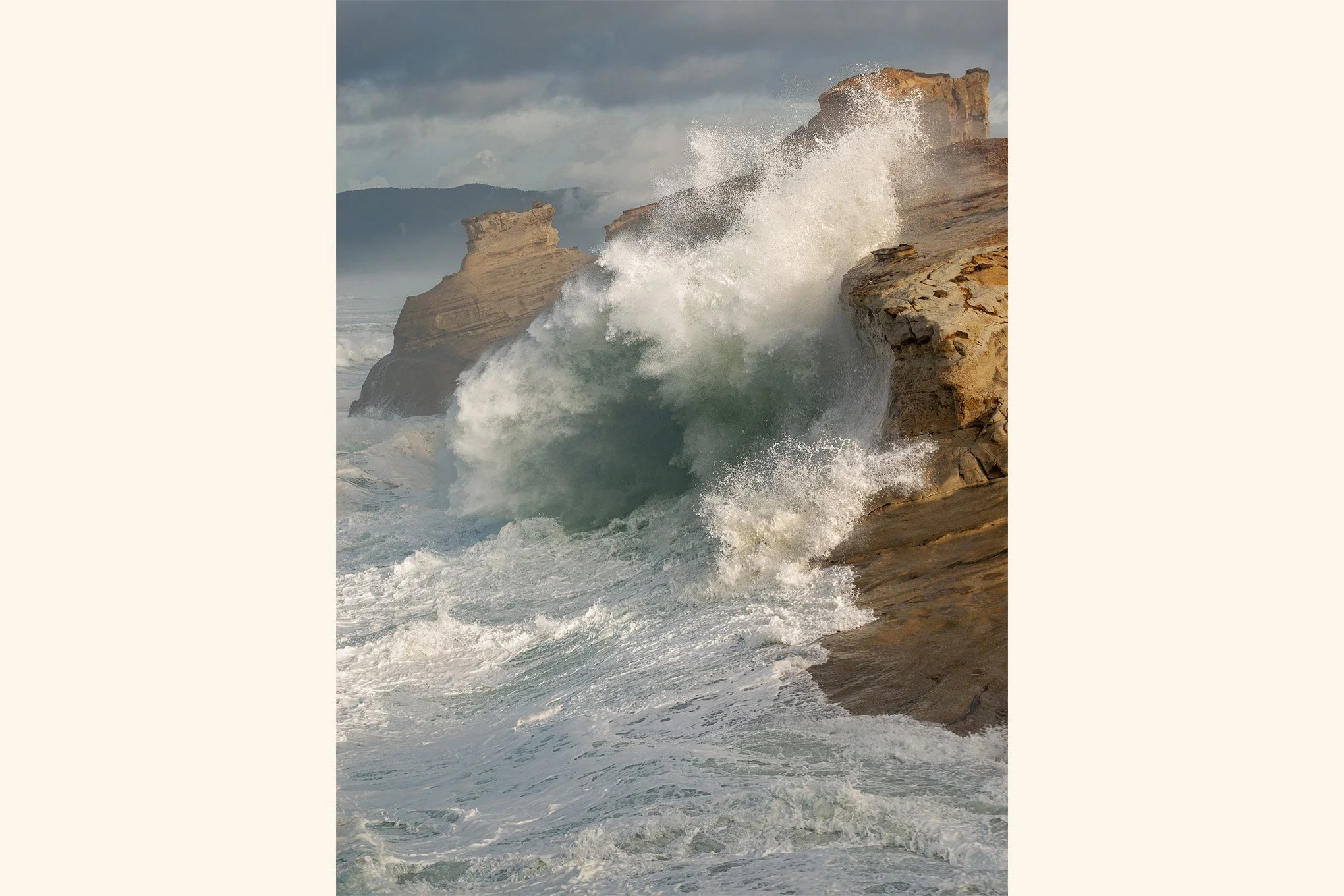
Cape Kiwanda’s sandstone cliffs take a direct hit from winter surf along the Oregon Coast. Formed from roughly 18-million-year-old sandstone sculpted by wind and waves, this Pacific City headland is part of the Three Capes Scenic Route and known for powerful storm seas.
Story:
A large swell smashes against the sandstone cliffs of Cape Kiwanda during a storm on a November morning.
The ocean rolled like thunder as it barreled toward the cliffs, where each swell burst upward in a spray of white water. Temporary waterfalls formed as the water receded. Birds scattered from the impact. Spectators gathered along the overlook to witness the ocean at full power.
I had come here specifically to see the forces of water meet sandstone — the browns and oranges of the cape contrasting beautifully with the gray-green Pacific. Not every swell produced a dramatic burst, so patience was required to capture the right moment.
As the storm passed, the light began to shift. When I first arrived, the sky was overcast and the distant coast range was hidden in fog. As the clouds thinned, reflected light turned the rain-darkened sandstone a bronze glow. Only later, when a brief shaft of sunlight broke through the clouds, did the scene align for this photograph.
Inspired by what I witnessed, I wrote the following:
Roaring swell,
Crashing spray,
Ocean crush,
Punch.
Sandstone breaking,
Battered coast,
Crescendo.
-BAP
Location:
Cape Kiwanda
Pacific City, Oregon
45° 13' 4.4'' N, 123° 58' 42.7'' W
Google Map Link
Time: 09:56 PST (morning)
Date: November 25th, 2020
Camera & Settings:
Single shot
Nikon D800E, NIKKOR 70-200 mm f/4G, Tripod
ISO 100, 102 mm, f/9, 1/125 sec

📥 Download FREE desktop wallpaper
🖼️ View artwork details & shipping
📸 Request a free wall preview
“Breaking Rocks”
Description:
At Cape Kiwanda, powerful surf rushes into a sandstone corridor carved by constant wave action. The cliffs here are part of Oregon’s soft, ever-changing coastline where arches collapse, boulders shift, and the Pacific continues its slow, relentless reshaping of the land.
Story:
The Pacific Ocean crashes against the sandstone along the northwestern edge of Cape Kiwanda. These rocks have been shaped, worn, and weakened by the tides for centuries. Their destiny is written in the water. What was once a sandstone arch now lies scattered as boulders, and someday even those will break down into grains of sand.
During low tide, the ocean sometimes retreats so far that it disappears from view. It was on a tide like that when I photographed “Forbidden Way” and “Cathedral (2)”. But in this photograph, the timing was entirely different. I waited for the moment when the sun would pass directly overhead this narrow channel — a brief alignment that only happens near the summer solstice.
For one instant, light poured straight down into the corridor, illuminating the restless water and the fractured stones that shapes it.
-BAP
Location:
McPhillips Beach
Cape Kiwanda
Pacific City, Oregon
45° 13' 19.2'' N, 123° 58' 32.4'' W
Google Map Link
Time: 15:38 PDT
Date: June 12th, 2019
Camera & Settings:
Single shot
Nikon D800E, NIKKOR 14-24 mm f/2.8G, Tripod
ISO 100, 21 mm, f/11, 1/200 sec

📥 Download FREE desktop wallpaper
🖼️ View artwork details & shipping
📸 Request a free wall preview
“Passing Storm”
Description:
Winter clouds sweep over Pacific City on the Oregon Coast, where Cape Kiwanda and the Nestucca River Estuary meet a wide stretch of beach. This area is known for powerful Pacific storms, fast-changing light, and dramatic coastal weather. It sits within the traditional lands of the Nestucca and Tillamook people.
Story:
A passing winter storm at Pacific City stirred the ocean into motion, dusted the foothills with snow, and transformed the sky into a shifting sea of clouds. Along the Oregon Coast, storms are unpredictable; they can just as easily bring hazards as they can bring extraordinary beauty. Staying home is always the safest choice, yet storms have a way of offering moments you’d never witness otherwise.
On this evening I wasn’t in danger, only aware that the atmosphere was in one of its rare, dramatic moods. Light broke through in scattered gold, clouds rolled like waves over the hills, and the landscape felt newly revealed.
Clouds like waves; sun like gold. The storm passed, and this was the quiet it left behind.
Photographed the same day as Kiwanda Storm.
-BAP
Location:
Pacific City, Oregon
45° 12' 56.3'' N, 123° 58' 21.3'' W
Google Map Link
Time: 17:13 PST (sunset 17:35)
Date: February 9th, 2019
Camera & Settings:
Single shot
Nikon D800E, Tokina 100 mm f/2.8, Tripod
ISO 100, 100 mm, f/9, 1/80 sec

📥 Download FREE desktop wallpaper
🖼️ View artwork details & shipping
📸 Request a free wall preview
“Throne”
Summary:
This Cape Kiwanda photograph captures a pigeon guillemot resting against the sunlit sandstone cliffs of Pacific City, Oregon. The black seabird’s nesting nook contrasts with the warm coastal rock textures, highlighting the wildlife and natural geology of the Oregon Coast.
Story:
This fearless bird was nesting just ten feet above the ground during low tide. You can’t see it in the frame, but two feet below the bird — just beyond the bottom edge of the photograph — young couples have carved their initials into the sandstone, love notes etched into semi-permanence.
I used a telephoto lens and kept my distance so I wouldn’t disturb the bird. Pigeon guillemots rarely nest on the sandstone cliffs of Cape Kiwanda, which made this a solitary outpost. It felt as if the bird had claimed the entire headland for itself — a private fiefdom overlooking the Pacific, where visitors like me are only granted access when the tide lowers at God’s discretion.
-BAP
Location:
Cape Kiwanda
Pacific City, Oregon
45° 13' 3.9'' N, 123° 58' 35.1'' W
Google Map Link
Time: 07:29 PDT (sunrise 05:57)
Date: June 29th, 2019
Camera & Settings:
Single shot
Nikon D800E, NIKKOR 70-200 mm f/4G, CPL filter, Tripod
ISO 100, 200 mm, f/6.3, 1/250 sec
📥 Download FREE desktop wallpaper
🖼️ View artwork details & shipping
📸 Request a free wall preview
“Radiant Rock”
Description:
Haystack Rock (Chief Kiawanda Rock) near Pacific City, Oregon is shown at sunset, silhouetted against a gradient sky. This sea stack, part of the Nestucca Formation, is a prominent landmark along the northern Oregon Coast. The photograph highlights the rock’s basalt structure and its position along the shoreline of Tierra Del Mar.
Story:
Haystack Rock off the coast of Pacific City rises as an angular black shape against a tapestry of color in this minimalist photograph made at sunset on a clear, cool, and calm evening.
In silhouette, Haystack Rock becomes a solid dark form that seems to project upward with tremendous force. The colors around it carry that sense of power. The orange and red glow of sunset slowly fades to a pale sky blue near the top of the frame, giving the rock an almost mystical presence.
To me the rock feels like a symbol of natural strength, even something supernatural. From what I understand, the Indigenous people of this area were the Kiwanda or Kiawanda Indians, and the basalt formation was known to them as Chief Kiawanda. It is easy to imagine they might have seen a similar sunset and felt the same sense of awe.
-BAP
Location:
Sandlake Road
Tierra Del Mar, Oregon
45° 14' 23.8'' N, 123° 58' 9.9'' W
Google Map Link
Time: 16:46 PST (sunset 16:41)
Date: November 20th, 2019
Camera & Settings:
Single shot
Nikon D800E, NIKKOR 70-200 mm f/4G, Tripod
ISO 100, 180 mm, f/10, 5 sec