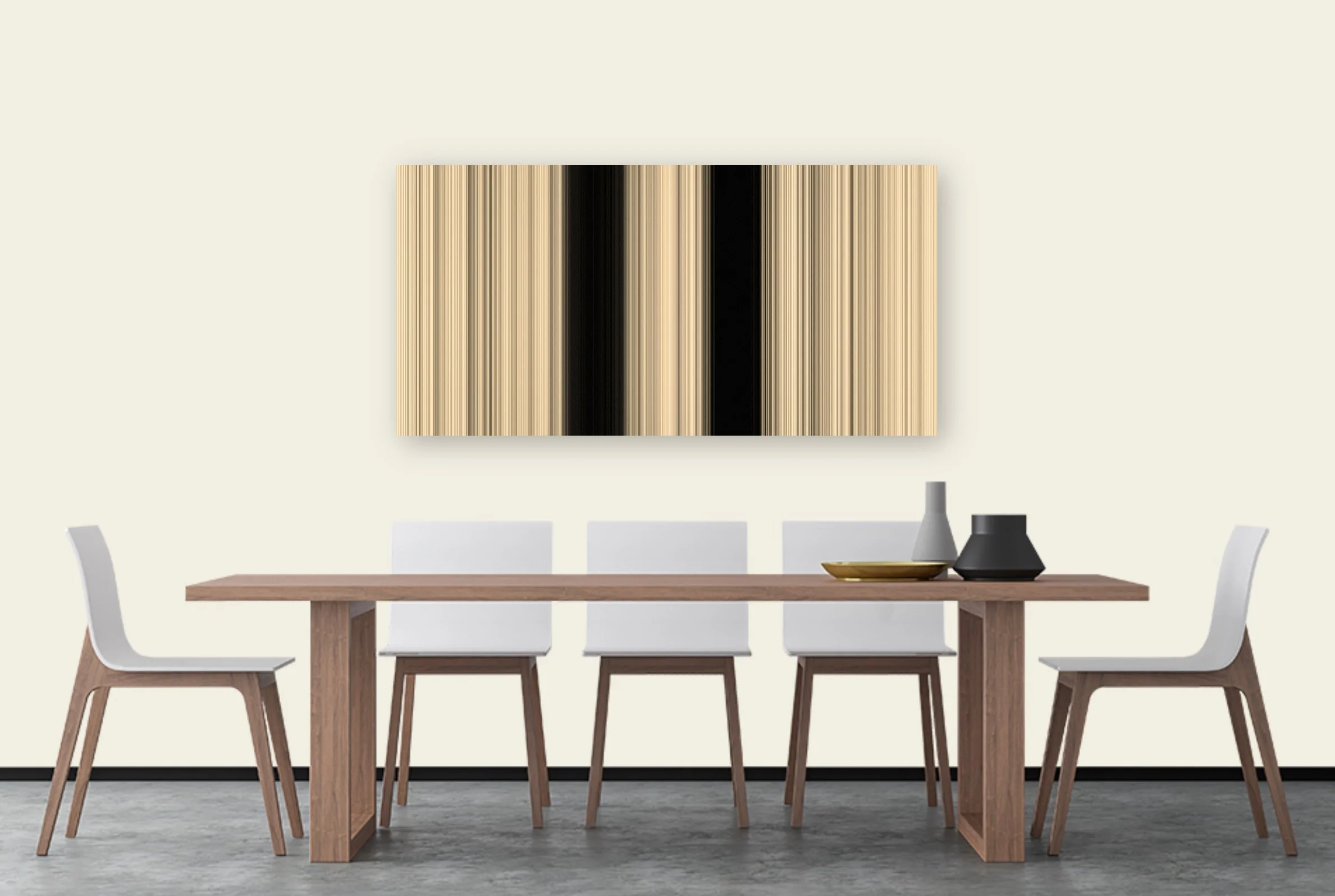
BAPstract Story
Every BAPstract begins with a moment – sunlight meeting water, memory meeting time.
Discover the BAPstract story: See how they began, what they express, and why they continue to grow.
BAPstracts
Brendan Alex Phoenix abstracts
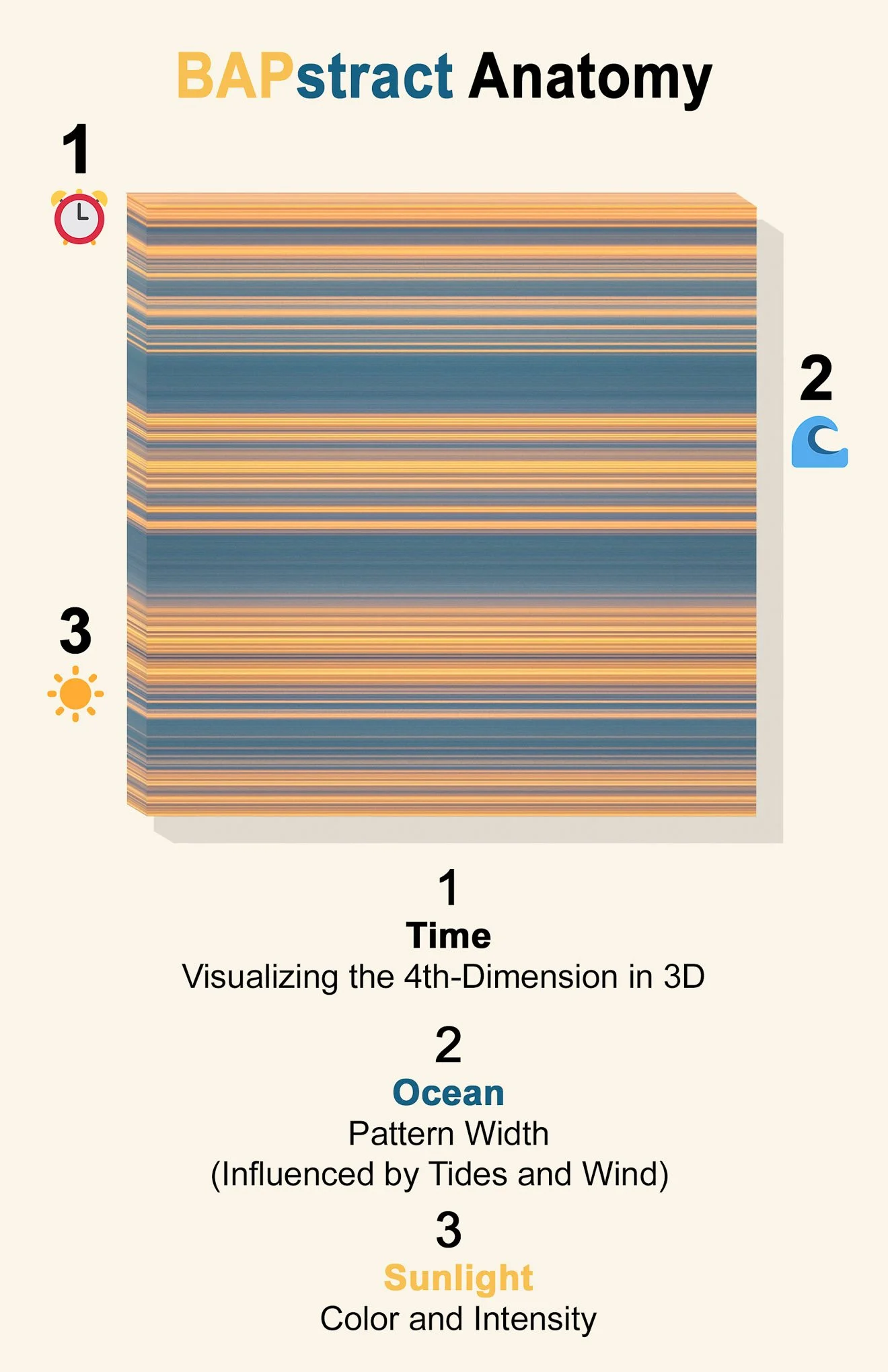
⏰Time 🌊Ocean ☀️Sunlight
“A slice of reality that is always present but never seen, only felt.”
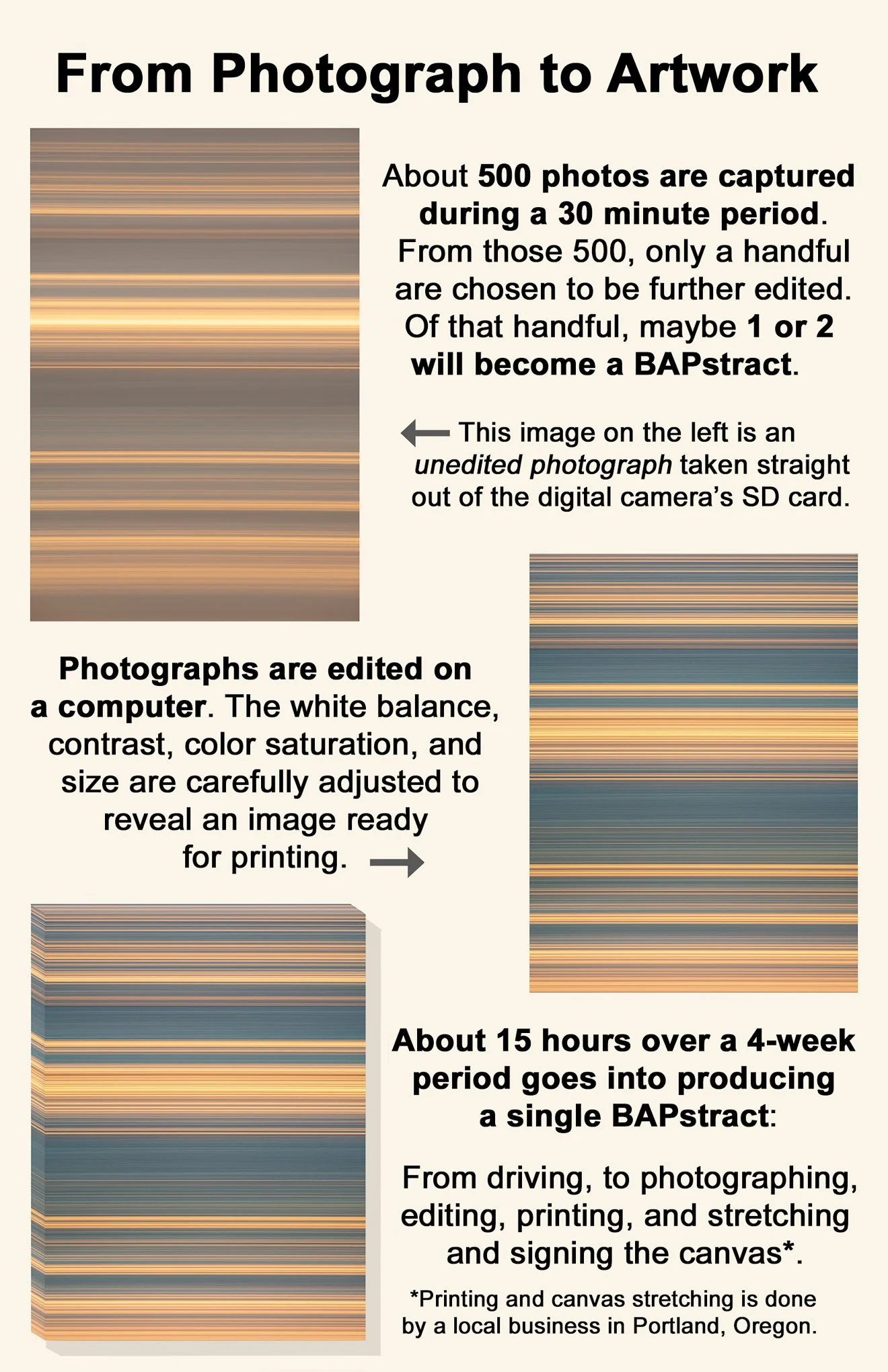
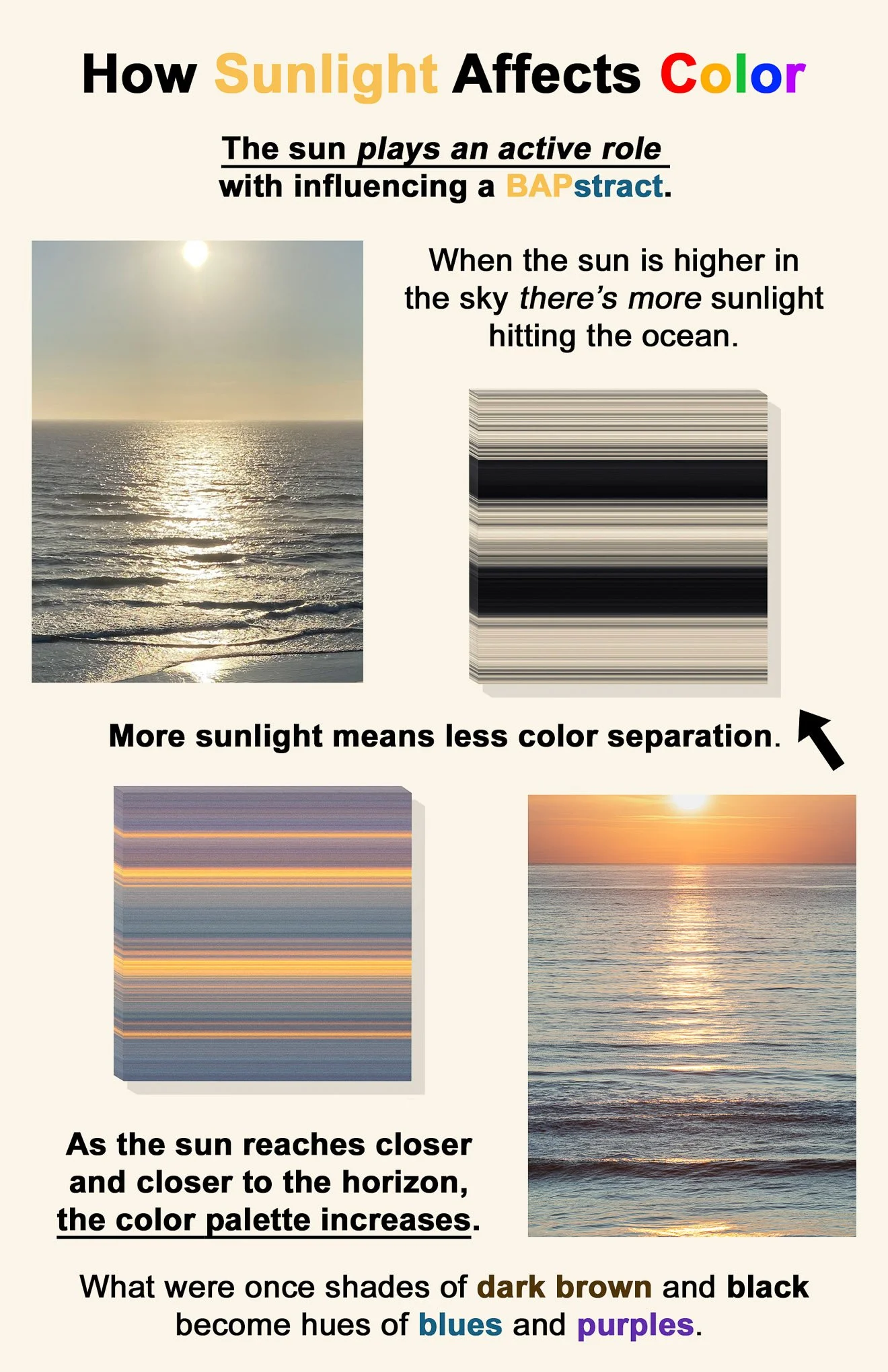

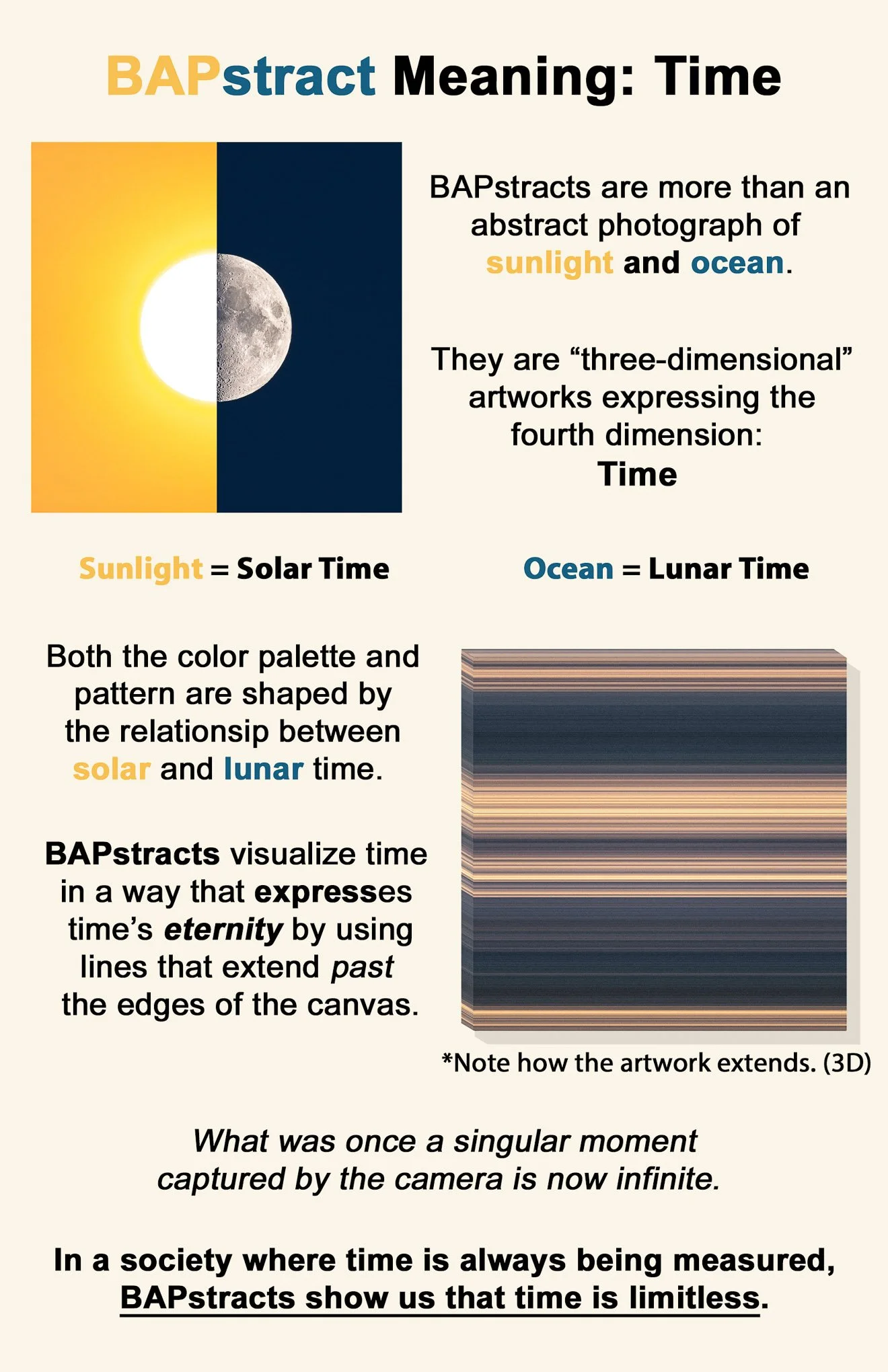
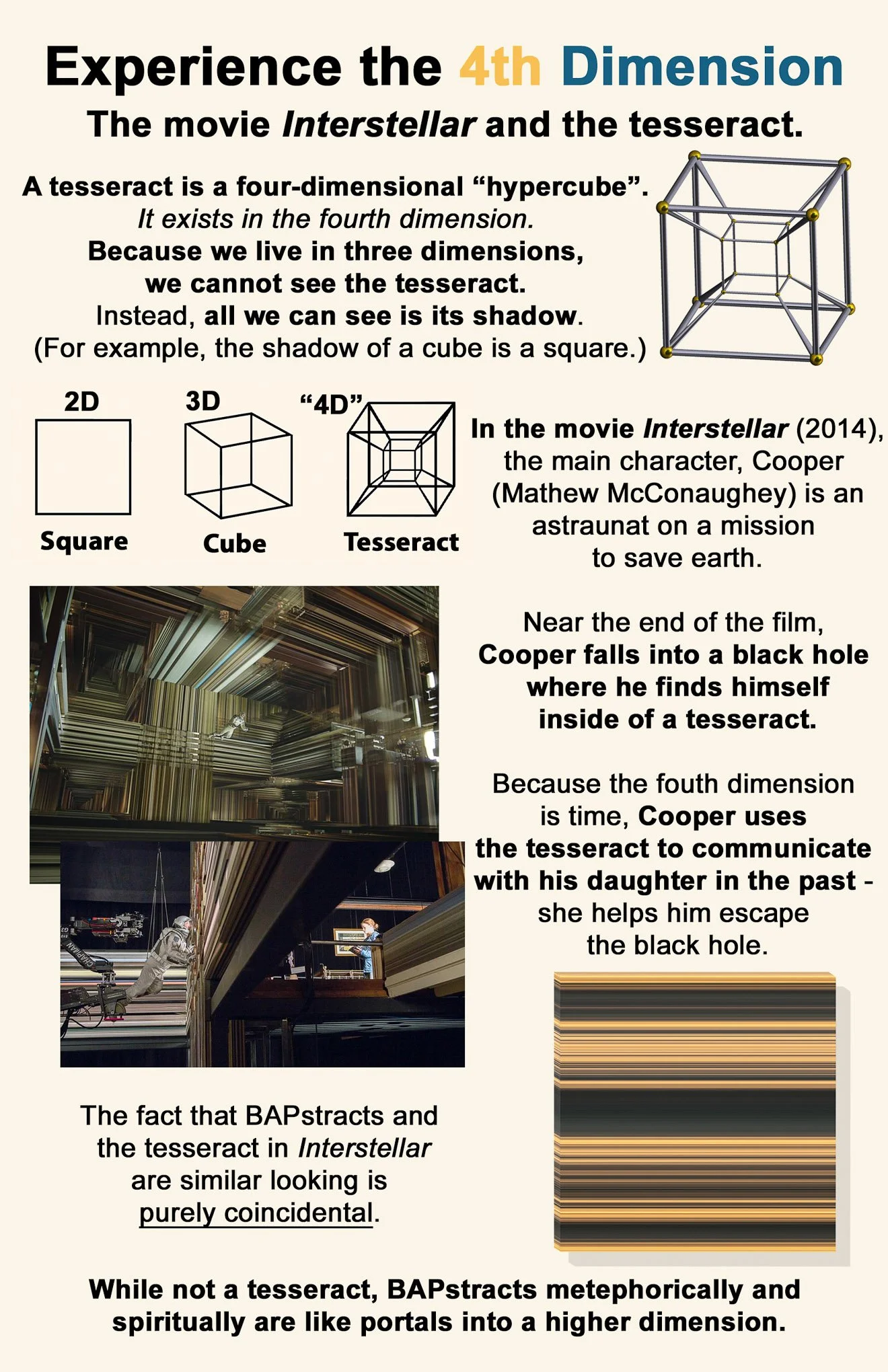
BAPstract Meaning — Time
BAPstracts are artworks about time itself, not just images of nature.
They visualize time by bringing together solar and lunar rhythms.
At a glance, these patterns may read as a tapestry of color. They can feel decorative and may even appear to echo the tones of a room or the furniture around them. But prolonged gazes gives us a chance to partake in a spirit of quiet reflection.
Instead of trying to force ourselves to see BAPstracts as traditional photography, the abstract pattern asks us to notice color and basic patterns over recognizable shapes and figures.
This gives our minds an opportunity to step back from associating meaning with place and instead experience the visual energy produced by shape and form.
What first appears static begins to feel active and alive.
What begins as photography becomes an expression of time as infinite.
The lines found in BAPstracts form a variable pattern of dark and light formed from how the sunlight interacts with the waves. This interaction creates an optical experience that appears to vibrate with energy.
That sense of movement is not literal motion, but perceptual motion. It emerges from contrast, repetition, and subtle variation across the surface of the artwork.
Each BAPstract produces its own unique energy:
Patterns that contain more sunlight have a higher energy.
Horizontal lines are calmer than diagonals.
Diamond shapes focus energy.
Lines that vary in length add motion.
The overall energy of the BAPstracts is one that is positive and uplifting.
In a society that constantly tracks time,
BAPstracts allow us to lose it.
BAPstract Meaning — Energy
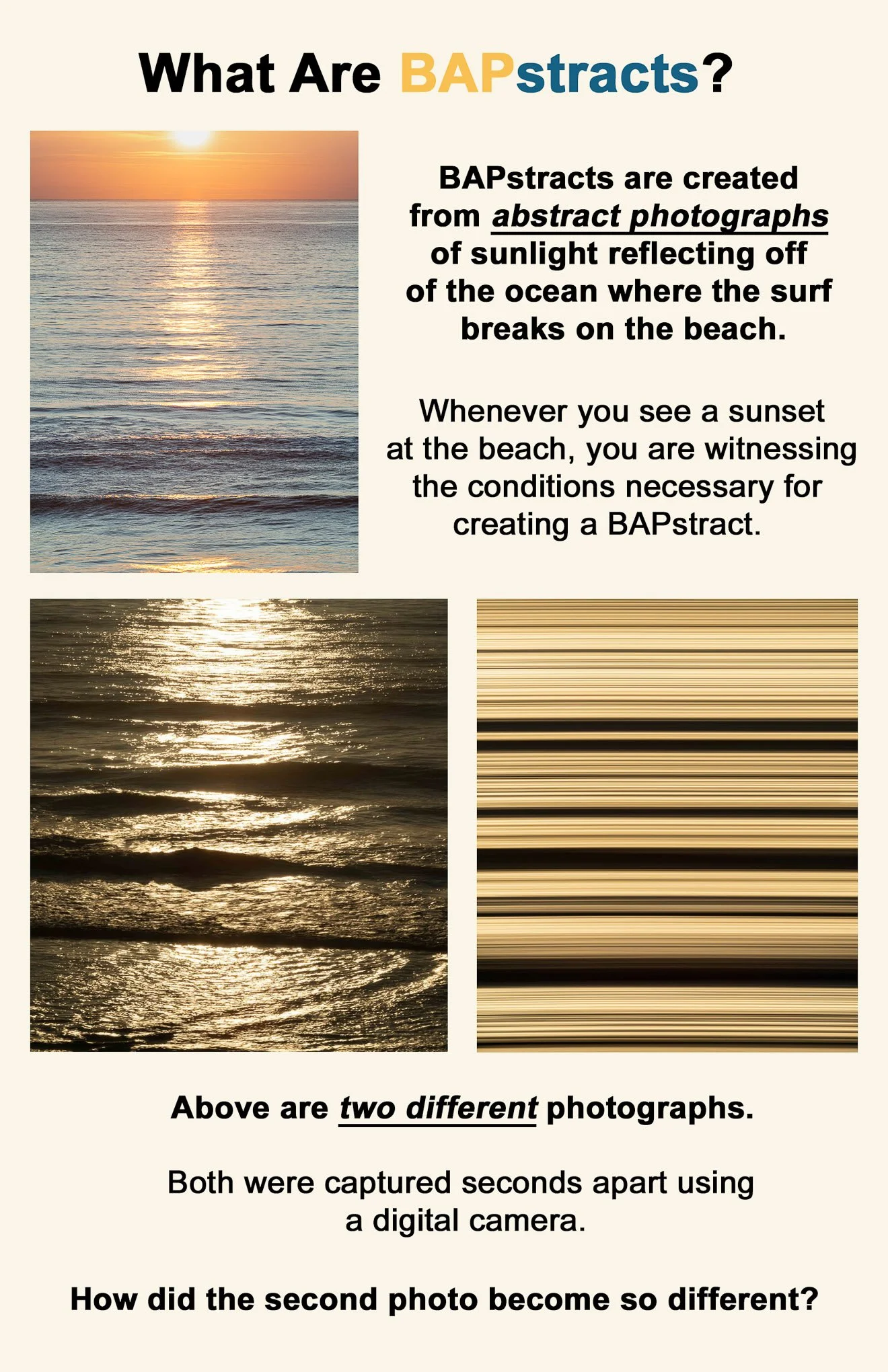
BAPstracts remove the literal image and replace it with visual energy.
Ocean waves and sunlight become high-fidelity patterns.
At a glance, these patterns may read as a tapestry of color. They can feel decorative and may even appear to echo the tones of a room or the furniture around them. But prolonged gazes gives us a chance to partake in a spirit of quiet reflection.
Instead of trying to force ourselves to see BAPstracts as traditional photography, the abstract pattern asks us to notice color and basic patterns over recognizable shapes and figures.
This gives our minds an opportunity to step back from associating meaning with place and instead experience the visual energy produced by shape and form.
What first appears static begins to feel active and alive.
The richness and depth of BAPstracts become more apparent the longer we engage with them.
The lines found in BAPstracts form a variable pattern of dark and light formed from how the sunlight interacts with the waves. This interaction creates an optical experience that appears to vibrate with energy.
That sense of movement is not literal motion, but perceptual motion. It emerges from contrast, repetition, and subtle variation across the surface of the artwork.
Each BAPstract produces its own unique energy:
Patterns that contain more sunlight have a higher energy.
Horizontal lines are calmer than diagonals.
Diamond shapes focus energy.
Lines that vary in length add motion.
The overall energy of the BAPstracts is one that is positive and uplifting.
In a society that is constantly in motion,
BAPstracts invite us to pause, reflect, and recharge.
BAPstract Meaning — Limits
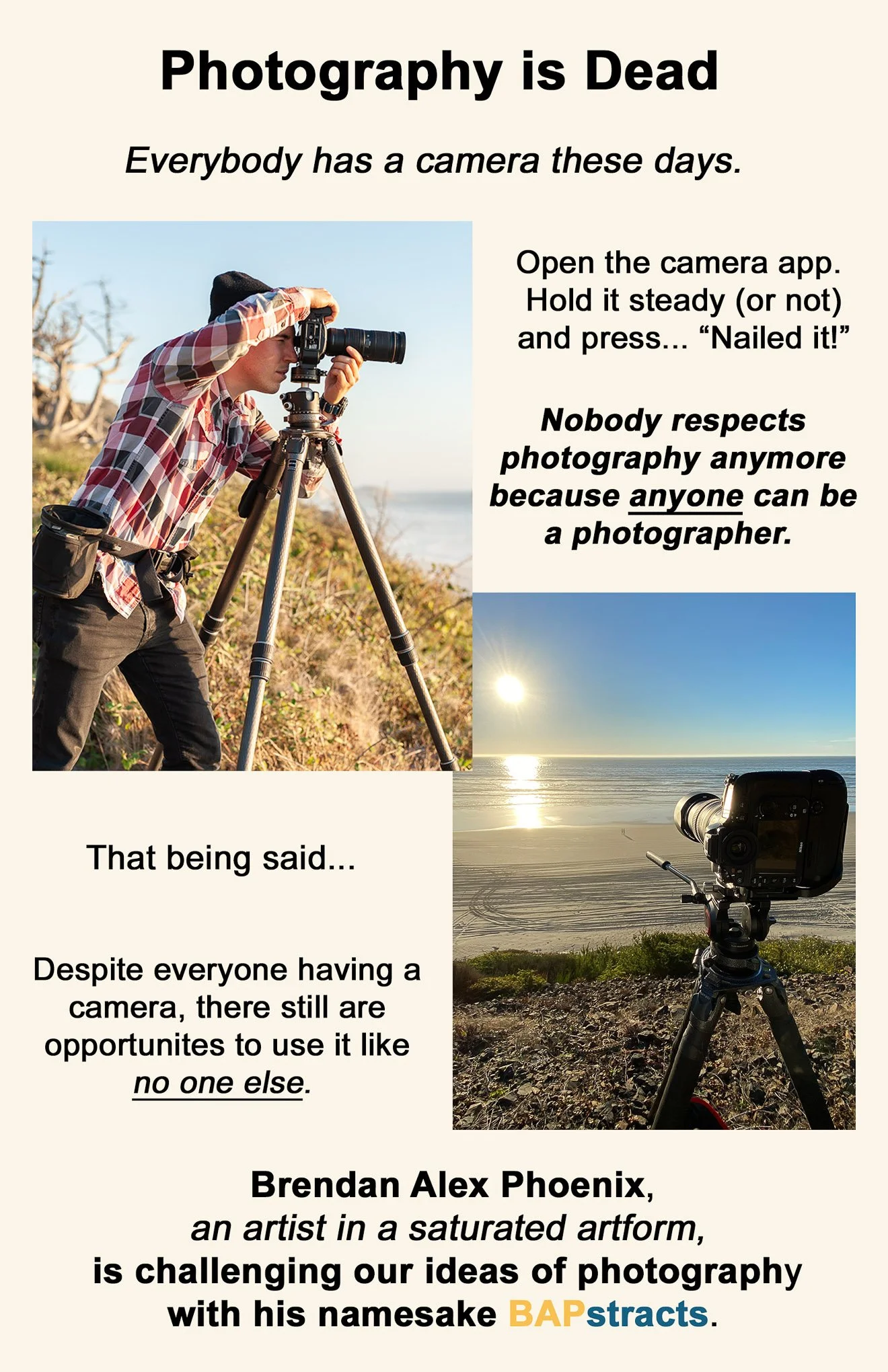
BAPstracts take our understanding of photography and turn it upside down.
Photography is no longer simply an extension of our eyes.
In a society where nearly everyone carries a camera and almost everything has already been photographed, new opportunities emerge. These opportunities do not come from repeating what we see, but from using photography in ways few others do.
Just as the invention of photography in the nineteenth century transformed how we paint, today’s tools are changing how we photograph. Digital cameras, artificial intelligence, and social media have expanded the medium beyond documentation alone.
Instead of only capturing what the eye can see, photographers are free to explore what cannot be seen directly.
We can express the abstract.
How we view photographs is subject to new interpretations.
Traditional thinking limits photography to flat, two-dimensional surfaces. These include digital screens, paper, aluminum, acrylic, and the front surface of a canvas.
Photographs, like paintings, are typically meant to be viewed straight on. The viewer stands square to the artwork. There is only one intended angle.
BAPstracts are not confined to this tradition:
They are three-dimensional photographic artworks that can be experienced from multiple angles and under changing light.
They do not exist strictly as photographs, nor do they exist as paintings.
They occupy a space between the two.
There is nothing else quite like a BAPstract.
In a society that conditions us to conform,
BAPstracts help us imagine new possibilities.
Similar Artists
The following artists share conceptual and formal qualities that resonate with BAPstracts. Each pursued abstraction not as decoration, but as a way to express universal structure, presence, and meaning beyond representation.
Piet Mondrian (1872–1944)
Mondrian sought to reduce the visible world to its essential relationships in order to reveal a universal order beneath appearances. By eliminating subject matter, place, and narrative, his work emphasized balance, structure, and connection over depiction. This pursuit of universality through reduction parallels how BAPstracts remove context to engage time, light, and structure directly.
Barnett Newman (1905–1970)
Newman approached art as a philosophical activity rather than an expressive one. Through scale, simplicity, and presence, his work aimed to create direct encounters instead of images to interpret. His writings and sculptures extended this thinking beyond the canvas, reinforcing the idea that art can function as a form of knowledge. This seriousness about meaning over style aligns with BAPstracts as a concept-driven body of work.
Mark Rothko (1903–1970)
Rothko demonstrated how abstraction can carry profound emotional and spiritual weight without relying on narrative or symbolism. Through color, scale, and immersion, his paintings create spaces for contemplation rather than explanation. This understanding of abstraction as an experiential encounter informs how BAPstracts function not merely as images, but as moments of presence shaped by time and connection.
BAPstract Future?
BAPstracts — From Accident to Artform
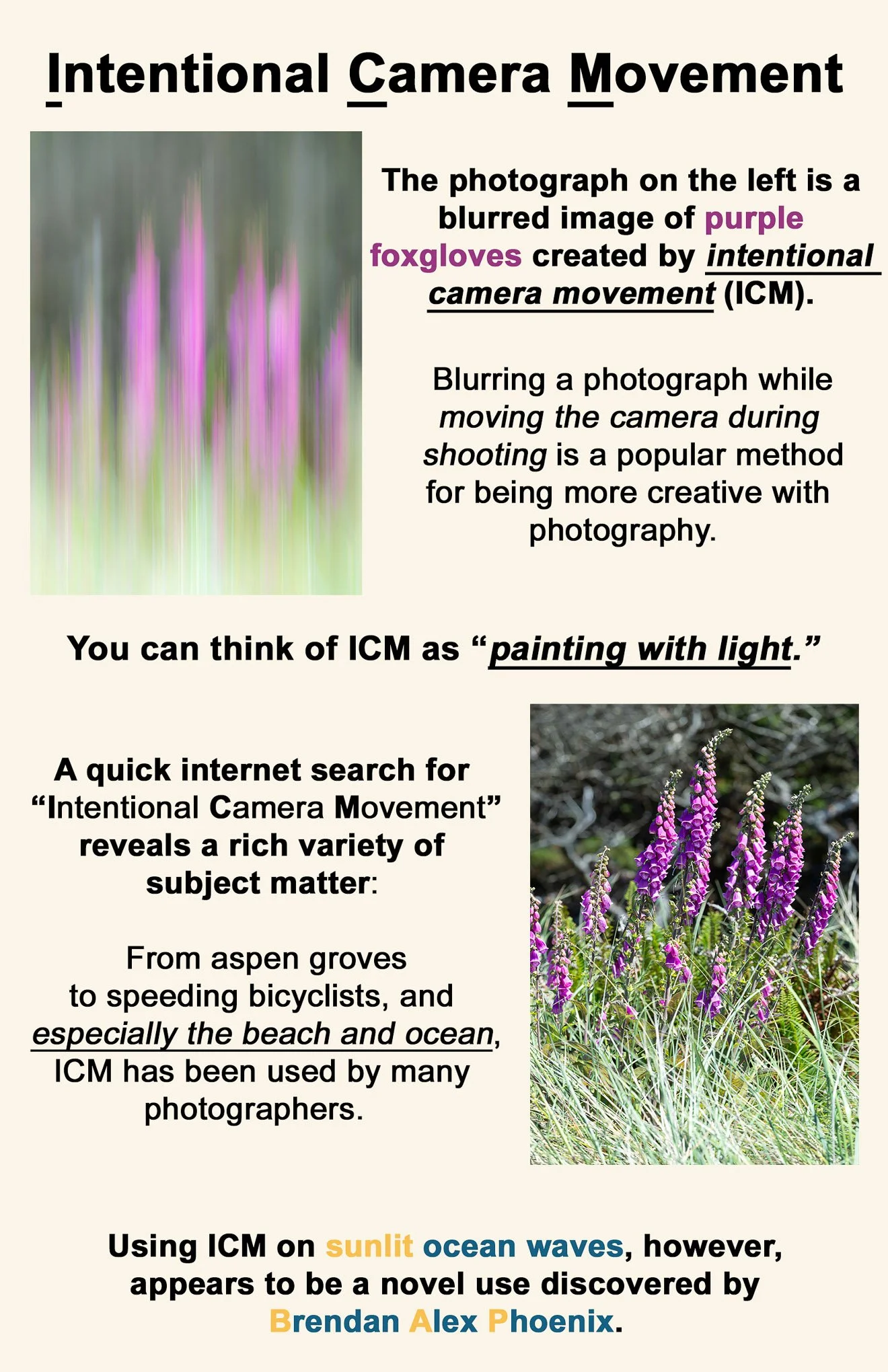
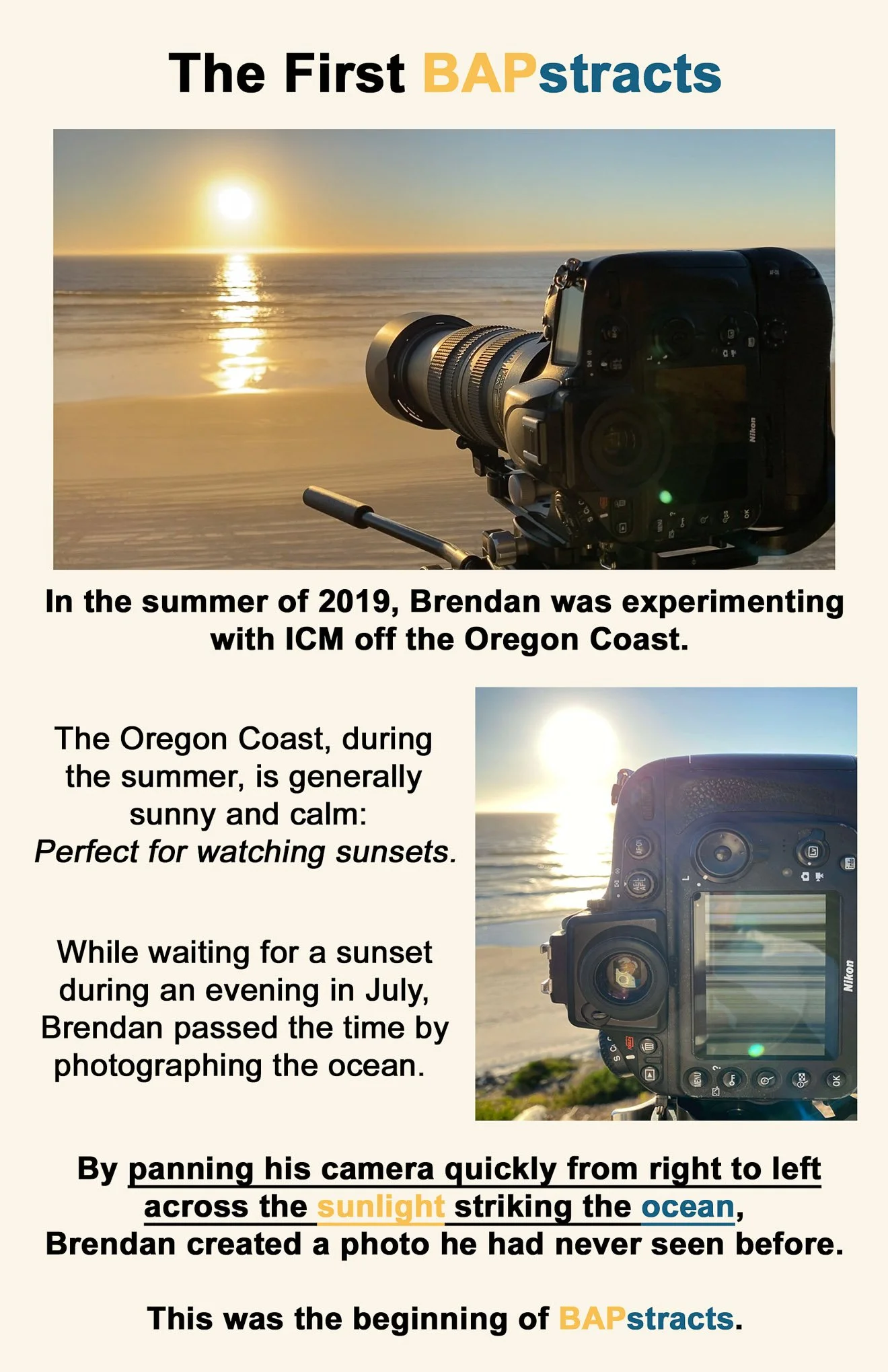
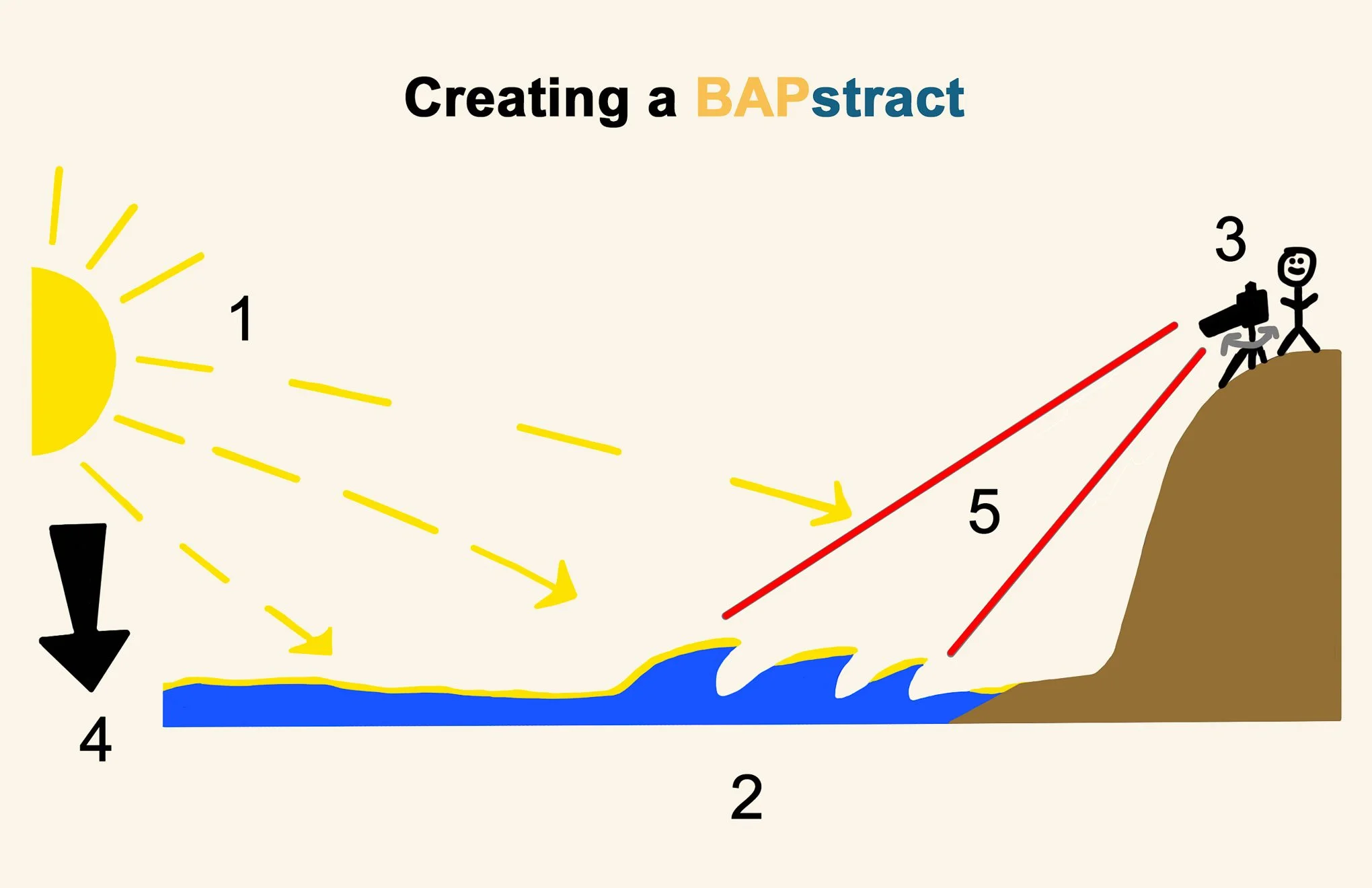
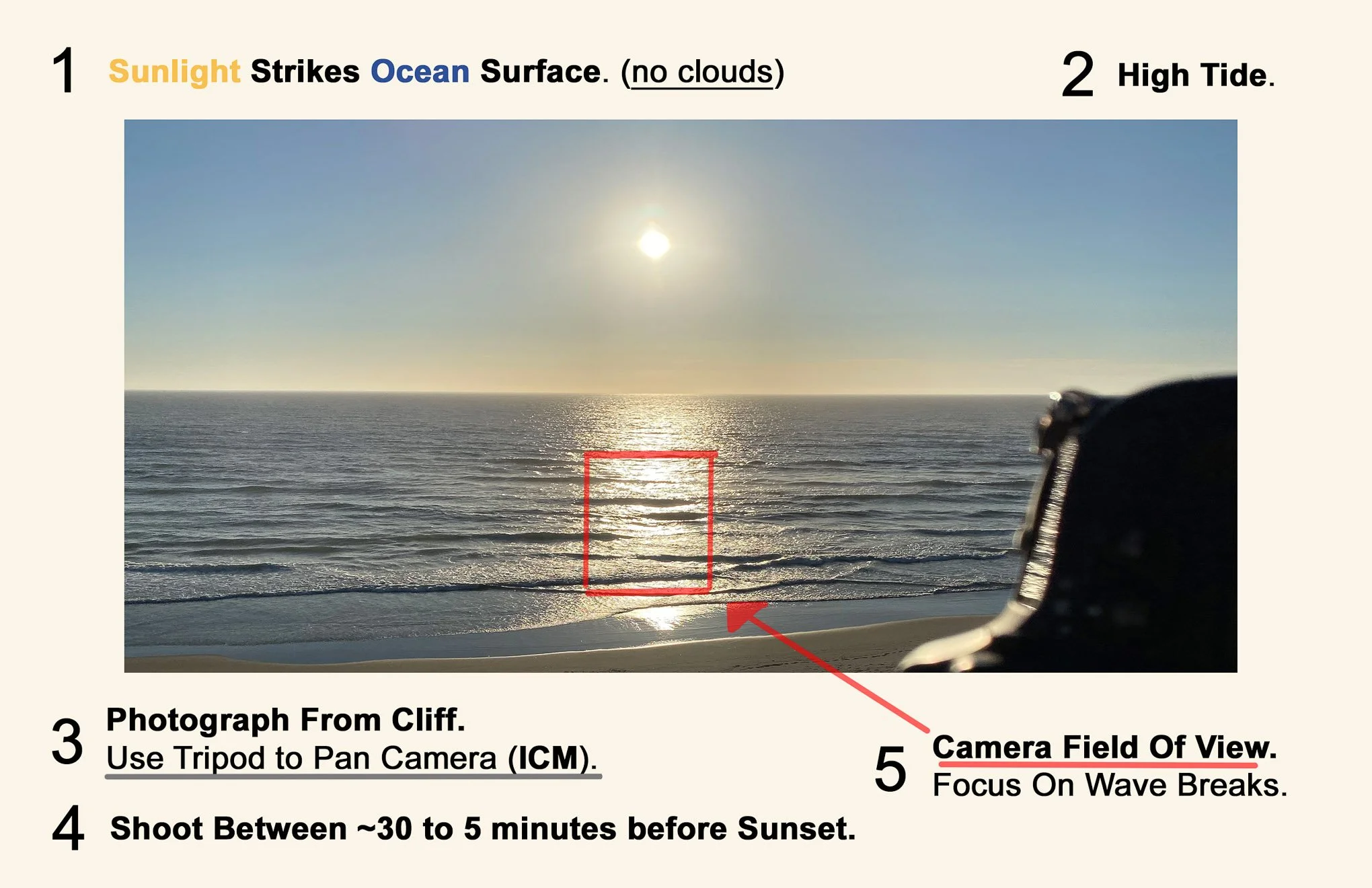
BAPstracts began unexpectedly. What started as an accident while photographing sunlight on the ocean revealed something deeper — a way of using the camera to visualize time rather than capturing a moment.
The earliest BAPstracts were small, experimental artworks. The first twelve were printed on photo paper and used to create handmade cards. A small number became digital wallpapers. Limited to two dimensions, they were focused on how the camera recorded the scene.
Over time, the artwork expanded into original, one-of-one canvases that move beyond traditional expectations of photography and behave more like paintings and wall sculptures. This shift allowed the work to become conceptual, moving beyond abstract photography and toward a way of thinking about connection across time and distance, with spacetime providing the underlying framework.
What Exists Today
Since 2019, BAPstracts have developed into a cohesive body of work based on a single process and vision.
Stripes are the foundation: abstract photographs that use the scientific framework of spacetime to explore connection across time and distance.
Now Clocks are physical objects built from Stripes, giving that idea a familiar form — a clock, but one that affirms the present as the only moment that exists.
These works exist today as finished, collectible artworks.
What Comes Next
Other directions are still unfolding.
Cosmic Puzzles explore how Stripes, each a timeless universal now, might be assembled into larger composite structures, bringing multiple nows into relationship without sequence or hierarchy.
Portals imagine Stripes translated into large-scale geometric forms, conceived as higher-dimensional objects intersecting our three-dimensional world.
Temporary light and sound installations create shared immersive experiences that use layered imagery and subtle sound to foster presence and connection across spacetime.
At this stage, these directions remain conceptual, proposals and models pointing toward future sculptures, installations, and experiential works extending BAPstracts.
Looking Forward
BAPstracts are still young. What exists today represents the beginning of a longer exploration rooted in photography, but open to new forms and experiences.
From the wall to clocks, and potentially into sculpture and immersive environments, the work continues to evolve.
Stay tuned.
About The Artist
Brendan Alex Phoenix “BAP” (b. 1990) is a self-taught photographic artist based in Newberg, Oregon, USA.
His work began to take shape while teaching English in South Korea, where living abroad and navigating an unfamiliar culture sharpened his awareness of time, place, and perception. That experience, combined with a background in environmental studies, fostered a way of seeing the world not as a collection of static scenes, but as interconnected systems in constant motion.
Through photography, BAP explores the physical and the metaphysical — using the camera not only to document what is visible, but to engage with how reality is connected. His work moves fluidly between representational landscapes and abstraction, reflecting an interest in how moments unfold, overlap, and persist beyond the instant they’re seen.
“Photography is the foundation of my work, but not its boundary. It is where the exploration begins.”